






Jorge Duarte | Hortitool Consulting
Labour shortages, rising costs, tighter quality standards. European berry producers know the pressure well. Robots are no longer a distant promise — they are picking raspberries in Portugal, scanning blueberries in Germany, and navigating strawberry tunnels in the UK. Here is where the technology stands today, and what it means for growers across the continent.
Walk through a raspberry plantation in Odemira, Portugal on an August morning and you might notice something unusual among the fruit-laden canes. Four articulated arms move steadily along a vertical trellis, pausing at each ripe berry, gripping its stem — not the fruit — and delivering it cleanly into a collection tray. No worker. No fatigue. No tea break. The machine works through the night.
This is not a trade fair prototype. Fieldwork Robotics, a spin-out from the University of Plymouth, has been commercially deploying its four-arm raspberry harvesting robot in Portuguese operations since 2022, in partnership with producers including Lusomorango and Driscoll’s.
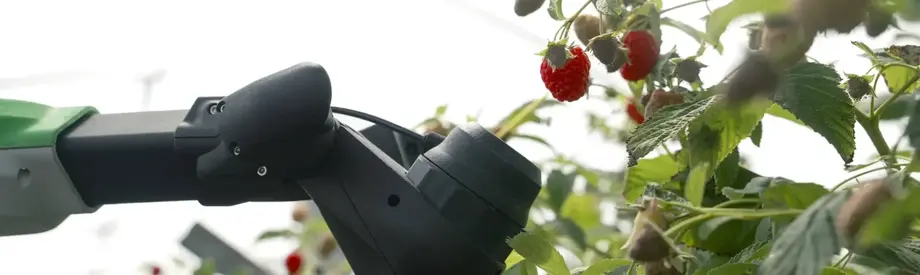
The same company unveiled its next-generation Fieldworker 1 in 2024, designed to match human picking speed while using spectral frequency analysis to assess berry ripeness more accurately than the human eye.
Portugal is not alone. Across Europe — in British strawberry tunnels, Dutch glasshouses, German research farms, and Norwegian fields — a quiet transformation is under way, but accelerating, in how small fruits are harvested, sorted, and managed.
For Italian growers the question is not whether this technology will arrive. It is whether they will be ready when it does.
A sector under pressure
To understand why robotics is advancing so fast in the berry sector, start with the labour arithmetic. In Italy, a skilled seasonal harvester costs between €15 and €20 per hour in total employment cost.
In the UK, experienced strawberry pickers harvest 15 to 30 kilograms per hour — and the industry needed around 63,000 seasonal workers annually even before Brexit reshaped the available labour pool.
The numbers are getting harder to make work. The European Labour Authority (2024) identified agricultural and horticultural picking among the most acutely shortage-affected occupations across all 31 EURES member countries.
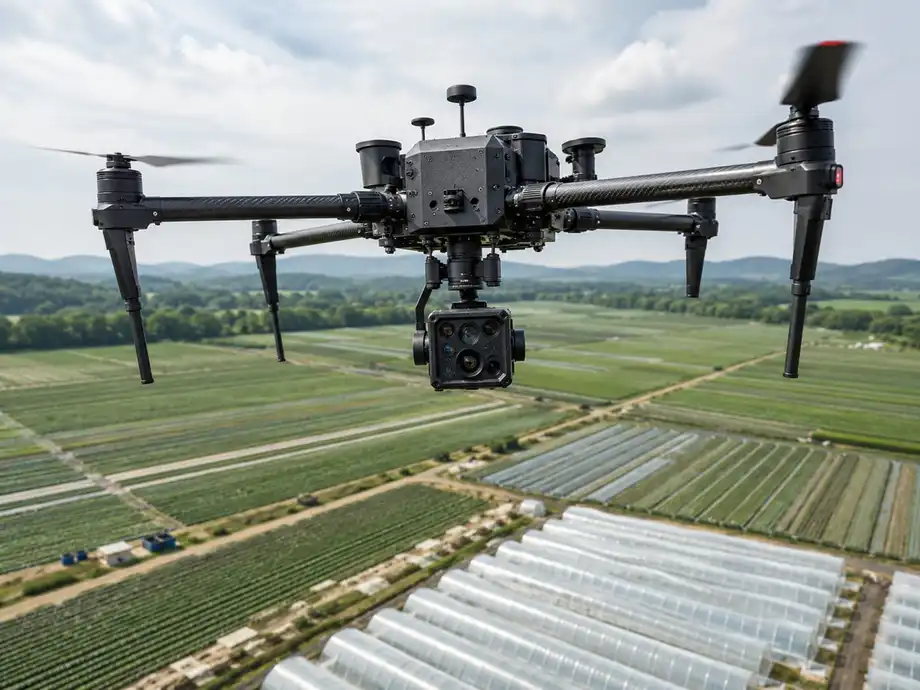
In the 2024 survey by Fruit Growers News, only 46% of respondents reported having adequate labour — down from 59% in 2019. The trend is structural, not cyclical.
Thomas AmRhein, one of the most attentive observers of robotics adoption in berry farming, identified three obstacles still slowing deployment: production system incompatibility, variety genetics not optimised for mechanical harvest, and — until recently — a labour supply that was scarce but just sufficient to keep growers from making the leap. That buffer is shrinking fast (Italian Berry, 2022).
“The growers who understand this technology today will have a decisive head start on everyone else.”
How the machines see the fruit
Ask any robotics engineer what the hardest part of harvesting a raspberry is, and the answer is almost never the mechanics. It is the vision.
A human picker instantly filters out leaves, stems, unripe fruit, and canopy shadow, and reaches for exactly the right berry. Replicating that in silicon and code has taken researchers decades.
The breakthrough came with deep learning — convolutional neural networks trained on thousands of field images across different cultivars, lighting conditions, and ripeness stages. Today’s best perception systems achieve fruit detection accuracy above 90% in commercial field conditions (Jin et al., 2025).
Modern harvesting robots combine RGB cameras with depth sensors — often Intel RealSense units — to build a three-dimensional map of the canopy and locate each fruit in space.
Multispectral imaging adds another layer: near-infrared signatures that reveal the internal chemistry of the berry, distinguishing ripe from unripe more reliably than colour alone.
Fieldwork Robotics uses spectral frequency analysis in Fieldworker 1 precisely because it eliminates the subjectivity that causes inconsistency even among experienced human pickers.
The challenge that remains is occlusion. Professor Stavros Vougioukas at UC Davis puts it directly: if a robot cannot see 30% of the fruit because it is hidden under leaves, it cannot harvest it.
His team is developing “active vision” strategies — moving the camera deliberately to explore the canopy from multiple angles before committing to a pick. It is, in essence, teaching the robot to look the way a human does (Vougioukas, 2024).
| Strawberry detection | 95% accuracy in ripeness classification — Robofruit system, Univ. of Lincoln (Parsa et al., 2023) |
|---|---|
| Blueberry quality | NIR spectroscopy identifies Brix level non-destructively, enabling export-grade sorting (Maf Roda, 2025) |
| Raspberry AI sorting | €30,000/year estimated labour savings per packing line with AI pick-and-place sorting (Italian Berry, 2024) |
| Key technical barrier | Occlusion: up to 30% of fruit may be hidden under foliage, undetectable by current systems (Vougioukas, 2024) |
The hand that does not bruise
Seeing the fruit is one challenge. Picking it without damage is another.
A raspberry tolerates almost no mechanical force before the drupelets bruise and begin to break down. A blueberry can lose its bloom — the delicate waxy coating that defines its fresh-market appeal — from a single mishandled grip.
These constraints have driven an entire engineering discipline: soft robotics.
The leading approach uses end-effectors made from flexible silicone or pneumatically actuated soft fingers that conform to the fruit’s geometry rather than imposing a rigid grip.
Researchers at the CSIC (Spanish National Research Council) developed a single-channel diaphragm-type soft gripper for small and medium fruits, fabricated by 3D printing in flexible thermoplastic elastomer — manufacturable as a single piece, easy to clean, and cheap to replace (Navas et al., 2024).
At the University of Arkansas, a team led by Renée Threlfall built a three-finger tendon-guided gripper using cable-like actuators, tested on fresh market blackberries. Results after 21 days in cold storage were acceptable for commercial fresh-market standards. The work earned the Outstanding Fruit Publication Award from the American Society for Horticultural Science (Threlfall et al., 2023).
One of the more creative solutions to cluster occlusion comes from the Robofruit system at the University of Lincoln. The end-effector developed by Parsa et al. (2023) has 2.5 degrees of freedom, including a dedicated mechanism that physically moves neighbouring fruit aside before the gripper reaches the target berry — a direct mechanical answer to the occlusion problem.
In commercial strawberry field trials with three different varieties, the perception system achieved 95% ripeness detection accuracy.
On wheels through the rows
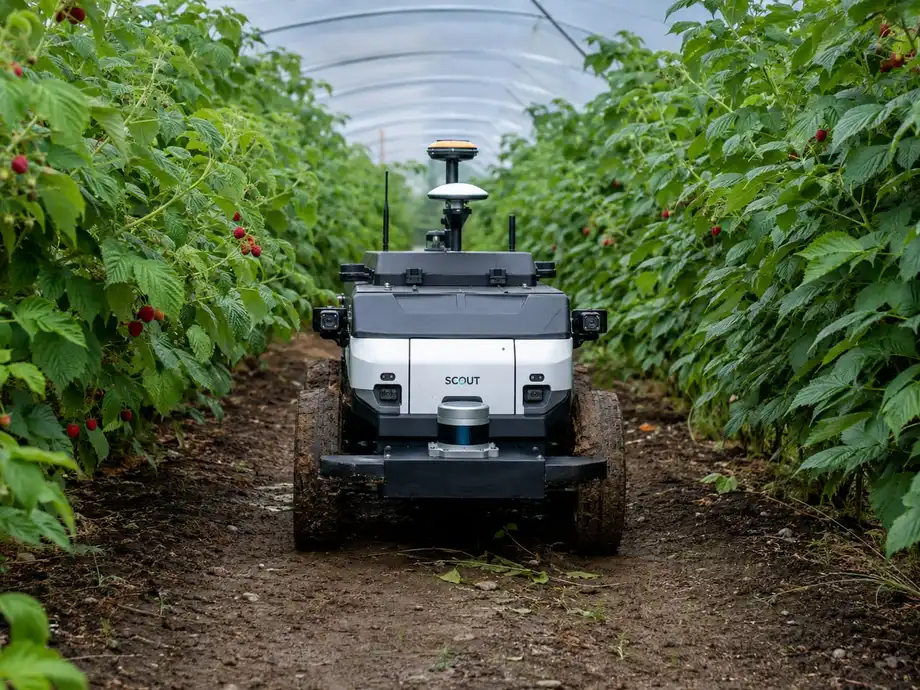
A robot that can see and pick still needs to move. The mobile platform is the unglamorous part of the story, but it is critical to commercial viability.
The machine needs to navigate rows designed for humans or tractors, not robots: varying widths, uneven soil, irrigation tape on the ground, support posts, and the occasional fallen cane.
Most commercial systems use GPS-RTK for outdoor field positioning and LiDAR-based SLAM (Simultaneous Localisation and Mapping) for tunnel environments.
Fieldwork Robotics uses a railed platform travelling along tracks installed within the growing structure — a high-repeatability solution suited to the substrate systems increasingly common in high-tech berry production.
Saga Robotics of Norway, which has deployed UV-C treatment robots across UK and Norwegian strawberry tunnels, built its platform on the same logic: standardise the movement path, and precision follows naturally (Italian Berry, 2022).
Weight, ground clearance, and turning radius all matter in practice. For packing houses, railed systems already in operation — such as those from TOMRA and Maf Roda — demonstrate that once the movement path is fixed, throughput and classification accuracy scale reliably with the quality of the sensing and sorting software.
Crop by crop: what works, what does not
Strawberry: the most advanced front
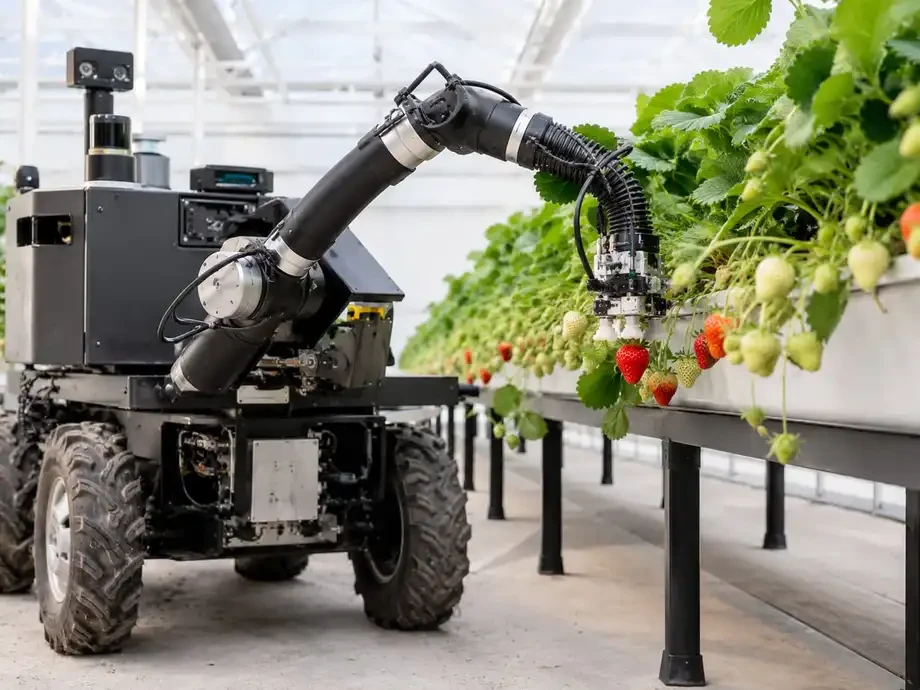
Strawberry is the most commercially mature frontier in robotics for berry harvesting. Dogtooth Technologies, based in the UK, already has more than 70 fourth-generation robots operating in tabletop strawberry operations. The company says its fifth-generation system, expected in 2024–25, will achieve picking costs equivalent to manual labour (Ingenia, 2024).
Agrobot’s SW6010 system, with 30 robotic arms, operates on the same principle: continuous, high-throughput picking in a structured crop geometry.
The constraint for Italian producers is that most advances have been designed for the Northern European tabletop growing system. Southern Italian strawberry production — much of it still in ground-level systems in Campania and Basilicata — presents a different geometric reality.
Adapting current platforms to ground-level cultivation is an active engineering challenge the sector has not yet fully solved.
Blueberry: the quality frontier
Blueberry harvesting robotics is advancing fast, driven in part by market economics: the global blueberry market was worth USD 2.65 billion in 2023 and is projected to reach USD 4.15 billion by 2029 (Market Data Forecast, 2024).
For a premium fresh-market crop where intact bloom, uniform colour, and surface quality directly determine price, the ability of robotic systems to select by ripeness and handle each berry individually is a compelling commercial argument.
The technical challenge is asynchronous ripening: berries within the same cluster ripen across a window of days to weeks, requiring multiple passes over the same plant.
At the packing line, AI-based sorting is already operational: Maf Roda’s BERRYSCAN G7 uses NIR technology to measure Brix level on every single berry — critical for exporters whose fruit will continue to ripen during weeks of transit to distant markets (Maf Roda, 2025).
In-field selective harvesting by ripeness is the logical next step, with validation programmes under way across Europe.
Raspberry: the hardest challenge, the strongest need
Raspberry is where the labour problem is most acute and the robotics challenge most difficult — a combination that has attracted the most intensive development work in the sector.
Fieldwork Robotics founder Martin Stoelen chose raspberry as the first target deliberately: if a robot can reliably harvest the most fragile small fruit, every other crop becomes easier. The Fieldworker 1, unveiled in 2024, is the result of eight years of iterative field development.
The raspberry’s drupelet structure and 2–3 day shelf life impose engineering constraints that do not apply elsewhere. The robot cannot apply lateral force to the fruit; it must grip the stem and detach cleanly.
The operational window between unripe and too soft to handle is measured in hours. And in a crop where delayed harvest means lost fruit, the machine’s ability to work overnight — something no human workforce can sustain — is the most powerful commercial argument.
What this means for Italy
Italy’s berry sector is not monolithic, and neither is its exposure to these technologies. In Trentino-Alto Adige, blueberry cultivation has expanded significantly, with operations that in scale and growing system are directly comparable to those where European robotic R&D is most advanced.
Labour costs in Italy, at €15–20 per hour, make the economic case for automation compelling at a threshold many Italian producers have already crossed.
In the South, the picture is more complex. Smaller farm units, ground-level strawberry systems, and growers accustomed to managing seasonal labour through established supply relationships will require technology that adapts to existing infrastructure.
The modularity and adaptability of next-generation platforms — designed to work across growing systems rather than demanding a single standard format — is a direct engineering response to this reality.
One area where Italian operations can engage immediately is post-harvest automation.
AI-based sorting and grading systems are commercially available and economically proven today. TOMRA’s KATO260 blueberry sorter, deployed by Logofruits at Alcácer in Portugal, sorts up to 572 berries per second and reduced client rejection rates to near zero (TOMRA, 2024).
Maf Roda presented its complete blueberry post-harvest line at Macfrut 2025, with the BERRYSCAN G7 already operational in multiple European operations. For many Italian producers, post-harvest is where the automation journey begins.
The traceability argument is becoming commercially decisive. Timestamped harvest data, per-pass yield records, and ripeness distribution maps generated automatically by robotic systems are part of what major European retailers increasingly expect from berry suppliers.
Producers who can provide this data are better positioned in contract negotiations and supply chain audits.
The next few years
Stoelen described the first generation of raspberry robots as complementary, not replacement: “These first robots will not replace manual labour. What we expect is that they will harvest the most accessible fruit, with human harvesters covering the rest” (Italian Berry, 2020).
That model — human and machine working together — remains the realistic near-term picture for most berry operations.
What is changing is the balance. Each generation of systems is faster, more accurate, more mechanically capable, and cheaper to produce.
Parsa et al. (2023) achieved 95% detection accuracy in commercial strawberry fields. Fieldwork Robotics claims human picking speed parity in 2024. The trajectory is unambiguous.
For Italian growers, the practical agenda is clear: understand which growing systems are compatible with current platforms; invest in post-harvest automation available today; follow the field validation programmes running in Portugal, Spain, and the UK; and plan for a production infrastructure that will not require complete rebuilding when in-field robotics arrives at commercial scale.
The fruit is already there. The robots are learning to pick it.
“The next few years will be decisive. The main obstacles are production systems, variety genetics, and a labour supply that is still just sufficient. All three are changing.”
References
APA 7th edition.
Bac, C. W., van Henten, E. J., Hemming, J., & Edan, Y. (2014). Harvesting robots for high-value crops: State-of-the-art review and challenges ahead. Journal of Field Robotics, 31(6), 888–911. https://doi.org/10.1002/rob.21525
British Berry Growers. (2024). The British berry industry in focus. British Berry Growers. https://britishberrygrowers.org.uk
European Labour Authority. (2024). EURES report on labour shortages and surpluses 2024. Publications Office of the European Union. https://www.ela.europa.eu
Fieldwork Robotics. (2024). Fieldworker 1: Next-generation raspberry harvesting robot [Press release]. https://italianberry.it/en/news/robot-picks-raspberries-speed-quality-of-human
Fruit Growers News. (2024). FGN labor survey results show challenges. Fruit Growers News. https://fruitgrowersnews.com/article/labor-report-fruit-and-vegetable-growers-voice-concerns-in-2024-labor-survey/
Italian Berry. (2020, February 4). Raspberry picking robot project accelerates. Italian Berry. https://italianberry.it/en/2020/02/04/robot-per-la-raccolta-di-lamponi-il-progetto-continua/
Italian Berry. (2022, September 27). Robots and strawberries: Where do we really stand? Italian Berry. https://italianberry.it/en/2022/09/27/robot-e-fragole-a-che-punto-siamo/
Italian Berry. (2024, November). Raspberry AI: Revolution in European packing houses. Italian Berry. https://italianberry.it/en/news/artificial-intelligence-lamps-packing-house-efficiency
Jin, Y., Xia, X., Gao, Q., Yue, Y., Lim, E. G., Wong, P., Ding, W., & Zhu, X. (2025). Deep learning in produce perception of harvesting robots: A comprehensive review. Applied Soft Computing, 174, 112971. https://doi.org/10.1016/j.asoc.2025.112971
Logofruits & TOMRA Food. (2024). Customer story: Logofruits Portugal. TOMRA. https://www.tomra.com/food/media-center/customer-stories/logofruits
Maf Roda Agrobotic. (2025). High-tech for berries: AI enters blueberry post-harvest [Macfrut 2025]. Italian Berry. https://italianberry.it/en/news/maf-roda-macfrut-ai-technology-post-harvest-blueberries-berries
Market Data Forecast. (2024). Global blueberry market size, share & industry report, 2033. Market Data Forecast. https://www.marketdataforecast.com/market-reports/blueberry-market-report
Navas, E., Shamshiri, R. R., Dworak, V., Weltzien, C., & Fernández, R. (2024). Soft gripper for small fruits harvesting and pick and place operations. Frontiers in Robotics and AI, 10, 1330496. https://doi.org/10.3389/frobt.2023.1330496
Parsa, S., Parsaei, M. R., Ghalamzan Esfahani, A. M., & Drust, M. (2023). Modular autonomous strawberry picking robotic system. Journal of Field Robotics, 40(5), 1031–1054. https://doi.org/10.1002/rob.22229
Threlfall, R. T., Howard, L. R., Brownmiller, C., & Howard, A. B. (2023). Development of a soft robotic gripper for the collection of fresh market blackberries. HortScience, 58(4), 496–504. https://doi.org/10.21273/HORTSCI17029-22
Vougioukas, S. (2024). Future of farm robotics [Interview]. UC Davis College of Engineering. https://engineering.ucdavis.edu/news/stavros-vougioukas-future-farm-robotics
Xiong, Y., Ge, Y., Grimstad, L., & From, P. J. (2020). An autonomous strawberry-harvesting robot: Design, development, integration, and field evaluation. Journal of Field Robotics, 37(2), 202–224. https://doi.org/10.1002/rob.21889