











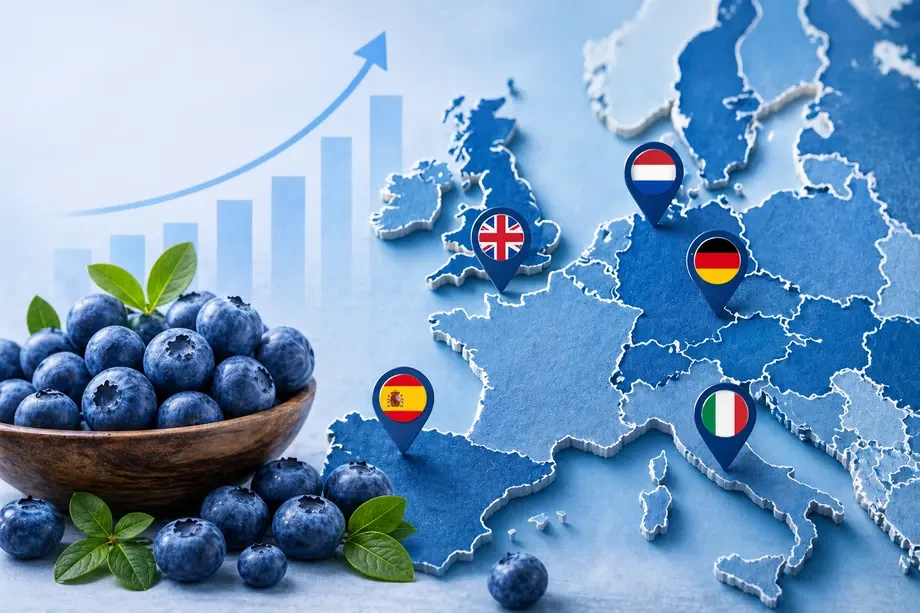
According to a recent research published by GTAIC, The Netherlands, Germany, Spain, the United Kingdom and Italy emerge as the five most promising and attractive European markets for supplies of fresh berries of the genus Vaccinium, particularly blueberries, in 2026.
The ranking is based on a composite scoring system that combines several indicators: recent import growth, price levels, market size, demand dynamics and future expansion potential. The result is a map of opportunities for exporters looking for new commercial outlets in Europe.
The top 5 most attractive markets
| Position | Market | Combined score | Estimated monthly potential |
|---|---|---|---|
| 1 | The Netherlands | 9.64 | US$3.9 million/month |
| 2 | Germany | 7.87 | US$2.78 million/month |
| 3 | Spain | 7.80 | US$2.45 million/month |
| 4 | United Kingdom | 7.77 | US$2.15 million/month |
| 5 | Italy | 5.86 | US$1.22 million/month |
The Netherlands: the most attractive market
The Netherlands ranks first overall for attractiveness, with a combined score of 9.64. The Dutch market represents the largest potential opportunity for new exporters, with estimated growth of almost US$3.9 million per month.
The Netherlands’ position reflects both its role as a European trading hub and the strong recent growth in imports. Over the past year, the Dutch market recorded the largest absolute increase in import value, confirming its central role in the European redistribution of blueberries and other fresh berries of the genus Vaccinium.
Germany: size and absorption capacity
Germany is the second most promising market, with a combined score of 7.87 and an estimated potential of around US$2.78 million per month for new suppliers.
The German market stands out for its size, absorption capacity and demand continuity. Together with the Netherlands and Spain, it shows one of the largest supply gaps ready to be filled by new operators, especially where products are competitive in terms of quality, price and logistical continuity.
Spain: strong growth and strategic role
Spain reaches a combined score of 7.80 and offers an estimated additional supply potential of US$2.45 million per month.
The Spanish market is particularly interesting because it combines two characteristics: on the one hand, it is one of Europe’s leading blueberry producers; on the other, it shows strong expansion in domestic demand and trade dynamics. Over the past twelve months it recorded one of the strongest growth rates, confirming its role not only as a production market but also as a commercial market.
United Kingdom: maximum score for export potential
The United Kingdom ranks fourth in the overall ranking, with a combined score of 7.77 and an estimated monthly potential of around US$2.15 million.
The most relevant figure concerns the “Final Score” for pure export potential: the United Kingdom reaches the maximum score, 14 points out of 14, tied with Switzerland. This confirms the high attractiveness of the British market for exporters, even in a more complex competitive and logistical context after Brexit.
Italy: fifth in Europe, but with very strong momentum
Italy closes the European top 5 with a combined score of 5.86 and a monthly potential estimated at more than US$1.2 million for new suppliers. Its final score for export potential is 12 points out of 14, a figure that confirms the growing relevance of the Italian market.
Key figure: Italy is not yet a premium market in terms of average price, but it is one of the fastest-growing European markets for imports of fresh berries of the genus Vaccinium.
Italy: imports up 40.9% in value
Over the latest twelve months analysed, the total value of Italian imports reached US$153.57 million, with growth of 40.87% compared with US$109 million in the previous period.
This growth is not episodic: the long-term trend shows a five-year CAGR of 25.88%, indicating a structural transformation of the Italian market for blueberries and other fresh berries of the genus Vaccinium.
Volumes also show very strong momentum. Italy imported 19,588 tonnes over the latest twelve months, an increase of 45.17%, equivalent to more than 6,000 additional tonnes compared with the previous year.
Italian prices: mid-range, with a slight recent recovery
Despite strong demand growth, Italy is not among Europe’s premium-price markets. The average import price over the latest twelve months was US$7,840 per tonne, down 2.96% compared with the previous period.
However, looking at the latest six months available, there is a sign of recovery: the average price reached US$8,220 per tonne, up 1.93% compared with the same semester of the previous year.
Who supplies the Italian market
The competitive landscape of Italian imports is dominated by European suppliers, some of which operate both as direct producers and as re-export platforms.
| Supplier | Value share | Export value to Italy | Annual change |
|---|---|---|---|
| Spain | 40.29% | US$61.87 million | +45.43% |
| The Netherlands | 30.84% | US$47.36 million | +70.96% |
| Germany | 10.57% | US$16.23 million | n/a |
| Poland | 9.73% | almost US$15 million | +70.44% |
| France | 5.46% | n/a | -16.95% |
| Romania | 1.14% | n/a | n/a |
Spain is the leading supplier to the Italian market, accounting for 40.29% of value and 39.47% of volumes. Spanish exports to Italy grew by 45.43%, reaching US$61.87 million.
The Netherlands follow with a 30.84% share in value and particularly marked growth: +70.96% over the past year, for a total of US$47.36 million. This figure confirms the weight of the Dutch hub also in supplies destined for the Italian market.
Germany is the third supplier, with 10.57% of value and 9.42% of volumes, equal to US$16.23 million. It is followed by Poland, with a 9.73% share and annual growth of 70.44%, reaching almost US$15 million.
France, with 5.46% of the market in value, is the only one among the main suppliers to show a significant contraction, down 16.95%. Among the smaller suppliers is also Romania, with a 1.14% share.
Premium markets: Iceland and Switzerland lead
If exporters’ objective is to maximise the average price, the most interesting markets do not necessarily coincide with the largest or fastest-growing ones. The countries with the strongest premium-price opportunities are Iceland, Switzerland, Norway, Denmark and Luxembourg.
In particular, Iceland and Switzerland record the highest average values overall:
- Iceland: US$10,990 per tonne, equal to US$10.99k/t;
- Switzerland: US$10,910 per tonne, equal to US$10.91k/t.
These values indicate smaller markets, but ones that may be highly attractive for specialised supplies, premium segments, high-value varietal programmes and fruit meeting superior quality standards.
Other opportunities: Poland, Greece, Serbia and Sweden
Outside the top 5, Poland deserves particular attention. Although it does not rank among the first five markets by combined score, it recorded one of the largest absolute increases in import value over the past year.
If, instead, the fastest percentage growth rates are considered, the most dynamic markets are Greece, Serbia and Sweden. These destinations may offer selective opportunities, especially for operators able to serve fast-expanding niches or still underserved commercial windows.
What this means for exporters
The picture of European markets shows increasingly clear segmentation. On the one hand, there are high-absorption-capacity markets such as The Netherlands, Germany, Spain, the United Kingdom and Italy; on the other, there are premium markets such as Iceland and Switzerland, where unit value may be higher but volumes are more selective.
For suppliers, market selection cannot therefore be based on a single indicator. The most attractive countries are those where demand size, import growth, price level, trade stability and room for new entrants combine.
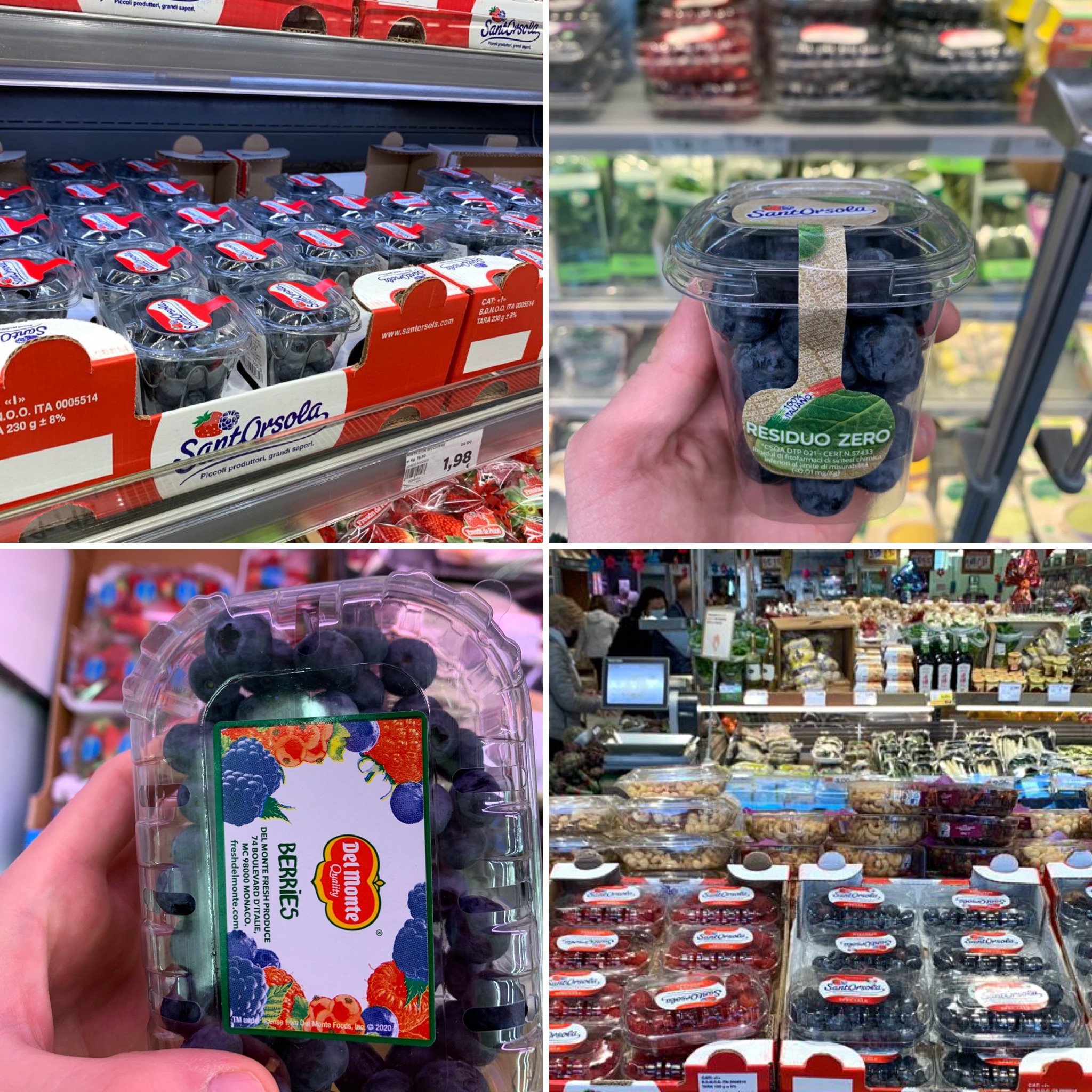
In this scenario, Italy is one of the most interesting markets to monitor: it is not yet a premium market, but it is growing at a very strong pace, shows expanding demand and has a distribution system increasingly open to broader supplies of blueberries and other fresh berries of the genus Vaccinium.
In summary: in 2026 Europe offers differentiated opportunities for exporters of fresh Vaccinium. The Netherlands leads the overall ranking, Switzerland and Iceland dominate premium prices, while Italy confirms itself as a fast-accelerating market that is becoming increasingly relevant in international supply strategies.