







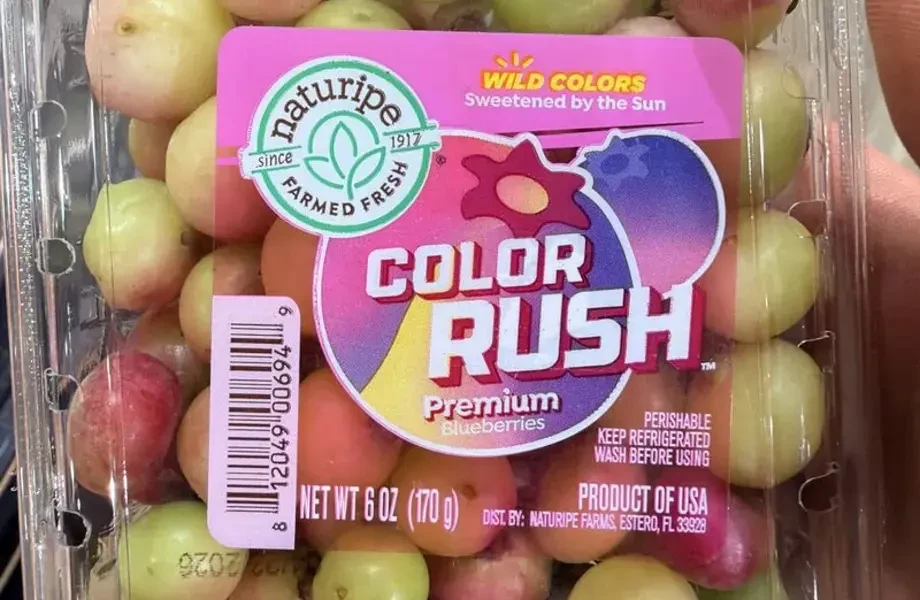
In the US berry market, a new trajectory of varietal innovation is taking shape: blueberries are no longer necessarily only blue, but can become pink, fuchsia, salmon-colored or multicolored. This is the direction taken by Color Rush, the premium line by Naturipe Farms dedicated to blueberries with strong visual impact, currently available through limited distribution at selected retailers such as ShopRite.
The product is part of Naturipe’s strategy to offer proprietary or highly differentiated premium varieties, capable of combining color, flavor and storytelling. It is a choice aimed at making blueberries more recognizable on the shelf, in a category where competition is increasingly based on perceived quality, consumption experience and the ability to generate curiosity.
A blueberry that changes the category’s visual code
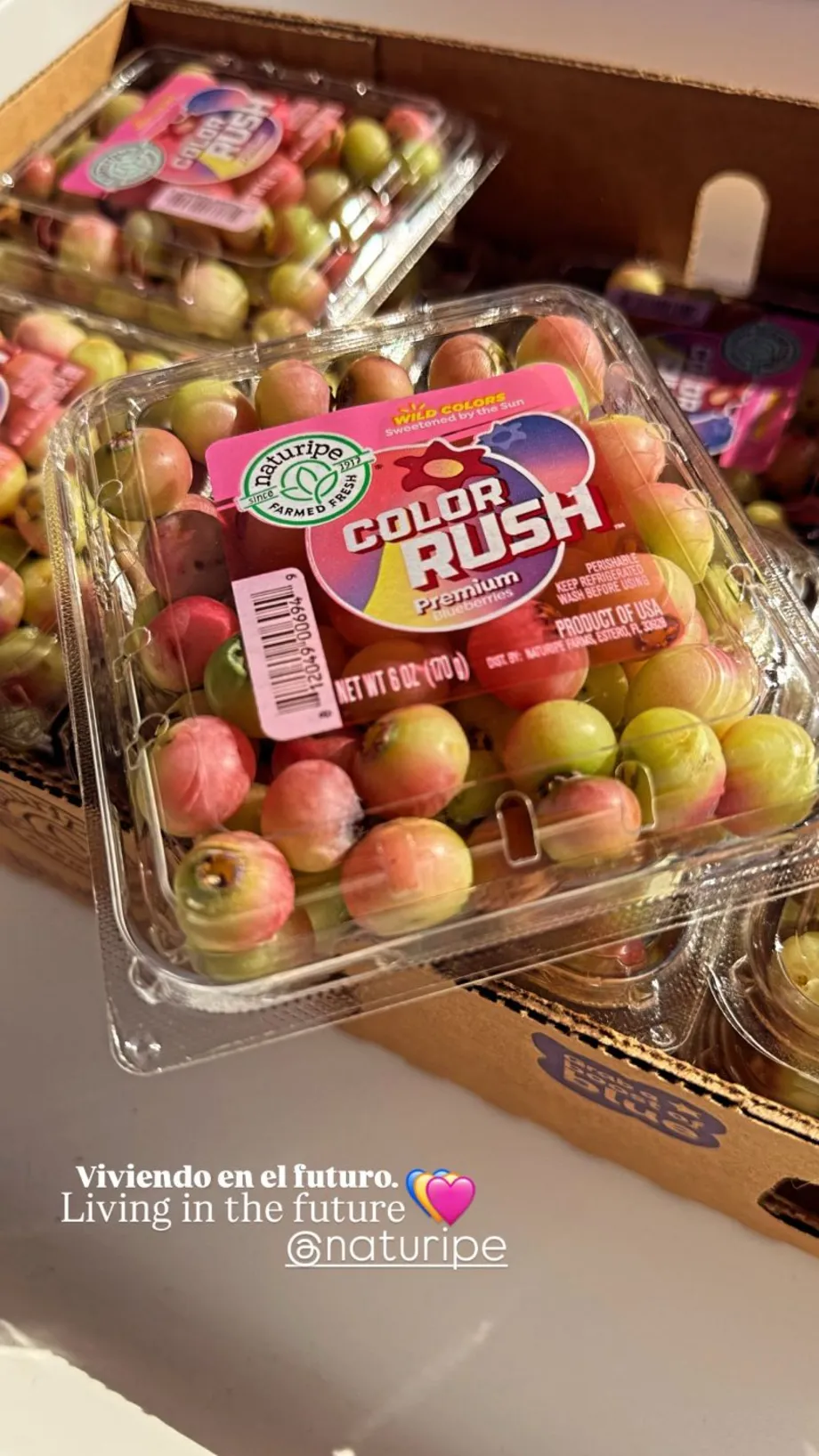
The distinctive feature of Color Rush is immediately clear: consumers are not faced with the traditional dark-blue blueberry, but with fruit showing shades ranging from light green to yellow-green, pink, salmon and intense fuchsia. The packaging highlights this feature with the claim “Wild Colors – Sweetened by the Sun”, turning color diversity into the product’s main distinguishing attribute.
This is an interesting commercial shift. In common consumer perception, a blueberry that is not fully blue may be interpreted as unripe. With Color Rush, however, color becomes a sign of varietal identity and premium differentiation. The challenge is therefore also educational: explaining to consumers that pink is not a defect, but the product’s natural characteristic.
Pink varieties: natural origin and sensory profile
Pink blueberries come from natural breeding programs. In many cases, these types can be traced back to varieties such as Pink Lemonade — a hybrid between Northern Highbush and Southern Highbush — or to proprietary crosses selected to adapt to specific climates and production systems.
During ripening, these berries follow a different color trajectory from conventional blueberries: they move from pale colors, light green or yellow-green, to shades of intense pink, fuchsia or rosy-red when they reach full maturity.
From an organoleptic point of view, the profile is often described as sweet, floral and aromatic, with high sugar content and, in some selections, a slightly citrusy or lemon-like finish. The texture generally remains firm, close to that of the best premium blue varieties, making the product suitable for fresh consumption, garnishing and preparations where visual appearance is part of the experience.
Not only Color Rush: the race toward differentiated blueberries had already begun
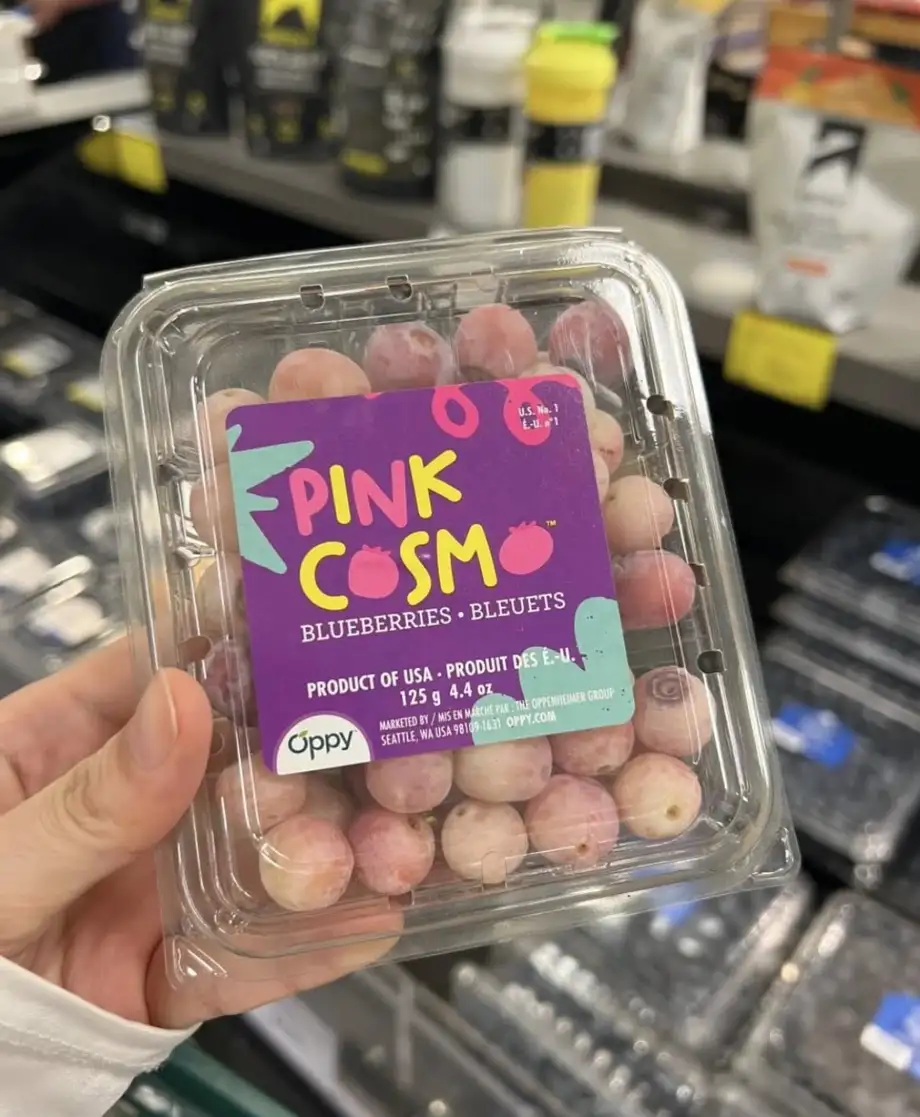
The Naturipe case is not isolated. As early as May 2024, Oppy and G&M Farms had announced two exclusive proprietary blueberry varieties: Pink Cosmo and Hunkaberry. Both were developed by professor Scott NeSmith, horticulture professor at the University of Georgia, and grown by G&M Farms in Fresno County, California. The two products aimed to redefine the traditional blueberry experience through flavor, size and visual impact.
Pink Cosmo was positioned very close to the concept now evoked by Color Rush: a pink blueberry with a classic blueberry taste, enriched by floral notes, peachy sweetness and a light fizzy sensation, enclosed in a visual range of pink tones. Its seasonal debut was scheduled for late May 2024, in 4.4-ounce packs.
Hunkaberry, by contrast, worked on another axis of premiumization: size. The variety was presented as a jumbo blueberry with fruit exceeding 18 millimeters, firm texture, pronounced crunch, high sweetness and low acidity, available in 9.8-ounce packs. Both varieties declared a Brix level above 18°, underlining how sweetness has now become a central requirement in premium programs.
That announcement already highlighted a trend that is becoming increasingly clear today: premium blueberries are segmenting along several directions. On one side there are jumbo, crunchy, high-Brix fruit; on the other, chromatically distinctive varieties are emerging, such as pink blueberries, capable of creating surprise and trial in the berry aisle.
Premiumization and differentiation on the shelf
Color Rush sits within Naturipe’s premium portfolio alongside other lines focused on offer segmentation, such as Mighty Blues, dedicated to jumbo fruit, and Sweet Selections, focused on flavor profile. The goal is to reach consumers looking for more distinctive berries, capable of delivering a different experience from the standard product.
The 6 oz / 170 g format reinforces this interpretation: this is not a family or value pack, but a pack designed for trial, tasting or impulse purchase. The positioning is focused on curiosity, discovery and the willingness to pay for a rare product.
For retailers, lines such as Color Rush, Pink Cosmo or Hunkaberry respond to the same need: creating products capable of catching the consumer’s eye, differentiating the shelf and generating a richer narrative than the simple price per kilo.
Why pink blueberries remain a niche
The availability of fresh pink blueberries in supermarkets is still limited. One of the main reasons is the product’s greater delicacy: some varieties have thinner skin than traditional blueberries, with consequences for shelf life, logistics and resistance during transport and handling.
This is compounded by agronomic complexity. The plants may require very precise soil and climate conditions, particularly in terms of soil acidity, and may be more difficult to manage than conventional cultivars. These factors help make the product rarer and more expensive. In some international markets, pink blueberries can reach prices much higher than standard blueberries, up to ten times as much in situations of greater scarcity.
How to enhance them at consumption
Because of their aesthetic characteristics and greater delicacy, pink blueberries are particularly suitable for fresh consumption. They can be used as a distinctive element in salads, yogurt bowls, desserts, cocktails and gourmet preparations, where color becomes an integral part of the experience.
An important element in consumer communication concerns the origin of the color. The pink pigmentation is the result of natural varietal selection, not genetic modification, artificial coloring or external treatments. This aspect can be decisive in overcoming possible initial resistance and building trust around a visually unconventional product.
From commodity blueberry to experiential blueberry
The launch of Color Rush at ShopRite confirms that innovation in premium blueberries is moving beyond the now-established parameters of size, crunch, shelf life and sweetness. Color becomes a new competitive territory, capable of turning the product into a more recognizable and memorable experience.
The precedent set by Oppy and G&M Farms with Pink Cosmo and Hunkaberry shows that the market is already testing several routes to expand the category’s value: pink blueberries, jumbo blueberries, dedicated packs, bolder branding and more precise sensory promises.
For growers, breeders and retailers, the direction is clear: the future of premium blueberries will not only be larger, sweeter or crunchier. It will also be more distinctive, more narratable and more capable of generating curiosity. The challenge, especially for pink blueberries, will be to turn possible initial skepticism — “are they unripe?” — into a new reason to purchase.