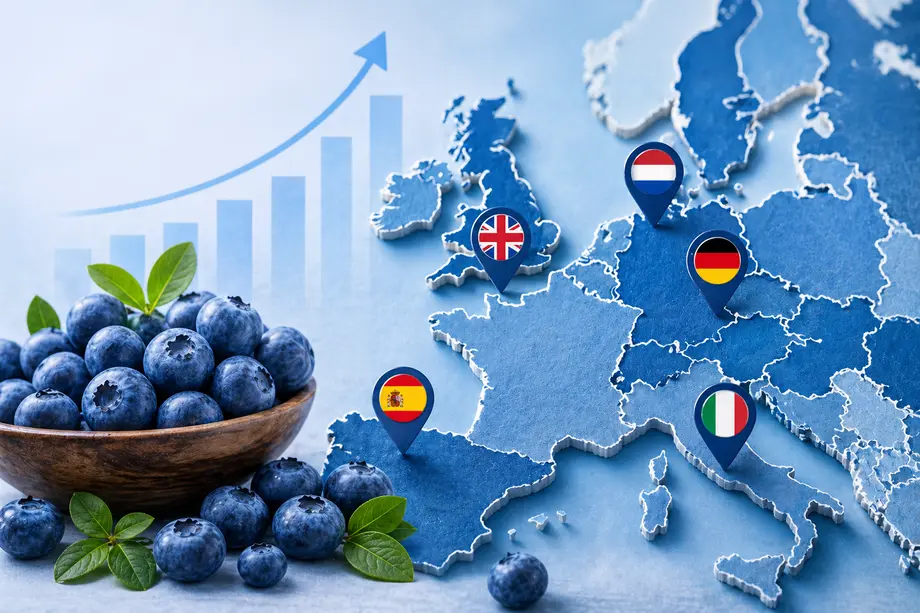







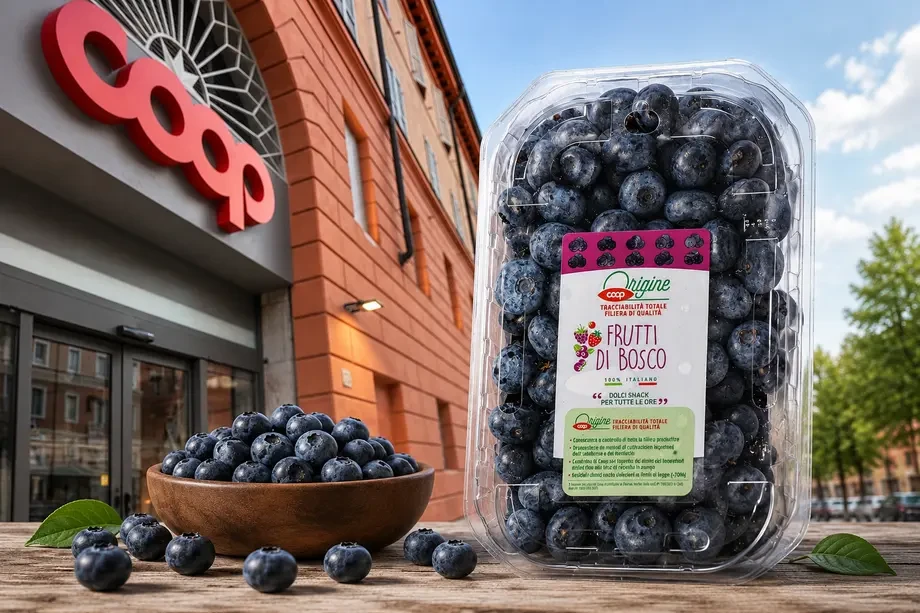
In 2025, the Italian blueberry market recorded exceptional growth, with household consumption close to 20,000 tonnes and total spending approaching €250 million. Within this scenario, Coop confirms its relevant role in category distribution, with 1.6 million kilograms sold and growth of 42% compared with the previous year.
The Coop figure should be read within a rapidly accelerating national market. According to YouGov Italian Berry data, in 2025 Italian households increased blueberry purchases by 50%, bringing total volumes close to 20,000 tonnes. This growth is not isolated: over the past six years, purchases by volume have more than tripled, confirming blueberries as the most dynamic product within the berries category.
The quantitative reading intersects with the vision expressed by Fabio Ferrari, fruit and import manager at Coop Italia, who spoke at the Berry Area during a round table organized by Myfruit and moderated by Raffaella Quadretti. According to Ferrari, berries have now completed the transition from impulse product to a stable and standardized category in Italian shopping baskets. To grow further, however, what is needed is product continuity, assortment depth, appropriate formats and varietal selection capable of ensuring more consistent quality.
Coop accounts for around 8% of domestic volumes
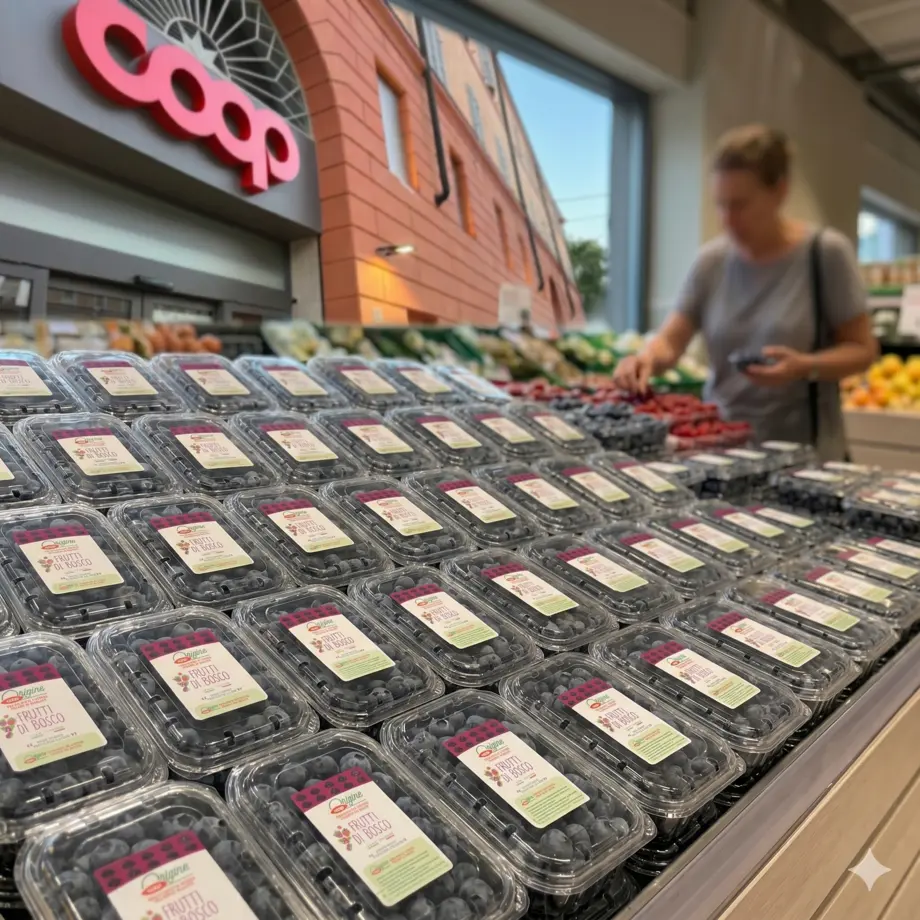
With 1.6 million kilograms sold in 2025, Coop represents approximately 8% of the Italian blueberry market by volume, calculated on the nearly 20 million kilograms purchased by Italian households during the year.
This is a significant share, especially considering that blueberries are now an increasingly widespread category, present across many large-scale retail banners, discounters, specialized channels and food e-commerce platforms. In terms of packs, the Coop figure is equivalent to around 6.4 million 250-gram punnets, the main format marketed by the retailer.
Applying the 2025 national average price for blueberries, equal to €12.33 per kilogram, to Coop’s volume, the corresponding theoretical value would be close to €20 million. This is naturally an indicative estimate, as Coop’s actual average price may differ from the national average, but the order of magnitude confirms the commercial weight of the category within the retailer’s fruit assortment.
Strong growth, but slightly below the market
The comparison between the two sources highlights an interesting aspect: Coop grew by 42%, while the overall Italian market grew by 50% in volume. The retailer’s performance is therefore very positive in absolute terms, although slightly below the exceptional growth rate of the national market.
This does not diminish Coop’s result, but it helps to better interpret the competitive context. In 2025, blueberries benefited from a general expansion in demand, supported by higher household penetration, lower average prices and increasingly year-round availability. In this context, growing by 42% means capturing the trend in a substantial way, even though the overall market pace was even higher.
The gap between Coop’s growth and national market growth can also be read in light of a rapidly transforming category, where expansion no longer depends only on promotion or shelf visibility. As Ferrari emphasized, for Coop Italia the key lever today is having product available consistently: continuous availability and assortment depth become decisive conditions for supporting demand that is now less occasional and more recurring.
Blueberries enter more than one in three Italian households
One of the main growth drivers is penetration. In 2020, only 16.5% of Italian households bought blueberries at least once a year; in 2025, this share reached 34.3%. In other words, more than one Italian household in three has now added blueberries to its shopping basket.
This figure is also strategic for Coop, because it shows that the category is no longer just a niche product or an occasional purchase. Blueberries are becoming an increasingly familiar item, with still significant potential compared with more mature markets such as the United Kingdom, the United States and Poland, where penetration has already reached or exceeded higher levels.
Ferrari summarized this transition by pointing out that berries are no longer perceived by consumers as a passing trend. They have now entered the shopping list on a regular basis. For Coop Italia, this means that the category has become a certainty within assortments, with customers buying berries with significant consistency and with still relevant growth margins.
From 125 grams to larger formats
One of the clearest indicators of blueberry development is the change in pack sizes. The market started with the historic 125-gram format, which accompanied the first phase of category development. Today, especially in blueberries, which Ferrari defines as the driving category within berries, Coop Italia also works with formats of 300 grams and above.
In 2025, Coop mainly markets blueberries in 250-gram punnets, accompanied in some periods by 300- or 500-gram formats. A 100-gram snack version is also arriving, while blueberries are also available in mixes with other berries in 200- or 250-gram formats.
The move toward larger pack sizes confirms that the product has become a stable presence in Italian purchasing habits. The larger format responds to a less occasional and more continuous consumption pattern: customers no longer buy the product only because they see it on the shelf, but include it in a logic of habitual shopping. As a result, the offer must also adapt to broader, more frequent and more diversified usage.
Prices are falling, but price is no longer enough
Another decisive element is price. In 2025, the national average price for blueberries was €12.33 per kilogram, down 5.9% compared with 2024. Translated into the most common formats, this is equivalent to around €1.55 for a 125-gram pack and €6.16 for a 500-gram pack.
The decline in prices helped broaden the consumer base, supporting both volumes and overall spending. Despite the decrease in the average price, household spending on blueberries in Italy approached €250 million, with an increase of 41% compared with the previous year.
However, in Coop’s view, price is no longer the central lever it was in the early development phase of the category. Ferrari emphasizes that price remains important, but it is no longer the determining element of the commercial strategy. Promotions retain a role, but they must be used in a targeted way: at specific times and on specific pack sizes.
This is particularly true for blueberries, a category that throughout the twelve months experiences peak periods, volume instability and price fluctuations. In this scenario, a commercial policy based only on price would be difficult to sustain. For Coop Italia, it therefore becomes a priority to guarantee product availability, assortment depth and consistent quality.
Assortment and seasonality: Coop focuses on continuity and origin
The management of seasonality is another defining element of Coop’s offer. In May, the Italian production available in stores comes mainly from Sicily and some areas of Calabria. In the following months, particularly August and September, sourcing gradually moves north through Italy, involving Campania, Tuscany, Veneto, South Tyrol and Piedmont.
This geographical progression makes it possible to enhance the value of the national product across different production windows, accompanying the consumer through an increasingly structured Italian seasonality. In periods when Italian product is unavailable or present in limited quantities, Coop integrates its offer with foreign origins, including Peru, Chile, Mexico, Morocco, Spain and Portugal.
Assortment continuity is a decisive factor for a growing category. If blueberries are to consolidate the transition from occasional purchase to recurring consumption, year-round availability becomes essential, especially for retailers with a broad base of loyal customers. It is precisely on this point that Ferrari’s vision appears clearest: today the priority is not simply to display berries, but to build a stable, broad and reliable presence over time.
The strategic issue of varietal quality
A central part of Ferrari’s analysis concerns the issue of blueberry varieties. The comparison with strawberries is significant: in the strawberry world, customers can now identify more precisely the varieties that guarantee a certain result and a certain level of satisfaction. In blueberries, however, this process is still less mature.
Ferrari describes the blueberry market as characterized by a “mix” of varieties, both in domestic production and in foreign supply. This fragmentation depends on many factors: production capacity, periods of the year, growing areas and availability at different moments of the season.
There is no single variety suitable for all periods or all growing areas. However, the strong differentiation encountered by consumers can generate a lack of consistency in perceived quality. Taste, size and crunchiness can vary significantly from one purchase to the next, making it more difficult to build a stable relationship between consumer and product.
For this reason, according to Ferrari, both production and distribution are working on varietal selection. The objective, at least for national production, is to select varieties as much as possible, reducing the alternation in the consumption experience. Varietal choice must not be guided only by production yield, but must focus on quality and quality consistency.
The growing weight of blueberries within berries
The national picture also shows a profound change in the category mix. In 2025, blueberries exceeded 80% of berry volumes and represented around 75% of value. Raspberries and blackberries together accounted for 18% by value and 13% by volume.
This means that blueberries are not only the most dynamic item, but also the product that is redefining the entire category. For retailers, including Coop, blueberry management therefore becomes a fundamental lever for building traffic, value and continuity on the berry shelf.
The presence of blueberries also in mixes with other berries, in 200- or 250-gram formats, also helps maintain a connection with the rest of the category, encouraging trial and combined consumption occasions. However, market data clearly indicate that blueberries are now the main engine of the segment.
An increasingly strategic category for large-scale retail
The intersection of YouGov Italian Berry data, Coop sales data and the vision expressed by Fabio Ferrari delivers a clear message: blueberries are now a strategic category for Italian retail. Coop, with 1.6 million kilograms sold and growth of 42%, is among the operators benefiting significantly from the expansion in consumption.
The overall market is growing even faster, with a 50% increase in volume, but Coop’s performance confirms the retailer’s ability to oversee a category that is changing in terms of size, purchase frequency and role in the fruit basket.
The next phase will probably be played out on several pillars: supply continuity, assortment depth, format differentiation, selective promotions, enhancement of Italian origin and greater varietal rationalization. In a market that is now moving toward the objective of 50% household penetration, the challenge will no longer be only to sell more blueberries, but to build a more stable, more recognizable and more reliable relationship between product, retailer and consumer.
Coop data source: Coop in the blueberry market