





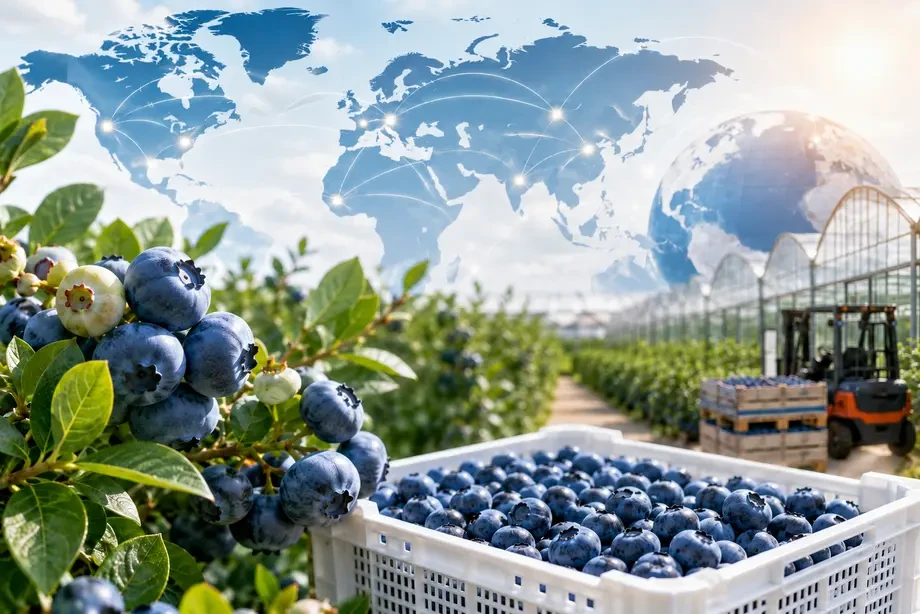
Summary of the presentation "Global expansion: blueberries as a supranational-scale opportunity" by Mario Steta (IBO - International Blueberry Organization), presented as part of the Berry Area 2026 event programme at Macfrut.
The global blueberry market is going through a crucial transition, moving from growth based simply on the expansion of planted areas to a model driven by agronomic efficiency, varietal innovation and the ability to serve premium segments.
Listen to Mario Steta's presentation on Spotify
International production dynamics show a profound reshaping of competitive balances, with the rise of major players such as China and Peru and the need for strategic repositioning by established production basins.
In the current context, marked by production exceeding 2.15 million tonnes in 2024, operators must deal with decisive structural challenges: labour, water, yields per hectare, genetics and quality differentiation.
Understanding these macro-trends is essential to seize the opportunities of an increasingly demanding consumer market, polarized between standard supply and products with high perceived value.
Key takeaways
1. Global production has exceeded 2 million tonnes for the first time.
In 2024, world blueberry production passed the 2 million tonne threshold, supported by almost 300,000 hectares under cultivation. Projections indicate a possible increase to 3.2 million tonnes by 2028.
2. Competitiveness depends on yields and varietal innovation.
Production levels below 10 tonnes per hectare no longer guarantee economic sustainability. Genetic renewal is becoming essential to avoid losing market share, as shown by the crisis of the Chilean model.
3. China and Peru lead two different models of leadership.
China has consolidated its position as the world's largest producer by volume, with over 698,000 tonnes in 2024, although a significant share is destined for processing. Peru, by contrast, dominates international fresh markets thanks to rapid expansion driven by capital, technology and new varieties.
4. Labour and water are the structural bottlenecks.
The availability of harvest labour and access to water resources are the most critical issues for future expansion, affecting both established production basins and emerging areas.
5. The market is polarizing towards bimodal pricing.
The sector is expected to grow at an estimated annual rate of 8.9% over the next five years, but value is not growing evenly. The market increasingly rewards premium product, creating a widening price gap compared with standard supply.
What emerges from the presentation
The global expansion of blueberries has reached unprecedented proportions, but the rules of the game for maintaining competitiveness and market share are changing radically.
Data from the International Blueberry Organization indicate that cultivated area has more than doubled over the last eleven years, reaching almost 300,000 hectares worldwide.
However, the real driver of volume growth no longer comes exclusively from the increase in planted areas.
The achievement of 2.15 million tonnes in 2024 signals a deeper shift: future growth will depend increasingly on higher yields, technical efficiency and the ability to introduce more performing varieties.
The new competitive threshold: 10 tonnes per hectare
In the global blueberry market, producing less than 10 tonnes per hectare means being exposed to a progressive loss of competitiveness.
Profitability now depends on high yields, updated genetics, consistent quality and the ability to serve increasingly selective markets.
Browse and download the presentation
Exceeding the 2 million tonne threshold represents a turning point for the sector.
Blueberries are no longer an emerging or niche category, but one of the fastest-growing fruit crops globally.
Projections towards 2028 indicate production potential of around 3.2 million tonnes, confirming a still very strong growth path.
This expansion, however, will not be neutral for market balances. The increase in volumes will make the difference between commodity producers and those able to position themselves on quality, continuity, flavour and commercial reliability even more evident.
Quantitative growth alone will not be enough to protect margins.
China and Peru: two different leadership models
The global competitive landscape is now clearly divided between different production models.
China has established itself as the world's largest producer in terms of volume, with over 698,000 tonnes in 2024.
A significant share of this production is destined for the processing industry, which absorbs a relevant portion of the fruit harvested globally.
Peru, on the other hand, represents the most emblematic case of rapid transformation in the fresh market. In just ten years, the country has moved from around 4,000 hectares to a dominant position in international supply.
This growth has been supported by targeted investment, strong capital availability, rapid adoption of new genetics and the ability to respond consistently to the needs of global distribution.
| Strategic factor | Key figure or dynamic | Implication for the supply chain |
|---|---|---|
| Global production | Over 2.15 million tonnes in 2024. | Blueberries enter a phase of full global maturity. |
| Cultivated area | Almost 300,000 hectares worldwide. | Future growth will depend increasingly on yields, not only on new hectares. |
| Production benchmark | Critical threshold around 10 tonnes per hectare. | Farms below this threshold risk losing economic sustainability. |
| China | Over 698,000 tonnes in 2024. | World's leading producer, with strong processing incidence. |
| Peru | Very rapid expansion driven by investment and genetics. | Leadership in international fresh markets. |
The Chile case: the cost of delayed varietal renewal
The case of Chile is the clearest warning for the entire global blueberry supply chain.
For years, the country held a leading position in exports, but delays in varietal renewal and yield improvement have progressively weakened its competitive positioning.
In a market where retailers demand fruit that is firmer, tastier, crunchier, more uniform and able to maintain quality along the logistics chain, remaining tied to varieties that are no longer adequate becomes a structural risk factor.
Chile shows that a historical leadership position is not enough to guarantee the future.
Without continuous genetic renewal, adaptability and investment in quality, competitive advantage can quickly erode.
Yield per hectare becomes the first indicator of sustainability
From an operational perspective, farm profitability now depends on much stricter benchmarks than in the past.
The threshold of 10 tonnes per hectare is emerging as a minimum reference point for remaining competitive in many production contexts.
Below this level, the costs of labour, inputs, agronomic management, logistics and post-harvest risk compressing margins excessively.
Productivity, however, cannot be separated from quality.
The market simultaneously requires volumes, continuity, shelf-life, size, texture and organoleptic profile. This is why varietal innovation becomes a vital condition, not just a technical improvement.
Genetics is the new competitive infrastructure
In global blueberries, variety is no longer just an agronomic choice.
It is a factor that determines yield, unit cost, perceived quality, market access, shelf-life and the ability to obtain a price premium.
Labour and water: the limits to future growth
Alongside genetics and yields, the sector must face two structural bottlenecks: labour availability and access to water.
Blueberry harvesting remains a labour-intensive activity, especially in segments destined for the premium fresh market.
Labour shortages no longer concern only high-income Western countries, but are beginning to emerge even in production basins traditionally characterized by greater worker availability, such as Mexico and China.
This is pushing the supply chain towards more rational plantings, varieties with more uniform ripening, greater suitability for mechanical harvesting and more efficient organization of production peaks.
The second limit is water. Competition for water resources and increasing climate stress are forcing producing countries to invest in infrastructure, precision irrigation technologies and more resilient agronomic models.
The market enters bimodal pricing
Volume growth does not mean uniform value.
The blueberry market is entering a phase of polarization, with real bimodal pricing.
On one side there is standard supply, more exposed to competitive pressure and price volatility. On the other, a premium segment is emerging, capable of obtaining higher economic recognition when it guarantees flavour, texture, size, freshness and reliability.
This dynamic progressively widens the distance between undifferentiated product and product with high perceived value.
For producers, the challenge is not only to enter the market, but to position themselves in the most profitable part of demand.
Expected annual growth of 8.9%
The outlook remains positive.
The sector shows an estimated compound annual growth rate of 8.9% for the next five years, confirming that global demand has not yet exhausted its potential.
However, this growth will selectively reward the most efficient operators.
The simple availability of product will not be enough: organization, quality, genetics, supply continuity, production sustainability and the ability to differentiate the offer will be required.
In a market heading towards 3.2 million tonnes by 2028, the main risk will be producing volume without generating value.
In summary
The global blueberry market has entered a phase of full competitive maturity.
Exceeding 2.15 million tonnes in 2024 and the prospect of reaching 3.2 million tonnes by 2028 confirm the structural strength of demand, but also the intensification of competition.
China dominates by volume, Peru by its ability to serve fresh exports, while the Chilean case demonstrates the risks of failing to renew varieties.
For the supply chain, the message is clear: the future will not be determined by the expansion of planted areas alone, but by the ability to produce more and better, with sustainable yields, modern genetics, efficient management of water and labour, and clear positioning in premium segments.