








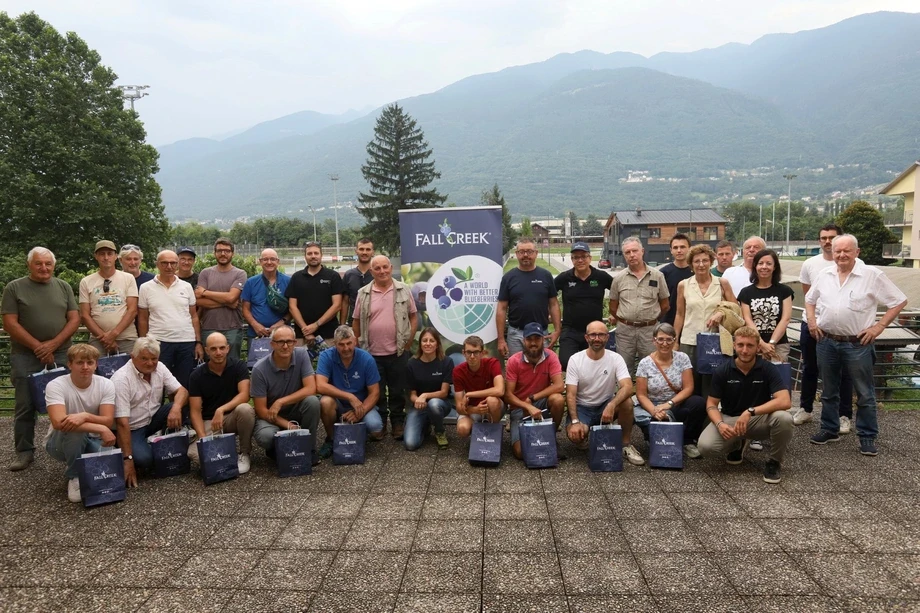
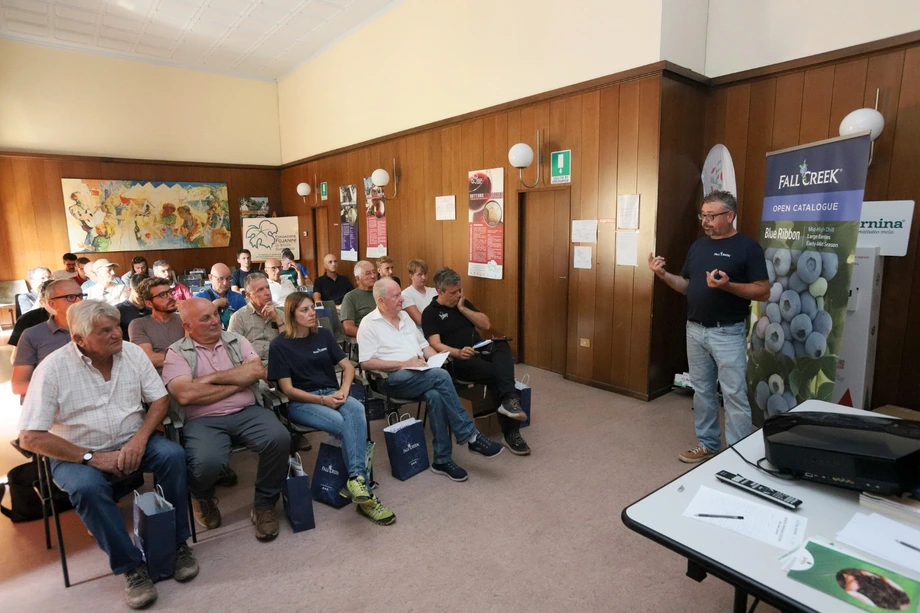
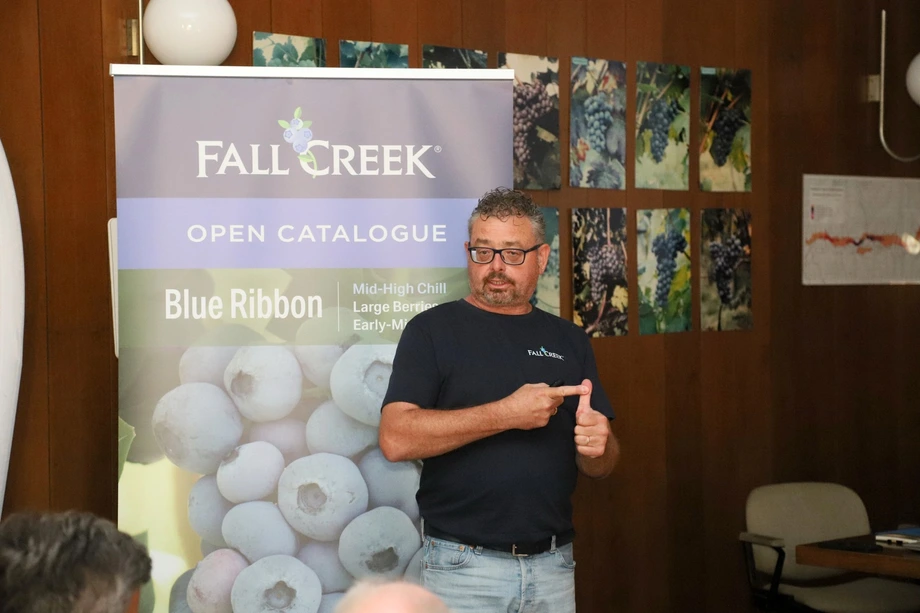
Summary of the presentation by Andrea Pergher (North EMEA Area Manager at Fall Creek®), delivered on 1 July 2026 as part of the Fall Creek® Connect event held in Sondrio.
The profitability of a blueberry plantation is decided long before the first harvest.
The initial choices regarding plant quality, planting density, orchard architecture, varieties and harvesting efficiency determine the economic sustainability of the entire production cycle.
In the cultivation of berries, dominated by rising labour, material and technical management costs, productivity optimization increasingly depends on reducing planning errors.
The presentation by Andrea Pergher highlights with concrete figures how apparently marginal savings at the start-up stage can turn into very significant economic losses over a twenty-year cycle.
Key takeaways
1. Initial savings on plants can generate enormous losses.
Choosing cheap, low-quality blueberry plants to save around 10,000 euros at the start of the plantation can translate, over a twenty-year cycle, into an estimated production loss of 1,000 quintals, equivalent to around 500,000 euros in lost revenue.
2. Overly wide planting layouts can significantly affect profitability.
Wide layouts, such as 4x1.2 metres with around 2,000 plants per hectare, create unproductive empty spaces. Compared with denser modern layouts, such as 3x0.8 metres or 3.2x0.8 metres, the loss can reach up to 1 million euros over twenty years, while fixed costs remain unchanged.
3. Berry size drastically reduces harvesting costs.
Since harvesting accounts for more than 50% of production costs, varieties with fruit larger than 20 mm make it possible to increase picking rates from 4-5 kg/hour to more than 12-15 kg/hour, reducing the incidence of this cost item from 50% to around 10% of turnover.
4. New plantations must also be designed for mechanization.
To contain rising labour costs, growers need to design plantations with trellising systems suitable for machinery, harvesting aids and brush systems capable of reducing fruit losses on the ground, which in standard machines can approach 30%.
5. Varietal strategy is structured around differentiated platforms.
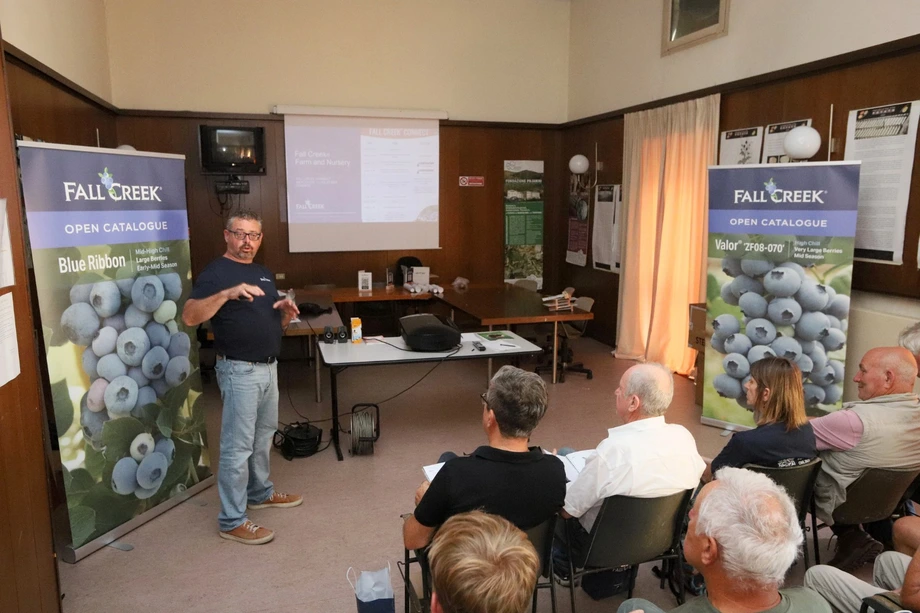
Global varietal innovation is now organized on three levels: Open Catalogue for all growers, the royalty-based Fall Creek® Collection and the premium, restricted Sekoya® program, designed to meet the requirements of large-scale retail.
What emerges from the presentation
The profitability of a blueberry plantation depends on the systematic prevention of errors.
Mistakes made during the initial phase do not remain confined to the moment of investment but continue to affect the entire production cycle of the orchard.
When added up over a period of around twenty years, seemingly limited errors can significantly affect the economic sustainability of the farm.
An initial saving estimated at around 30,000 euros per hectare, obtained by purchasing cheaper plants and adopting overly wide planting layouts, can generate total losses of up to 1.5 million euros over the lifetime of the plantation.
This figure clarifies a fundamental principle: in modern blueberry cultivation, the real cost is not what is spent at the beginning, but what is lost through future missed productivity.
False savings are the first economic risk
Saving on plants, density and plantation design may seem convenient at the start-up stage.
But in blueberries, a perennial crop requiring high investment, every initial mistake is multiplied across twenty years of lost production, inefficient harvesting and unchanged fixed costs.
Quality plants: the first production investment
The first mistake to avoid concerns the quality of nursery material.
Buying cheap, low-quality plants may generate an initial saving of around 10,000 euros, but this benefit is misleading.
Less-performing, non-uniform plants or plants with slower vegetative development lead to plant losses, lower vigour, slower entry into production and lower yields.
Over a twenty-year production cycle, this choice can result in an estimated loss of 1,000 quintals of product, equivalent to around 500,000 euros in lost revenue.
Plant material is therefore not a cost item to be compressed indiscriminately.
In blueberries, the plant is the basis of the entire economic model: if the starting point is weak, even the best agronomic protocol struggles to recover the lost potential.
Planting layouts: when empty space becomes a loss
The second critical element concerns planting density.
Overly wide layouts, such as 4x1.2 metres, result in around 2,000 plants per hectare and create large unproductive empty spaces.
These spaces do not produce fruit, but they continue to generate costs: irrigation, mulching, posts, soil management, maintenance and cultivation operations remain substantially unchanged.
The result is a structural loss of efficiency.
Compared with denser and more modern layouts, such as 3x0.8 metres or 3.2x0.8 metres, with more than 4,000 plants per hectare, the economic loss can reach up to 1 million euros over twenty years.
Keeping a full row means making better use of the surface area, increasing productivity per hectare and spreading fixed costs over a larger quantity of harvested product.
| Technical choice | Frequent mistake | Potential economic impact |
|---|---|---|
| Nursery material | Purchasing cheap, low-performing plants. | Up to 500,000 euros in lost revenue over 20 years. |
| Planting layout | Overly wide layout with unproductive empty spaces. | Up to 1 million euros in potential losses over 20 years. |
| Fruit size | Small-fruited varieties and slow harvesting. | Harvesting cost up to 2.5 euros/kg. |
| Harvesting | Plantation not designed for harvesting aids or mechanization. | Greater dependence on labour and lower operating efficiency. |
| Varietal strategy | Lack of alignment between climate, market and commercial channel. | Lower value, reduced shelf life and more difficult access to large-scale retail. |
Harvesting is the real economic bottleneck
The third issue concerns harvesting, one of the heaviest cost items in the blueberry profit and loss account.
According to Andrea Pergher’s presentation, this operation can account for more than 50% of production costs.
The decisive variable is fruit size.
Traditional small-fruited varieties limit picker output to around 4-5 kg/hour, with a harvesting cost close to 2.5 euros/kg.
By contrast, modern varieties with fruit larger than 20 mm can easily reach 12-15 kg/hour.
This efficiency leap reduces harvesting costs to around 0.70-0.80 euros/kg and lowers the incidence of the operation from 50% to around 10% of turnover.
Fruit size is therefore not only a commercial or aesthetic attribute: it is a direct lever of profitability.
Mechanization: designing today to harvest tomorrow
The rise in labour costs makes it increasingly urgent to design plantations around harvesting efficiency.
Even in mountain areas, where mechanization may appear more complex, the structure of the plantation must be planned in advance.
Trellising systems, row width, accessibility, plant uniformity and management of the productive wall must be evaluated not only according to current manual labour, but also with future mechanical passages in mind.
Harvesting aids, such as shakers, belt-mounted mobile baskets and brush systems, can become decisive tools for reducing the incidence of labour.
Particular attention must be paid to fruit losses on the ground: in traditional machines they can approach 30%, a level that is difficult to sustain for high-quality fresh product.
New solutions must therefore aim not only to harvest faster, but also to preserve the value of the fruit.
Harvesting is decided already at planting stage
A plantation that is not designed to be harvested efficiently becomes more expensive every year.
The choice of varieties, layout, trellising and accessibility must anticipate the evolution of labour availability and mechanization.
Production calendar: Italy can cover January to October
Varietal choice must be consistent with the local climate and the target commercial supply chain.
Italy offers an extraordinary range of microclimates, from the very low-chill areas of Sicily to the high-chill environments of the North.
If properly managed, this diversity makes it possible to build a very broad commercial calendar, from January to October.
To achieve this, however, it is not enough to plant blueberries in different areas.
It requires a careful combination of genetics, chilling requirement, harvest timing, fruit quality, shelf life and commercial destination.
The competitive advantage comes from the ability to serve precise market windows, avoiding overlaps and maximizing the value of each stage of the production calendar.
From Duke to new varietal platforms
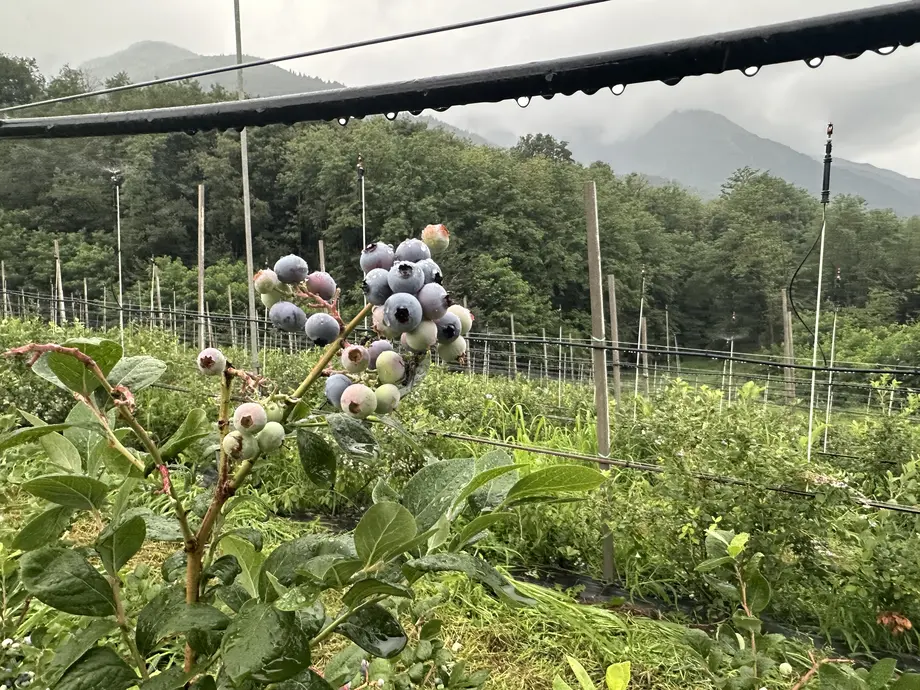
The transition from old varietal standards, such as Duke, to innovative platforms is one of the most relevant steps for Italian blueberries.
The market requires fruit that is firmer, crunchier, more uniform and capable of maintaining quality along the logistics chain.
The new platforms developed by Fall Creek® respond to this evolution through differentiated access models.
The Open Catalogue provides access to varieties available to all growers.
The Fall Creek® Collection introduces a royalty-based model, with selected genetics and a higher level of innovation.
The Sekoya® program, on the other hand, serves the restricted premium segment, designed for large-scale retail and high-value commercial programmes.
This segmentation reflects a structural change in the market: not all varieties have the same role, not all growers serve the same channel and not all genetics are designed for the same commercial strategy.
The quality required by large-scale retail
Large-scale retail requires continuity, shelf life, uniformity and reliability.
Growers can no longer think only in terms of kilograms per hectare, but also in terms of stable commercial quality.
Crunchier, firmer fruit that is more resistant to handling helps reduce waste, claims and value losses along the supply chain.
Shelf performance therefore becomes a central element of profitability.
A modern variety must meet several needs at the same time: field productivity, harvesting efficiency, consumer appeal and logistics performance.
The blind test with 6 varieties
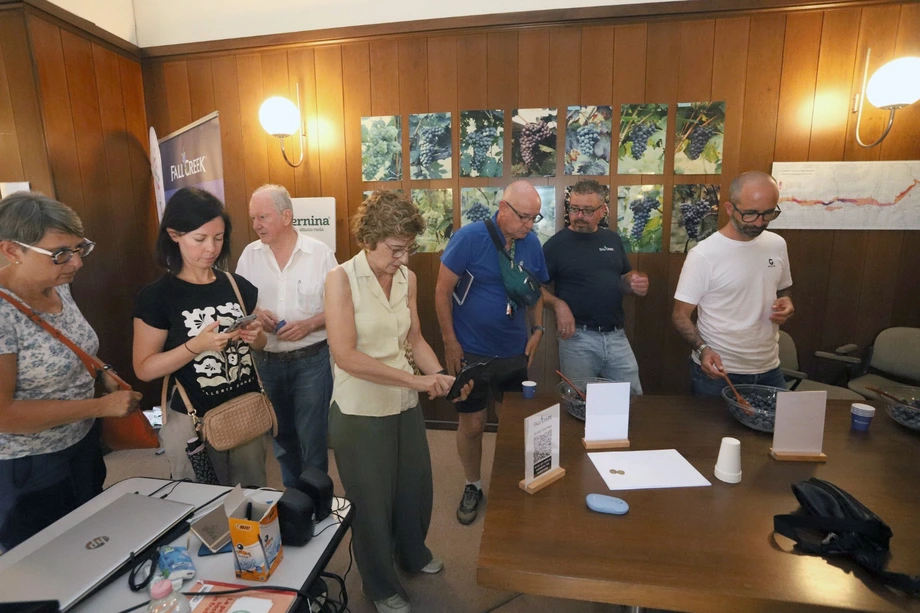
At the end of the presentations, participants carried out a blind test on 6 varieties, whose identity was revealed only when the results were presented.
The varieties evaluated were Duke, Blue Ribbon, Top Shelf, Draper, ArabellaBlue® 'FC14-062' and Valor® ‘ZF08-070’.
The variety that received the highest overall appreciation was ArabellaBlue® 'FC14-062', which was also the favourite for texture, chosen by 52% of voters, and flavour, chosen by 44%.
Top Shelf received the most votes for berry size, with 32%, while Valor® ‘ZF08-070’ recorded the highest appreciation for appearance, with 32%.
In summary
Andrea Pergher's presentation highlights a clear message: in blueberries, profitability does not depend on a single choice, but on the coherence of the entire plantation project.
Quality plants, adequate density, modern varieties, large fruit size, harvesting efficiency and readiness for mechanization are all components of the same economic model.
Saving money at the beginning can mean losing hundreds of thousands of euros over time.
By contrast, designing the plantation correctly makes it possible to maximize productivity, reduce harvesting costs, improve access to premium channels and enhance the potential of Italy's different production areas.
For blueberry growers, the real challenge is not simply to plant, but to build a system capable of generating value for twenty years.