






In North Carolina, the blueberry season is approaching its peak. But among the rows, alongside growers, a new ally is also emerging: artificial intelligence. A team from the N.C. Plant Sciences Initiative is working with growers to develop a system capable of estimating more accurately when to harvest, using computer vision and AI.
An app to “read” blueberry plants
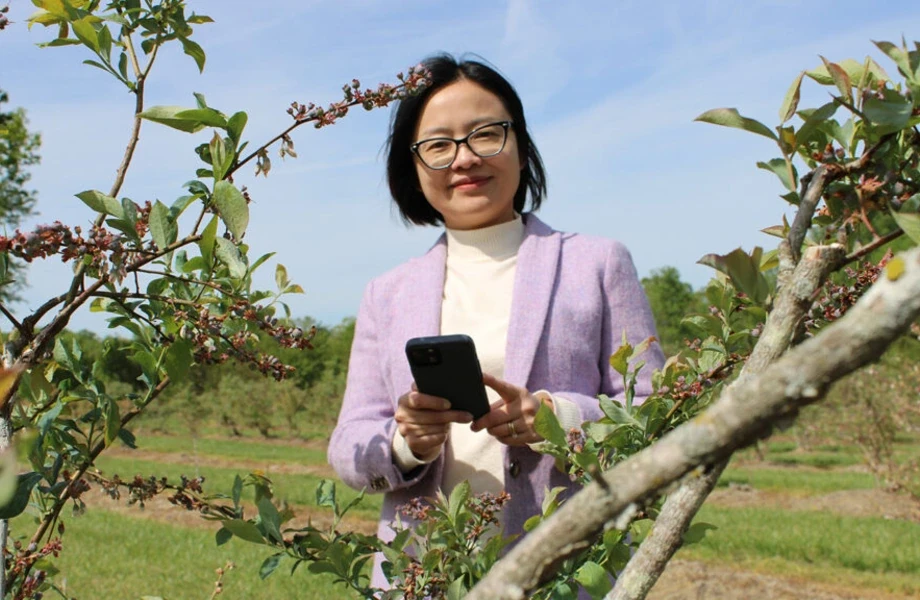
On a cool spring morning in Randolph County, NC State University researcher Jing Zhang walks through the blueberry plants, stops in front of a bush and takes out her smartphone.
The scene is simple, but its potential is relevant for the entire supply chain. North Carolina harvests around 54 million pounds of blueberries each year (about 24.5 million kg), accounting for nearly 9% of U.S. production. In a production context of this scale, accurately understanding which plants are more heavily loaded and when the fruit is ready can make a difference in terms of efficiency, quality and labor planning.
Zhang takes a photo of a blueberry plant and uploads it to an app installed on her phone. Within seconds, the artificial intelligence-based system provides two key pieces of information: the number of berries on the bush and the percentage of ripe fruit.
From flowering to harvest: real-time data
In the field observed by the researcher, there is still about a month to go before the flowers turn into ripe, plump and juicy berries. The low temperatures of the day reduce bee activity among the bell-shaped flowers, but some of the first fruits have already begun to swell.
The result of the analysis appears on the smartphone display. “It sees 112 berries,” says Zhang, a horticultural science professor affiliated with the N.C. Plant Sciences Initiative and head of NC State’s Translational Plant Phenomics Lab.
The project aims to provide growers with a more accurate tool to assess the productivity of individual plants and plan the optimal harvest timing, moving beyond traditional visual observation alone.
Practical support for growers
The use of computer vision in blueberries may open up new prospects for more precise field management. Knowing how many berries are present on a plant and how many are already ripe allows for more informed decisions, especially during a delicate phase such as harvest.
For growers, this means being able to better organize timing, teams and field passes, with the goal of harvesting the product at the most suitable moment and maximizing fruit quality.
The future of harvesting is data-driven
The work of the N.C. Plant Sciences Initiative shows how digital innovation is increasingly entering berry supply chains. In blueberries, where ripening, yield and harvest timing directly affect competitiveness, AI- and image-based tools could become a strategic support for growers and technicians.
The challenge now is to turn this technology into a practical, accessible and useful solution at farm scale, capable of supporting growers from plant monitoring through to the final decision: when to harvest.
Text and image source: cals.ncsu.edu