






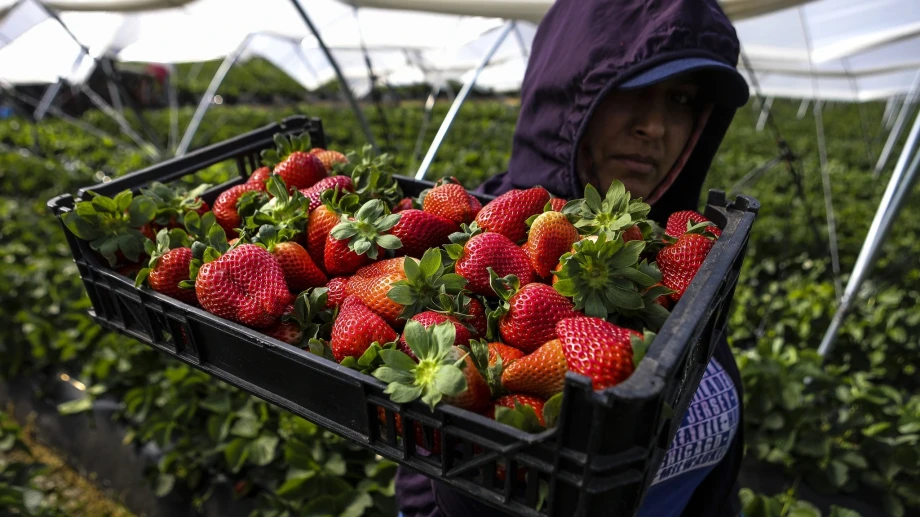
Eleven almost uninterrupted storms have destroyed a large part of strawberry, raspberry and blueberry crops in Portugal, Spain and Morocco. Quality has also been compromised.
The depressions Ingrid, Joseph, Kristin, Leonardo and Marta, together with two fronts associated with the depression Nils, between January 1 and February 28 devastated farms in Portugal, Spain and Morocco.
They caused a historic paralysis in the production of berries: strawberries, raspberries and blueberries.
For many small farmers, what remained after floods, winds and high humidity has reduced farms to zero productive capacity.
And now the recovery of operations is marked by “uncertainty”, explains José Gonçalves, head of Nutrix – Organic Berries based in Leiria, to the newspaper PÚBLICO. The company produces organic raspberries in Monte Real.
The waiting time
The waiting time for the aid announced by the Government to reach those who need it is not encouraging at all. “By the end of April we must submit the application to benefit from the support.
Then the Regional Coordination and Development Commission (CCDR) Centro has one month to verify on site the situation we describe. After that, it will take another two weeks for any aid to be assigned.” Meanwhile, concludes the farmer, “it will already be summer and the agricultural year will be lost”.
The Kristin storm
The storm Kristin “completely destroyed our productive capacity on about one hectare of greenhouses, which were literally lifted by the wind”.
One hectare corresponds to 10,000 square meters. He also recalls the comment made by Agriculture Minister José Manuel Fernandes during a recent visit to the farm:
“We cannot give everything to everyone.” A possible solution will therefore involve a redistribution of the aid. To mitigate the extent of the damage suffered, the entrepreneur appealed to the solidarity of citizens.
“We only ask that they bring boots, gloves and a good cutter to remove plastic, metal pipes and wood.” The goal is to recover the recently transplanted plants.
The response of volunteers
On February 21, people actually arrived and at least the clearing of the area was completed. A gesture that José Gonçalves thanked with emotion. He hopes volunteers will also return for the next necessary operations.
In the district of Leiria there are several companies dedicated to the production and marketing of berries, often destined for export markets.
Many have ended up in a critical situation because of the storms. “Most small farmers will not resume activity if they do not receive aid from the Government.” This is confirmed by Gil Cabecinha, owner of Gcberries. The company is a blueberry producer in the Leiria region.
A year of waiting
“The situation is so dramatic that we no longer know where to start.” “The water is still a handspan above the pots where the plants are placed.” Blueberry plants have a very dense and shallow root system.
They have thin roots highly sensitive to waterlogging. Only when the fields are free from the “liquid blanket” covering the soil will we truly understand what has happened.
“We will have a shortage of berries and prices will rise on supermarket shelves.” As for aid, “we are still waiting for it”. Just like those promised a year ago after the Martinho depression. Those aids have still not arrived.
Fear among farmers
“My hope of receiving support is little or none.” Gil Cabecinha also highlights another consequence. The weather has left in farmers’ subconscious the fear that the situation could repeat itself. “A stronger gust of wind makes our hearts jump”.
In contrast with the many small farms destroyed in central Portugal, the Kristin storm also left serious damage in the Perímetro de Rega do Mira (PRM) in Odemira.
Producers reported losses in greenhouses, plastic tunnels and irrigation systems. There are concerns about delays in planting and about reduced yields in the coming months.
The Instituto Nacional de Investigação Agrária e Veterinária (INIAV) published on February 16 a study on berry cultivation in Odemira. The study estimates about 1,000 hectares dedicated to raspberry cultivation.
While 150 hectares will be dedicated to blueberries. According to Joel Vasconcelos, CEO of Lusomorango, the company concentrates 90% of its raspberry production in Odemira. It also represents 17% of the national berry production.
Destruction up to 70%
After assessing the damage caused by the storms in the PRM, several companies recorded destruction levels between 50% and 70%. Damage to tunnels, irrigation systems and labor has been estimated at over 20 million euros.
“Exceptional situations require exceptional measures.” The manager recalls that the Perímetro de Rega do Mira generated in 2023 about 502 million euros in gross value added.
It created more than 16,000 jobs directly and indirectly. It also generated 134 million euros in tax revenues. It contributed 22 million euros to the real estate sector, 13 million to local commerce, and 5 million to the hospitality sector.
The weight of agriculture
In summary, agriculture represents more than 60% of Odemira’s economy. “It is the survival of companies that is at stake.” Farmers in Mira are calling for rapid and concrete support measures.
They are also asking for a support line to restore productive capacity, with immediate access to financing. “The closure of companies, the loss or reduction of activity could have serious consequences for the territory”.
Joel Vasconcelos complains that so far there has been no response from the Government. He also draws a parallel with the Martinho depression in March 2025. “That storm caused damage to PRM farms, but farmers are still waiting for the aid promised by the Government”.
Not enough fruit for consumption
The consequences of the devastation caused by the storms are already being reflected in berry consumption. “Production is very scarce and the available fruit is highly valued”.
Weather conditions have reduced both quantity and quality. “In the short and medium term production will remain compromised”. In Spain, in the Huelva region, the Association of Strawberry Producers and Exporters of Huelva (Freshuelva) has raised the alarm over the collapse of strawberry exports.
The reduction is 50% compared to the same period in 2025. The association has requested urgent aid to mitigate the damage caused by the storms. The report from the Price and Market Observatory of the Regional Government of Andalusia indicates that the prices of all berries are higher due to the lower supply caused by the storms.
Damage also in Morocco
In northern Morocco as well, heavy rains and strong winds have seriously damaged berry plantations. The situation threatens the production and exports of the sector.
The president of the Moroccan Association of Berry Producers (AMPFV), Amine Bennani, said that violent winds tore off the plastic coverings of greenhouses.
They also damaged more than 20% of the cultivated areas. Floods affected between 10% and 15% of farms. Given the scale of the disaster, the situation has become “critical for producers”. Producers acknowledge significant export losses.
Source text and image: Publico