










The “smart” blueberry is no longer just an idea for tech conferences. For an industry that generates an impact of nearly $9.1 billion (around €8.4 billion) on the U.S. economy, turning field-collected data into operational decisions can become a concrete driver of competitiveness.
This is the vision behind BerrySmart Field, the program sponsored by the U.S. Highbush Blueberry Council (USHBC) and implemented by innov8.ag, an ag-tech company based in Walla Walla, Washington, founded in 2019 by former Microsoft executive Steve Mantle.
The goal is to build a new network of “smart farms” for blueberries, capable of connecting university research, advanced technologies and everyday field realities with measurable results across the entire value chain.
An innovation model designed for growers
Sensors, high-resolution imagery, automation, artificial intelligence and advanced analytics are rapidly entering specialty fruit production as well. But for many growers, the risk is facing complex tools that are difficult to integrate and often far removed from the real pressures of farming operations.
BerrySmart Field was created precisely to bridge this gap. The program aims to select, test and validate solutions that can truly work in blueberry fields, providing growers with tools, training and useful insights not only for agronomic management, but also for labor planning, packing, logistics and sales.
In the blueberry sector, much innovation has historically focused on the post-harvest stage. What has remained less measurable, however, is what happens in the field, from the soil to the canopy. BerrySmart seeks to close this gap by linking agronomic data and economic performance at the shed, marketer and end-customer level.
Validate first, then scale
As Noel Sakuma, a Washington State grower and chair of the USHBC BerrySmart Technology Task Force, points out, innovation cannot simply mean “putting a robot in the field” and considering the problem solved.
For this reason, the program adopts a gradual approach: starting from the basics, testing the reliability of technologies and only then applying them on a broader scale.
In the first phase, benchmarks are established and it is verified that sensors, imagery and analytics work in real commercial blueberry fields, not only in controlled trials. In the next phase, data is used to improve irrigation, nutrition, pruning, pollination and harvest planning. Finally, the most effective practices and strongest tools are extended to different farms and regions.
This pathway reduces risk for both growers and technology companies, building trust and making it clearer what “success” in the field really means.
Pilot farms as open-air laboratories
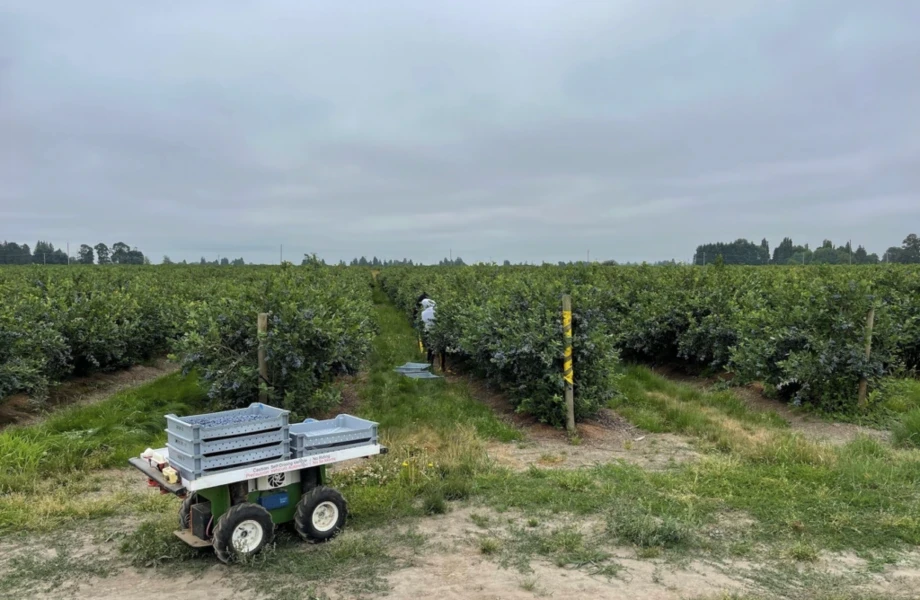
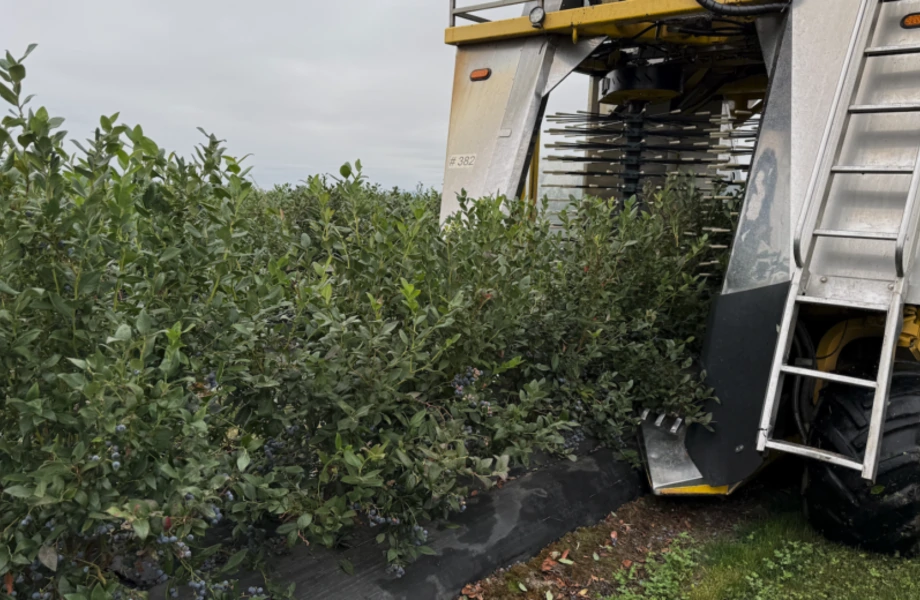
BerrySmart Field is based on pilot farms in Oregon, Washington and, more recently, New Jersey and Florida. These sites operate as real-world laboratories, where technologies are tested under commercial conditions: dust, rain, heat, harvest peaks and daily operational constraints.
Tools tested here include high-resolution soil mapping, blossom and fruit imagery, autonomous carts and AI-assisted yield forecasting systems.
The BerrySmart Field Days, held annually at these sites with partners such as Washington State University, Oregon State University, University of Florida and Rutgers University, have already brought hundreds of supply chain stakeholders directly into the fields to observe practical comparisons, ask questions and analyze the data collected.
Yield forecasting: the decisive proving ground
One of the most important areas of the program concerns yield forecasting, a priority for the entire blueberry industry.
According to Paul Macrie III, a New Jersey grower and former USHBC Council member, growers do not simply need more data, but better insights. Yield estimation is a central variable: when accurate, it can make the difference between a profitable season and a missed opportunity; when wrong, it can undermine labor planning, logistics and customer relationships.
Under the BerrySmart umbrella, innov8.ag and the program partners are working on two complementary data-driven lines. On one hand, they are using AI and satellite imagery to identify blueberry acreage by farm, county, state, region and, in the future, country. On the other, they are analyzing harvest timing for early-, mid- and late-season acreage, together with the impact of weather and planting year on productivity.
The work is based on a multi-year database that includes more than 45 varieties, 1.97 billion blueberries counted, 432 million images analyzed and forecasts covering more than 79,000 hectares of crops.
The shift is significant: from block averages and intuition-based experience to a row-by-row, plant-by-plant view, combining national historical data with up-to-date information on what is happening in the field.
A more connected and precise blueberry value chain
Now in its fifth season, BerrySmart Field is entering a crucial phase. The program can begin to generate tangible results: greater yield visibility earlier in the season, more consistent data collection across farms and production areas, and increased confidence in the adoption of new technologies.
The outlook is for a blueberry value chain that is increasingly connected, where growers and marketers can manage complexity with more precise tools. Technology is no longer just about accumulating data, but about supporting more profitable decisions for all stakeholders involved: from field crews to the final consumer.
Text and image source: northamerica.visionmagazine.com