










Summary of the round table "Sekoya premium blueberries: opportunities for growers and consumers" with Marius Sponholz (Sekoya), Carlo Lingua (RK Growers) and Erminio Colombini (SanLucar), moderated by Thomas Drahorad (Italian Berry) as part of the Berry Area 2026 event programme (Macfrut).
The berry market is going through a phase of profound evolution, in which competition is progressively shifting from the race for volumes to the creation of value.
The definition of a premium category for blueberries is no longer just an agronomic or varietal challenge, but requires a rigorous and fully integrated supply chain architecture.
From the genetic control of propagation material to shelf presentation, every link in the system must guarantee consumers an excellent, consistent and recognizable taste experience.
Addressing this transition means balancing rising technology costs and difficulties in sourcing labour with higher price positioning, ultimately competing in terms of perceived value even with the snack industry.
Key takeaways
1. The price differential rewards the high-end segment.
International data show that premium blueberry varieties achieve a price more than 1.50 dollars per kilo higher than traditional varieties, confirming the market's willingness to pay for a superior consumption experience.
2. Premium quality requires an end-to-end supply chain model.
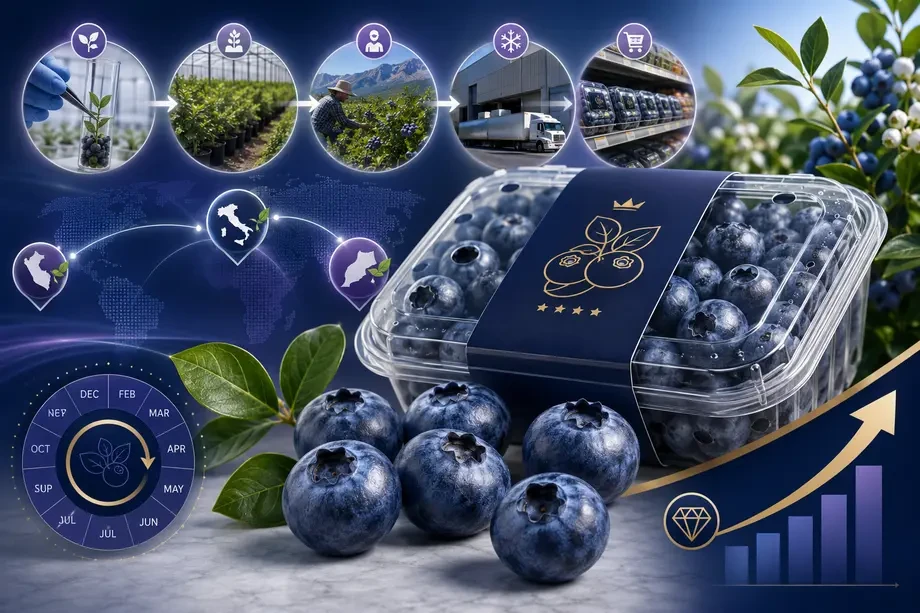
Quality standardization is achieved through full control of the process: a single programme supplies plants to nurseries, coordinates fruit through an exclusive network of authorized members and ultimately connects it to large-scale retail.
3. Continuity of supply is part of the premium standard.
To be defined as premium, a blueberry must guarantee the same characteristics of taste, texture and size 12 months a year, integrating production from different origins such as Italy, Morocco and Peru.
4. Operating costs have a decisive impact in Italy.
High-quality production requires professionalism, technology and substantial investment. Labour alone for harvesting in Italy exceeds 2.50 euros per kilo, in addition to the difficulties of finding and managing qualified personnel.
5. The six-second shelf barrier is decisive.
Consumers spend very little time making their choice at the point of sale. This makes clear segmentation of the offer by retailers and highly communicative, recognizable packaging consistent with premium positioning essential.
What emerges from the round table
The construction of a premium segment in blueberries requires a profound paradigm shift that goes far beyond the introduction of improved cultivars.
A top priority is the need for an end-to-end operating model, capable of aligning all supply chain players, from breeders to distribution, around the same commercial and quality objective.
This integrated approach, such as the one adopted by the Sekoya programme, connects genetics, growers and a network of 14 authorized distributor members worldwide, enabling precise volume planning and coordinated market release.
Premium does not only mean variety
Premium value comes from the combination of genetics, production techniques, quality control, continuity of supply, selective distribution and the ability to clearly communicate the difference to consumers.
A superior variety alone is not enough if it is not part of a system capable of ensuring consistent quality and commercial recognition.
An integrated model from plant to shelf
In the premium segment, the supply chain cannot function as a series of separate steps. Instead, it must operate as a coordinated system in which every phase contributes to building final value.
The control of plant material, the selection of growers, volume management, the choice of origins and access to distribution must all be governed by common standards. Only in this way is it possible to avoid quality discontinuities and protect product positioning.
The end-to-end logic also makes it possible to programme supply on an international basis, integrating complementary production areas and reducing the risk of supply gaps or unmanaged overlaps.
Producing high-end blueberries costs more
From an agronomic perspective, producing high-end blueberries requires strict standards and significant investment.
The distinction between high-chill and low-chill varieties now makes it possible to grow blueberries from Southern to Northern Italy, expanding the national production potential. However, this evolution requires more advanced technologies, substrate systems, greater agronomic precision and specialized technical expertise.
The main obstacle remains labour. The shortage of personnel, combined with harvesting costs exceeding 2.50 euros per kilo to ensure delicate handling of the fruit, represents a structural critical issue for the Italian supply chain.
In the premium segment, harvesting is not just a field operation: it is a decisive phase for preserving bloom, texture, size and appearance, the elements that make the difference visible at shelf level.
The price differential justifies the investment
Despite the production challenges, commercial dynamics confirm the strength of premium positioning.
Analyses carried out in key production areas, such as Peru, show that the market recognizes a premium of more than 1.50 dollars per kilo for top-level product compared with traditional varieties.
This differential indicates that quality, when it is perceptible and consistent, can become real value along the supply chain. Consumers and retailers are willing to recognize a higher price, but only if the product consistently delivers on its promises of taste, texture and reliability.
| Factor | Impact on premium | Necessary condition |
|---|---|---|
| Genetics | Defines the potential for taste, size, crunchiness and shelf-life. | Varieties selected and managed within controlled programmes. |
| Production technique | Allows the varietal potential to be expressed in the field. | Agronomic expertise, technology and rigorous standards. |
| Harvesting | Directly affects fruit integrity and perceived quality. | Qualified labour and delicate product handling. |
| Continuity | Makes premium positioning credible for distribution. | Complementary origins and international programming. |
| Packaging | Quickly communicates the difference to consumers. | Clear segmentation, visual identity and recognizable message. |
Quality continuity is the true condition for premium
To consolidate the value of the premium segment, the essential condition is quality consistency.
Consumers must find the same characteristics of taste, texture and size in the product twelve months a year. This objective cannot be achieved by relying on a single origin or a single production window.
Instead, a global orchestration of production is required, integrating complementary areas across the two hemispheres. Origins such as Italy, Morocco and Peru can contribute to building continuous supply, provided they are part of a common system of standards, controls and programming.
The decisive challenge is played out at the shelf
The final and decisive barrier is encountered at the point of sale.
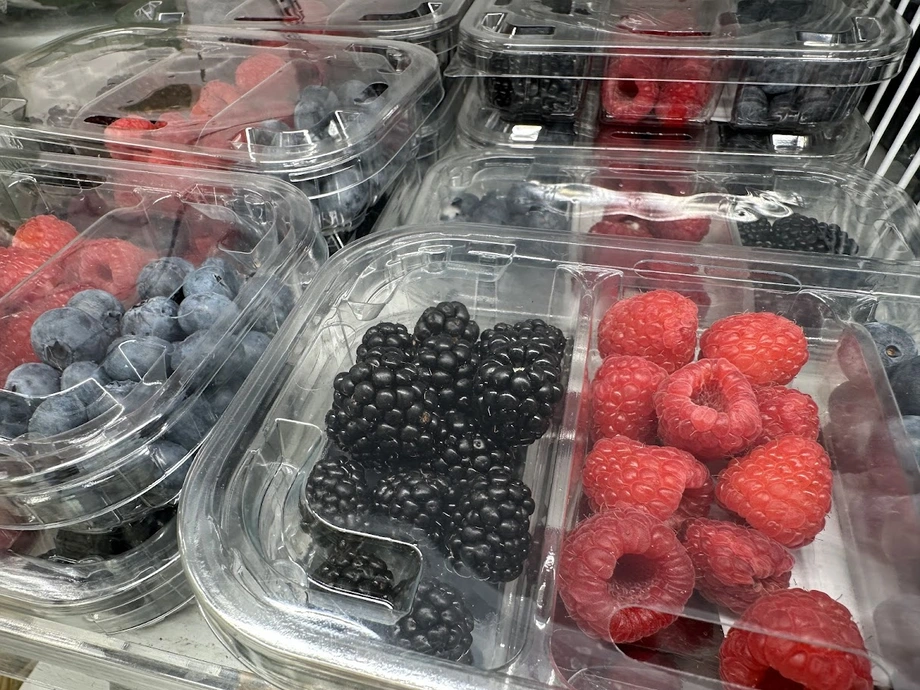
Consumers spend very little time choosing in front of the shelf: in some cases no more than six seconds. In this extremely short interval, the product must immediately communicate why it is different and why it deserves a higher price.
The role of large-scale retail therefore becomes crucial. Without clear visual and conceptual segmentation, the risk is that premium will be perceived simply as a more expensive blueberry, rather than as a superior consumption experience.
Packaging, brand, communication materials and shelf positioning must work together to make the value understandable: taste, health, wellness, consistent quality and eating pleasure.
In summary
A premium blueberry is not just a better fruit, but the result of a supply chain designed to generate value consistently: from genetics to production, from harvesting to distribution, right through to the consumer's decision at the shelf.
In a market where Italian per capita consumption is still around 300-400 grams per year, there is still considerable room for growth. The challenge is to position blueberries not as a commodity, but as a product of wellness, quality and pleasure, capable of competing even with industrial snacks with high perceived value.