




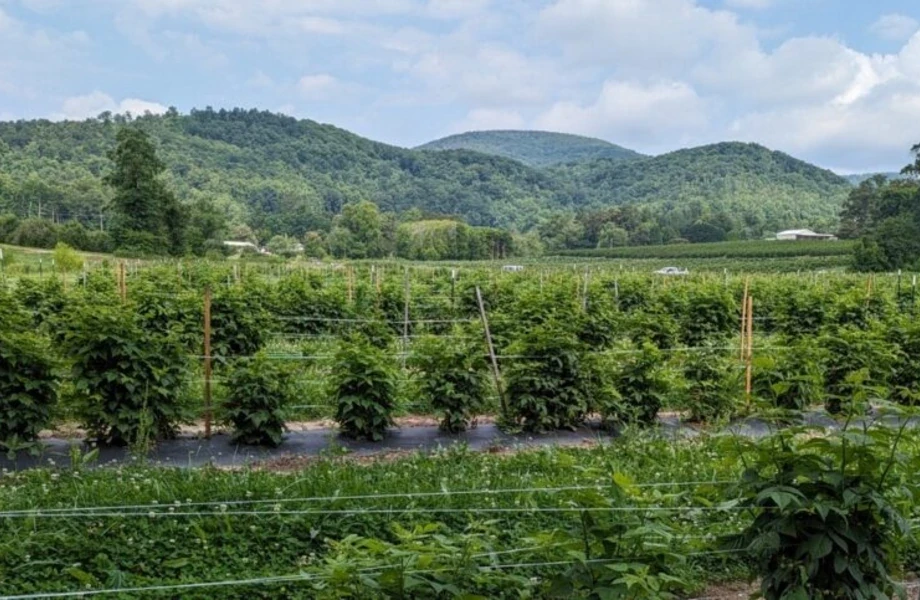
The cultivation of raspberries in North Carolina has long been constrained by a structural limitation: the lack of cultivars capable of combining high productivity, heat tolerance, and good shelf life. To address this gap, a collaborative research project funded by the Southern Region Small Fruit Consortium was launched in 2022, with the aim of identifying new varieties suited to the pedoclimatic conditions of the western part of the state.
The trial: 10 cultivars compared under real conditions
The trial was conducted in Henderson County, North Carolina, at approximately 670 meters above sea level. Here, plants were grown in open field conditions, without protective covers, on raised beds with drip irrigation and standard pest and fertilization management.
A total of 10 cultivars from breeding programs at Cornell University, USDA-ARS/Oregon State University, and NC State University were tested, including Nantahala (control) and Heritage (reference standard).
During the 2023 and 2024 seasons, data were collected on phenology, yield performance, and post-harvest quality. Parameters analyzed included bud break and harvest timing, average berry weight, Brix level, acidity, firmness, juice leakage, rot incidence, and storage behavior.
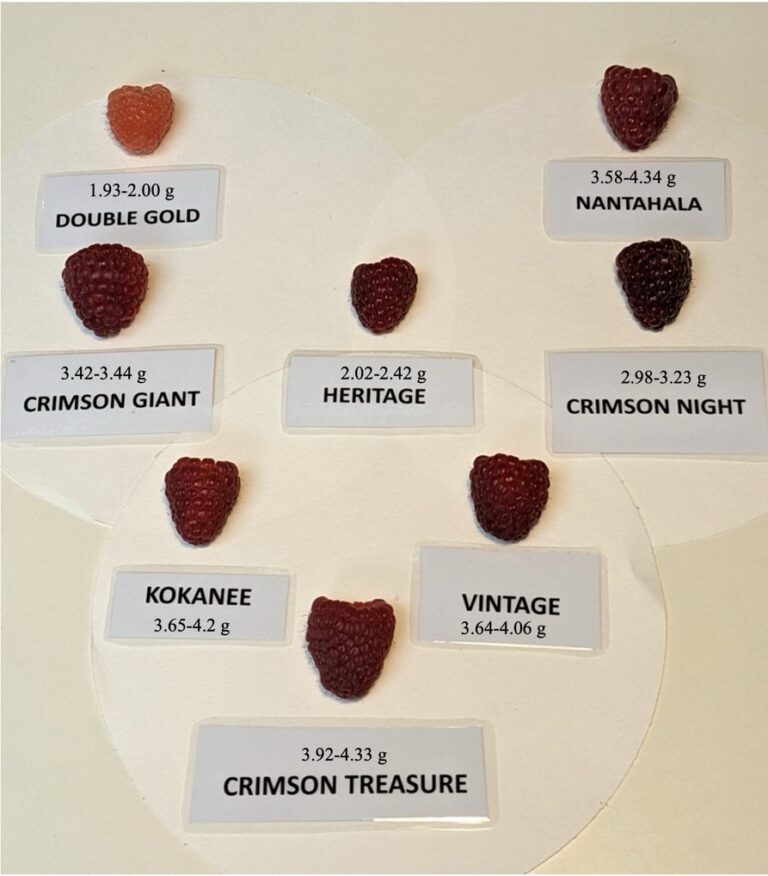 Average berry weight, size, and shape across the 2023 and 2024 seasons.
Climatic conditions and their impact
A notable factor observed in 2024 was the effect of rainfall: in September alone, Henderson County recorded 18.96 inches of rain, negatively affecting fruit quality and significantly increasing rot levels during the final harvest phase.
The most promising cultivars
The study highlights two varieties with strong potential for commercial production in western North Carolina.
- Crimson Treasure stands out for its large berries (3.92–4.33 g), high productivity (37 lbs/m²), and early harvest (July 26). The plant shows a compact, easy-to-manage architecture, and the fruit retains a bright red color even after harvest. It also avoids cold damage thanks to late bud break. Based on the results, it is already recommended for commercial cultivation.
- Kokanee shows similar performance, with high yields (41 lbs/m²), large fruit (3.65–4.2 g), and excellent storability, with no rot and minimal losses. The only limitation observed is slight “tip burn” due to early spring emergence.
- Nantahala, a variety already widespread in the state, confirms good sugar content (up to 11.43 Brix in 2024), but shows high levels of leakage (up to 54%) and lower yields compared to the best new selections.
Critical issues: poorly adapted varieties
Some cultivars showed significant limitations for commercial production.
- Vintage, despite recording the highest yield (62 lbs/m²) and excellent taste test results, suffers from poor shelf life and high juice leakage. It may find a niche in the u-pick segment, where shelf life is less critical.
- Crimson Night and Crimson Giant show issues in both yield and quality: the former due to low productivity and high leakage, the latter due to limited yields and significant losses despite good firmness.
- Double Gold proves to be the least suitable: low productivity, small fruit (1.93–2.00 g), susceptibility to sunburn, and difficult harvesting due to plant structure.
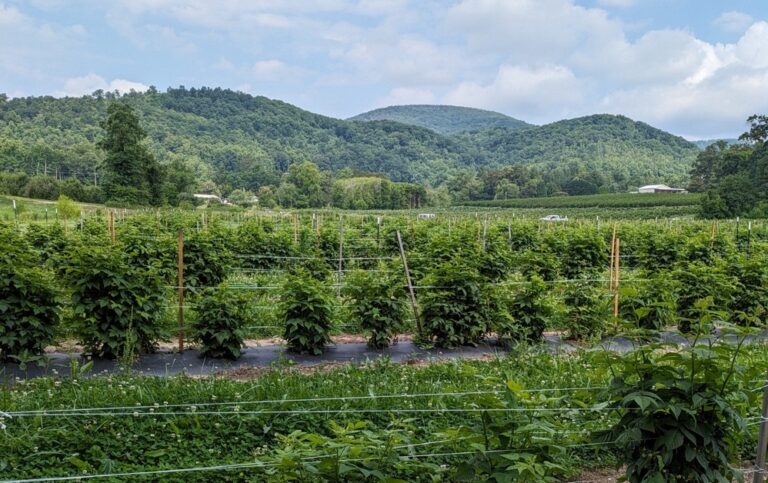 First year of cultivation of the Crimson Treasure variety using tomato trellis systems and high planting density.
Outlook: from field to supply chain
The trial results have already had a tangible impact: in 2025, several hectares of Crimson Treasure were planted in western North Carolina, with 2026 marking the first full production season.
At the same time, growers are testing new agronomic techniques, such as support systems inspired by tomato cultivation and higher planting densities, to reduce costs and increase yield per hectare.
Over the next two years, attention will focus on key aspects such as heat tolerance and plant longevity, particularly for Crimson Treasure and Kokanee. The results will be compiled into a technical bulletin published by NC State Cooperative Extension, aimed at providing increasingly precise operational guidelines for growers.
Source of text and images: smallfruits.org