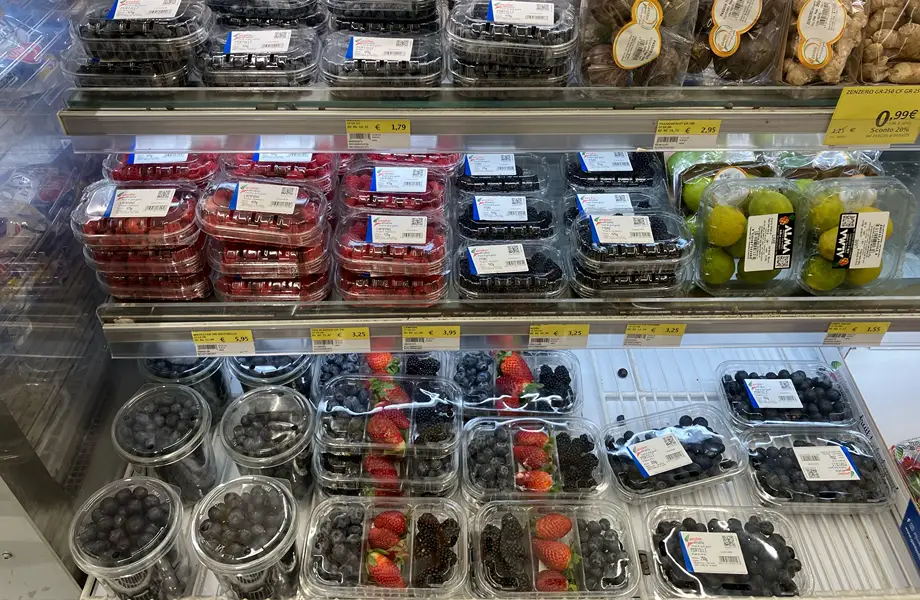












Berries have become the top-selling fresh fruit category in the United States by value, driven largely by household demand rather than luxury consumption.
Parents report that berries are among the most expensive recurring items in their grocery budgets, with many families spending significant monthly amounts due to how quickly children consume them.
Surveys show that berries are often eaten in entire cartons within a single day, making them a constant and costly staple.
Berry sales and household impact
According to data from Circana, US berry sales reached $12.6 billion (circa €11.6 miliardi) over a recent 52-week period, accounting for nearly a quarter of total fresh fruit spending.
This dominance is striking given that berries are not consumed in larger quantities by weight than other fruits, but instead command a much higher price per pound (circa 0,45 kg).
Compared to apples, bananas, and citrus, berries are several times more expensive, amplifying their impact on household food costs.
Income and accessibility
Income plays a role in access to berries. Households with lower annual incomes are significantly less likely to purchase blueberries, raspberries, and blackberries than higher-income households, highlighting affordability as a barrier.
While apples show relatively small purchasing gaps across income levels, berries remain a premium category that not all families can sustain regularly.
Family habits and preferences
Beyond price, consumption patterns help explain berry dominance. Parents consistently report that children prefer berries for their sweetness, ease of chewing, and familiarity, often treating them as a default snack or meal starter.
What begins as a convenient and healthy choice for toddlers can quickly turn into a daily necessity, with berries becoming embedded in household routines.
Industry influence and market trends
The produce industry has actively shaped this shift. Companies such as Driscoll’s transformed berries from a seasonal product into a year-round commodity through breeding, branding, and global sourcing.
By positioning berries as a consumer product rather than a traditional agricultural output, the industry expanded demand and normalized daily consumption, especially among families with young children.
Since 1990, per-capita availability of strawberries has doubled, while blueberry availability has increased nearly eightfold, even as consumption of fruits like peaches, plums, and pears has declined.
Despite their cost, many parents view berries as a worthwhile expense compared to processed snacks, and some attempt to offset spending through home growing.
Still, the rapid rise of berries reflects a broader shift in fruit consumption shaped by pricing, marketing, and changing family habits.
text and image source: www.freshfruitportal.com