













Fabio Ferrari, fruit and import manager at Coop Italia, outlined at the Berry Area a very clear vision of the evolution of berries in modern retail: the category is no longer a trend, but a stable presence in Italians’ shopping baskets. To continue growing, it needs product continuity, assortment depth, suitable formats and varietal selection capable of ensuring consistent quality.
The berries category has completed its transition from impulse product to standardised category. This is the starting point of the analysis proposed by Fabio Ferrari of Coop Italia during the round table “Berries on the rise: new directions to accelerate”, moderated by Raffaella Quadretti of Myfruit.
According to Ferrari, the transition phase is not simply underway: it has already happened. Berries are no longer perceived by consumers as a passing trend or as an occasional purchase linked simply to the product’s visibility on the shelf. They have now regularly entered the shopping list.
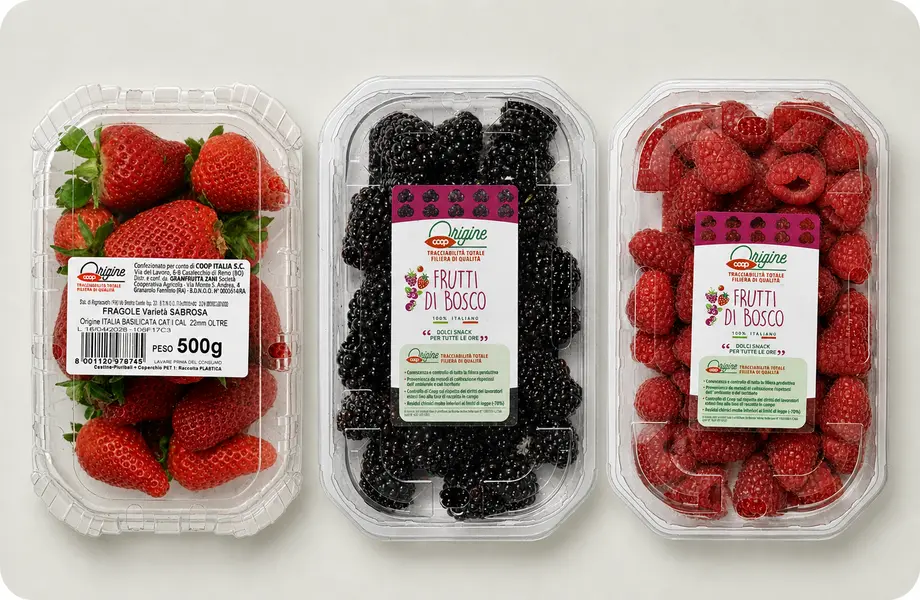
 Coop Origine blueberries in the 250g format (Berry Area 2025)
For Coop Italia, this means that the category has become a certainty within the assortment and within the retailer’s assortment structures. Customers now purchase berries with significant consistency, making the market more stable, while still leaving substantial room for growth.
From 125 grams to formats of 300 grams and above
One of the clearest indicators of this evolution is the change in pack sizes. Ferrari recalls how the market started with the “historic” 125-gram format, which accompanied the first phase of development of the category.
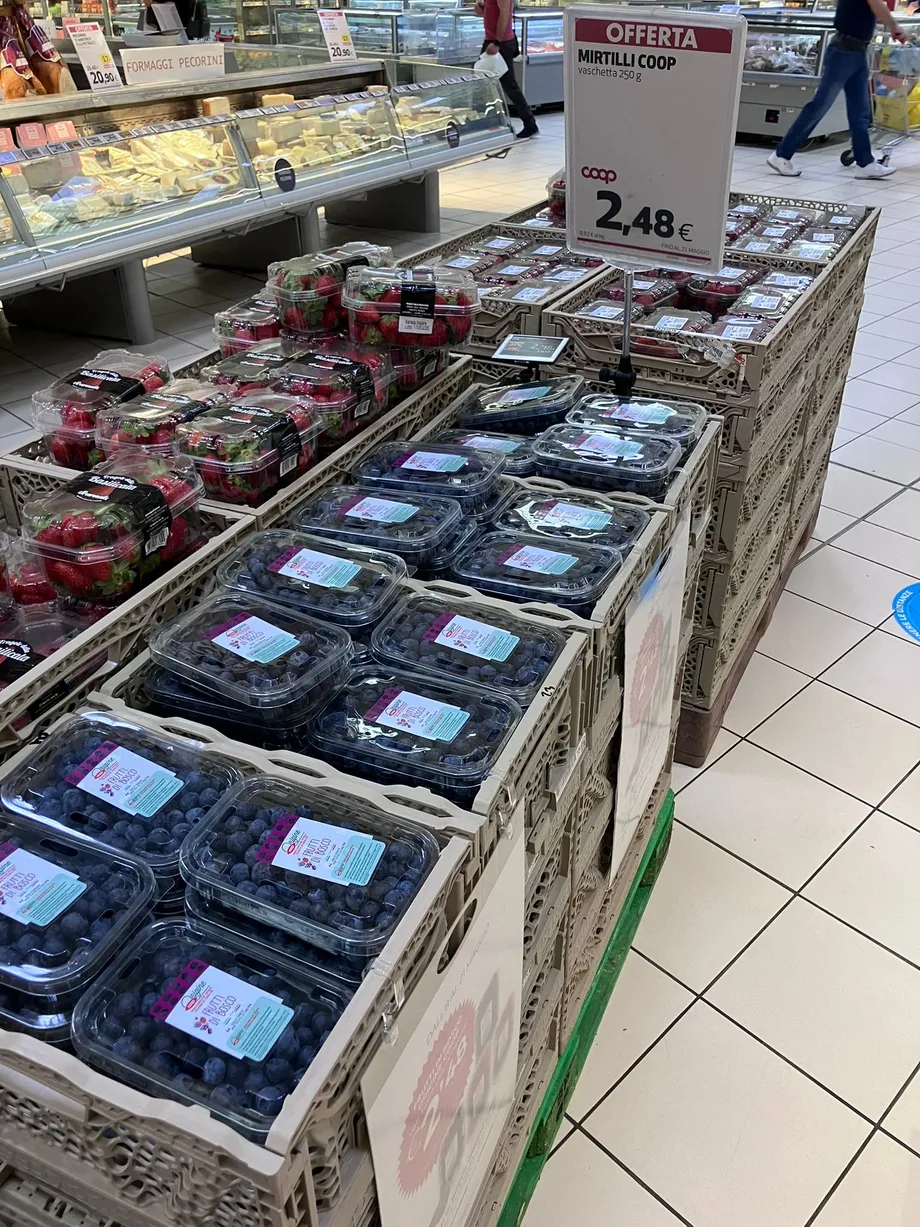
Today, especially in blueberries, which Ferrari defines as the driving category within berries, Coop Italia also works with formats of 300 grams and above. This shift confirms that the product has become a stable presence in Italian purchasing habits.
The larger format responds to a less occasional and more continuous form of consumption. Customers no longer buy the product only because they see it on the shelf, but include it in a regular shopping logic. As a result, the offer also needs to adapt to broader and more recurring consumption.
The priority: ensuring consistent product availability
In Coop Italia’s strategy, the key lever is no longer promotion alone. Ferrari stresses that today the most important thing is having the product, meaning guaranteeing constant availability and adequate assortment depth.
Assortment depth must offer consumers a wide range of purchasing, consumption and usage options. It is therefore not just a matter of displaying berries, but of maintaining a sufficiently broad and continuous offer over time.
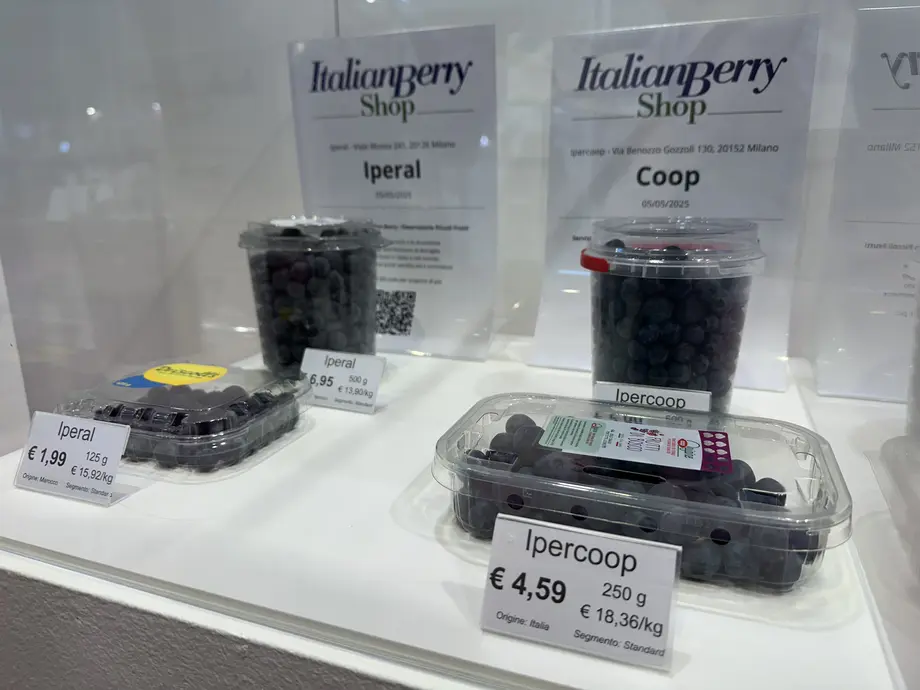
Price remains an important lever, but it is no longer as decisive as it was in the past. According to Ferrari, the price variable can still have an impact in certain contexts, but it no longer represents the central element of the commercial strategy.
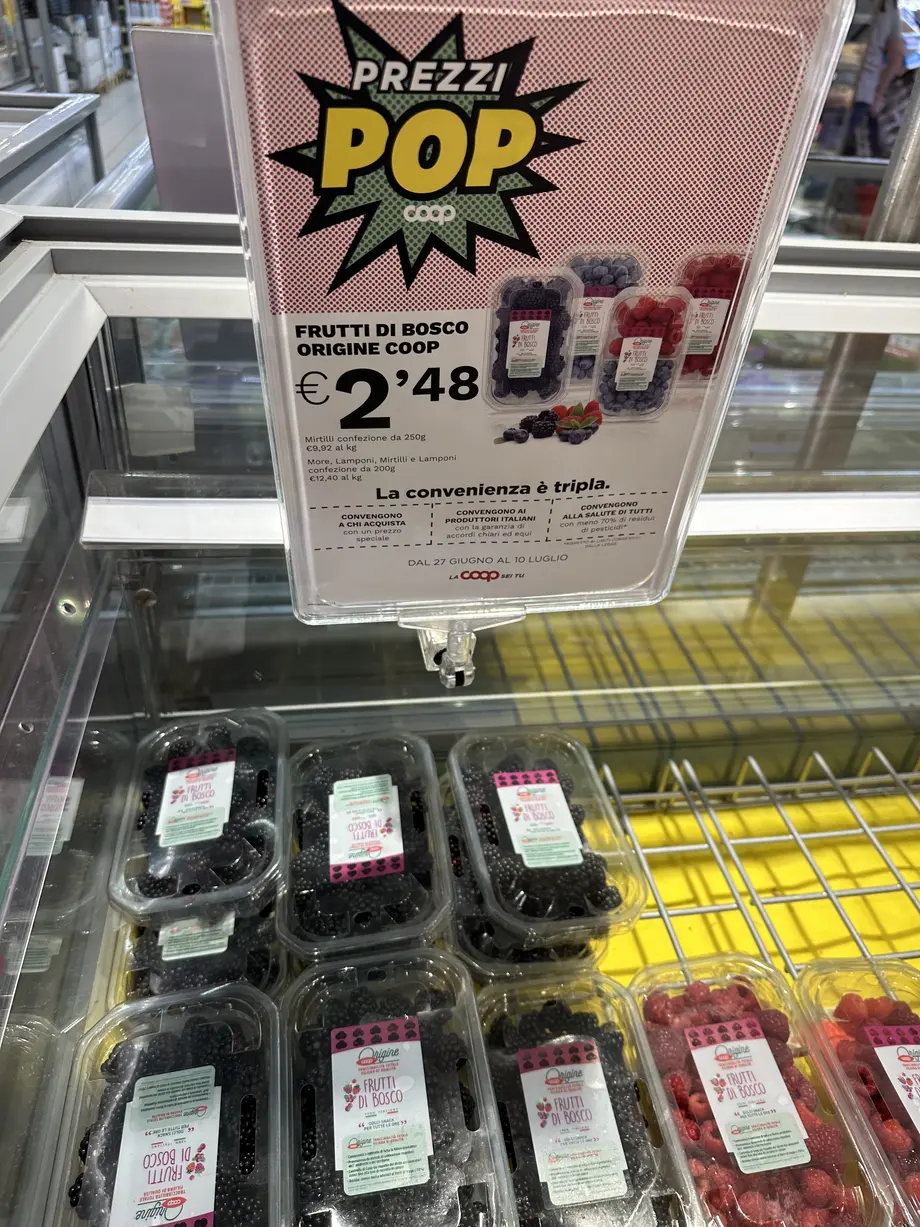 Photo: Italian Berry archive (2024)
This is particularly true for blueberries, a category that over the course of the twelve months experiences peaks, volume instability and price fluctuations. These dynamics make it difficult to build a stable pricing policy over time. In this scenario, for Coop Italia it becomes a priority to guarantee continuous product availability.
Ferrari does not dwell on quality as an accessory lever, because he considers it a prerequisite. But precisely from this assumption, he states that continuity of product availability is now decisive.
Targeted promotions, not the main lever
According to Ferrari, promotional activities still have a role, but they must be used in a targeted way: at specific times and on specific pack sizes.
Promotion is therefore not excluded from Coop’s strategy, but is repositioned in a more selective role. It is no longer the main lever for developing the category. The priority is to build a stable presence, with available product, deep assortment and formats consistent with new consumption behaviours.
Berries and strawberries: two categories to be read separately
Ferrari clearly distinguishes the path of berries from that of strawberries. The two categories, although close in consumers’ perception, follow different dynamics.
Berries are still a growing category, with margins that Ferrari describes as “impressive” in terms of gaining ground and increasing sales. The market has stabilised and can already rely on loyal customers, but there is still a segment of consumers to be won over.
 Source: Italian Berry archive (2025)
The outlook is therefore expansive: new customers can approach the consumption of berries and, if satisfied, return to purchase them. For this reason, Ferrari considers the category still destined for significant growth.
The situation is different for strawberries, which represent a more stable and mature market. In this case, growth depends less on category discovery and more on consumer trust.
Strawberries: quality, varieties and format make the difference
On strawberries, Ferrari observes that in recent years the price lever has not proved to be fundamental. What really matters is product quality.
When Coop Italia offers a product even at a higher price, but with a consistent quality level, consumers respond positively. Ferrari cites as an example the development and success of the retailer’s own-brand top-of-the-range line, describing it as representative of this dynamic.
For strawberries, three elements are essential: choice of varieties, product quality and sales format.
In particular, Ferrari refers to the success of the single-layer format, i.e. the “displayed” product, where the customer can see the whole pack and all the fruits inside it. According to Coop Italia’s results, this format has achieved a good level of success because it increases the transparency of the offer and strengthens consumer trust.
According to Ferrari, the strawberry market will continue to be stable and with fewer surprises than berries. What will make the difference will above all be quality: a satisfied customer comes back, even if the product costs a little more.
Blueberries: the issue of varietal variability
A central part of Ferrari’s speech concerns the issue of blueberry varieties. The comparison with strawberries is significant: in the strawberry world, customers are now able to identify more precisely the varieties that guarantee a certain result and a certain level of satisfaction.
In blueberries, this is not yet possible. Ferrari describes the market as characterised by a “potpourri” of varieties, both in national production and in imports. This diversity of supply depends on many factors: production capacity, periods of the year and growing areas.
There is not, Ferrari stresses, one variety suitable for all periods or for all growing areas. However, the strong differentiation encountered by consumers over time has generated a lack of consistency in perceived quality, which may have represented a brake on the development of the category.
The future strategy: selecting more consistent varieties
According to Ferrari, both production and distribution are working on this issue. The fact that several modern retail operators have raised the topic indicates that varietal selection has become a strategic matter.
For the future, at least as far as national production is concerned, the goal is to select varieties as much as possible, reducing fluctuations in taste, size and crunchiness.
This alternation can create confusion for the final customer. A consumer who experiences very different quality levels from one purchase to the next struggles to build a stable relationship with the product. For this reason, Coop Italia identifies quality consistency as one of the essential conditions for further consolidating the category.
Distribution and production can therefore focus on the choice and identification of varieties capable of offering greater guarantees. Ferrari stresses that these choices must not be driven solely by yield, but must aim for quality.
Price is important, but quality is more important
The summary of Coop Italia’s position is clear: price remains important, but quality is more important.
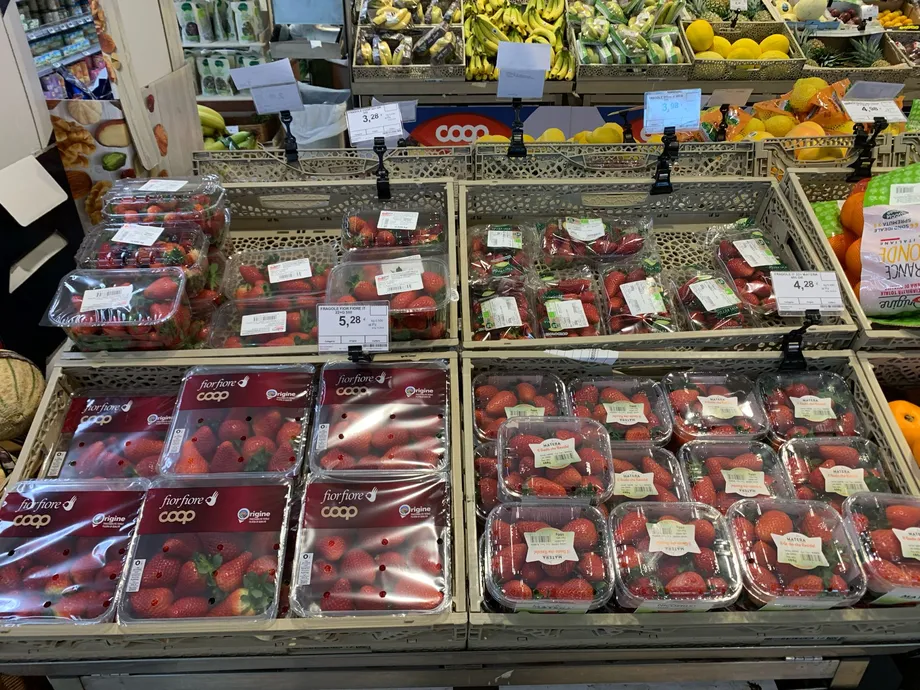 Photo: Italian Berry archive (2024)
This principle applies both to strawberries and to berries, but it takes on a particularly strategic role in blueberries, where varietal and quality variability can directly affect consumer satisfaction.
For Ferrari, the main move to further strengthen the category is therefore to work on targeted choices: raising the quality level, making it more consistent over time and reducing variability in the consumption experience.
From this perspective, Coop Italia’s strategy for berries is based on several pillars: product continuity, assortment depth, formats consistent with habitual consumption, selective promotions, focus on quality and greater varietal rationalisation.
The category has already become a stable part of Italians’ shopping baskets. The challenge now is to make it grow further, transforming the stability achieved into a stronger, more recognisable and more reliable relationship between product, retailer and consumer.