











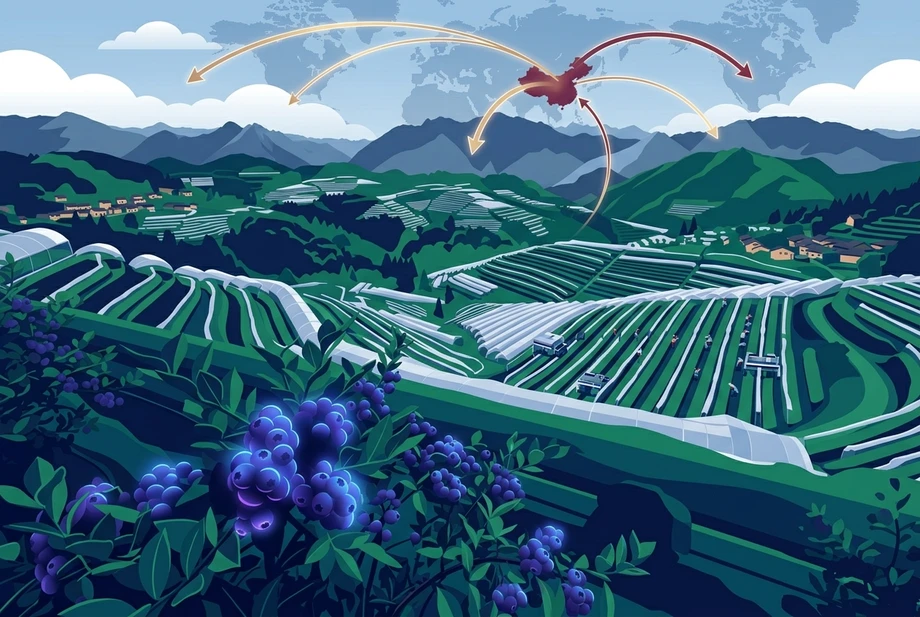
China’s blueberry industry is projected to exceed 1.2 million tonnes by 2029, while the country’s first historic exports to Asian and neighbouring markets are beginning to gain momentum.
The global blueberry industry is witnessing a phenomenon unprecedented in both scale and speed: the expansion of China. Historically focused on meeting its vast domestic demand, the Chinese industry has now reached a level of production maturity that is driving the country’s strong debut on international markets, transforming it from a net importer into a formidable competitor in global export channels.
Data from the IBO Global Blueberry Report 2026 show that China is no longer merely a destination market, but the new centre of gravity of global production.
The report (294 pages – in English) can be downloaded free of charge from the IBO website.
Breaking the 100,000-hectare barrier and “brute force” growth
In 2025, China reached a historic milestone with 102,251 planted hectares, twice the area recorded in the United States, which stands at 51,678 hectares, and accounting for almost one-third of the world’s entire cultivated area.
Total production reached 753,470 tonnes (753.47 thousand tonnes), representing a significant increase from the 638,580 tonnes recorded in 2024.
This extraordinary increase is being fuelled by what analysts describe as “brute force” growth, with 86% of the rise in global volumes driven by the planting of new hectares and only 14% by improvements in agronomic yields per hectare.
By 2029, Asia-Pacific is expected to become the world’s fastest-growing macro-region (+60%), while China alone will exceed 1.2 million tonnes of cultivated blueberries, accounting for approximately 94% of the region’s total production.
China’s export debut: entering the global Top 15
The most disruptive aspect of the Chinese market’s evolution is its sudden emergence as an exporter. In 2025, China officially entered the ranking of the world’s 15 largest exporters of fresh blueberries, overtaking established producing countries such as Romania, Ukraine, Serbia and Zimbabwe.
Chinese fresh blueberry exports reached 7,100 tonnes in 2025. Although this volume remains modest compared with national production, it has opened strategic trade channels that can help relieve pressure on the domestic market. China has already become the fifth-largest exporter of fresh blueberries to Asian destinations by volume and the third-largest by value.
Trade flows show a clearly defined geographical distribution towards neighbouring markets and Eurasia:
- Hong Kong: remains the leading destination, receiving 2,390 tonnes.
- Malaysia: received 1,130 tonnes.
- Singapore: imported 930 tonnes.
- Russia (Siberia and the Moscow market): recorded significant volumes amounting to 870 tonnes.
- Kyrgyzstan: imported 700 tonnes.
Data from the first months of 2026 confirm this acceleration: in March and April, Chinese shipments to Southeast Asia set two consecutive monthly records.
Although they remain lower in volume than Peruvian exports to the region, the gap is narrowing considerably in value terms. This indicates a genuine possibility that China could eventually challenge Peru’s commercial leadership in high-purchasing-power Asian markets.
The role of Yunnan and the “democratisation” of blueberries at home
The driving force behind this revolution is the south-western province of Yunnan, China’s leading hub for the cultivation of low-chill blueberries (Southern Highbush). If Yunnan were an independent country, it would rank firmly among the world’s top five producers of fresh blueberries.
Expansion in the region appears unstoppable, with an estimated 7,000 to 10,000 hectares of new plantings in 2026 alone.
However, the sudden influx of enormous volumes of fruit from Yunnan has generated strong downward pressure on domestic prices, particularly before and after the Chinese New Year holiday period. This decline in prices has triggered an interesting dynamic involving the “democratisation” of consumption.
In the past, blueberries were sold almost exclusively in premium supermarkets in wealthy coastal cities at prohibitively high prices. Today, they can commonly be found at street stalls at prices affordable to average consumers, including in inland areas. This represents a crucial turning point for a country where annual per capita consumption has historically been low, at approximately 200 grams.
From an agronomic perspective, China presents a varied mosaic. In addition to Yunnan, production is expanding in Sichuan province (Xichang), which is characterised by later harvests, and in Guizhou province, which has the largest cultivated area but mainly produces rabbiteye varieties destined for the juice and processing industries, with limited impact on the fresh market.
In the north-east, particularly in Liaoning and Shandong, summer production of Northern Highbush must contend with an unstable monsoon climate and intense technological competition.
B2B implications for the international industry
For the international berries industry, China’s transformation is creating an immediate domino effect. As Chinese producers refine their quality standards and improve the cold chain serving neighbouring countries such as Singapore, Thailand and Vietnam, major Southern Hemisphere exporters—led by Peru—will have to redefine their trade routes and diversify their markets.
With China’s domestic production advancing rapidly towards greater stability and the export of late-season surpluses, competition in Asia is set to become one of the most complex challenges facing global blueberry players over the next four years.
Italian Berry – All rights reserved