











From Yunnan to China’s major metropolitan areas, the blueberry has become a symbol category of the new agri-food live commerce. On Douyin, thousands of creators sell the product live, while an increasingly integrated supply chain makes the commercial promise of next-day delivery possible.
In China, blueberries do not grow only in the fields. They also grow in the algorithms. On Douyin, the Chinese version of TikTok and one of the country’s leading live commerce platforms, the product has become a high-speed category, sold through short videos, live streaming, territorial storytelling and fast deliveries to major cities.
The phenomenon is relevant not only because of the size of the Chinese market, but also because it points to a possible evolution in the commerce of berries: fresh produce is no longer simply displayed on the shelf, but narrated, tasted, sold and shipped within the same digital ecosystem.
According to a report released by Douyin E-commerce, more than 42 million blueberry orders were sold on the platform over the past year, with a value exceeding 2.4 billion yuan (about 288 millions). Orders increased by 122% year-on-year, while sales value rose by 94%. Over the same period, 32,536 creators sold blueberries on the platform, up 79%, while 7,260 merchants generated revenue from the category.
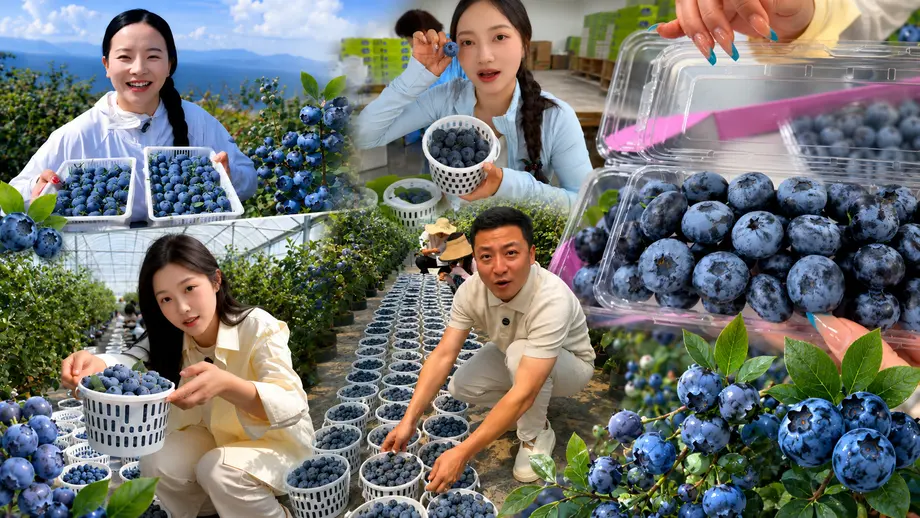
Yunnan at the centre of the boom
The productive and narrative heart of this phenomenon is Yunnan, the region in south-western China that in recent years has established itself as one of the most dynamic areas for blueberry cultivation.
Yunnan’s competitive advantage is twofold. On the one hand, favourable pedoclimatic conditions and a strategic production window; on the other, growing integration between agricultural production, cold chain, logistics and digital platforms.
Produce Report has reported that Yunnan can harvest and market blueberries from December to July and that, during the Chinese New Year period, it is effectively the only major Chinese origin able to offer high-quality blueberries on a large scale, with a market share of over 90% in that window.
It is therefore no surprise that, according to the Douyin report, Yunnan creators are among the best-performing sellers and that blueberries from this origin account for around 70% of the category’s value on the platform.
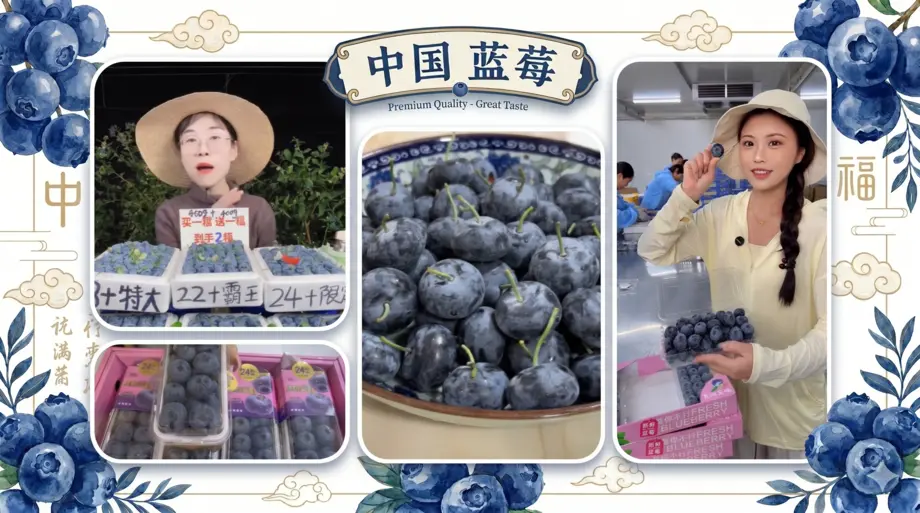
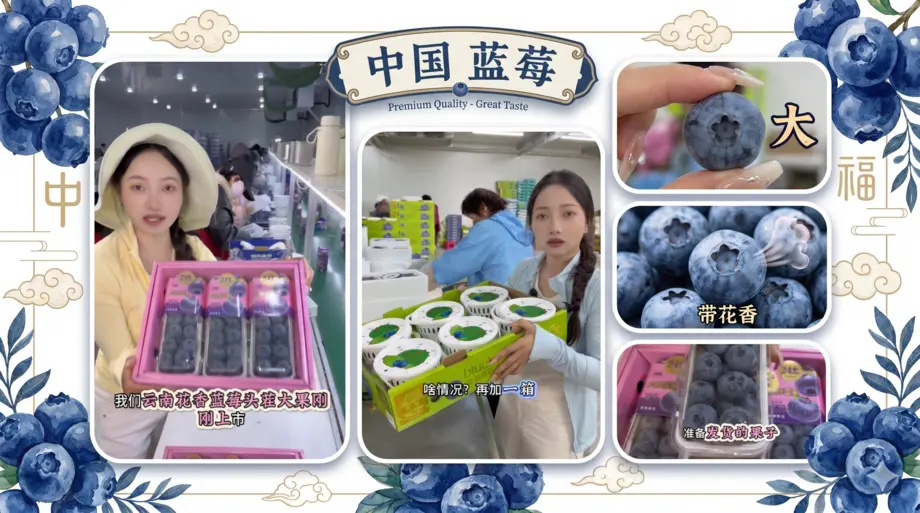
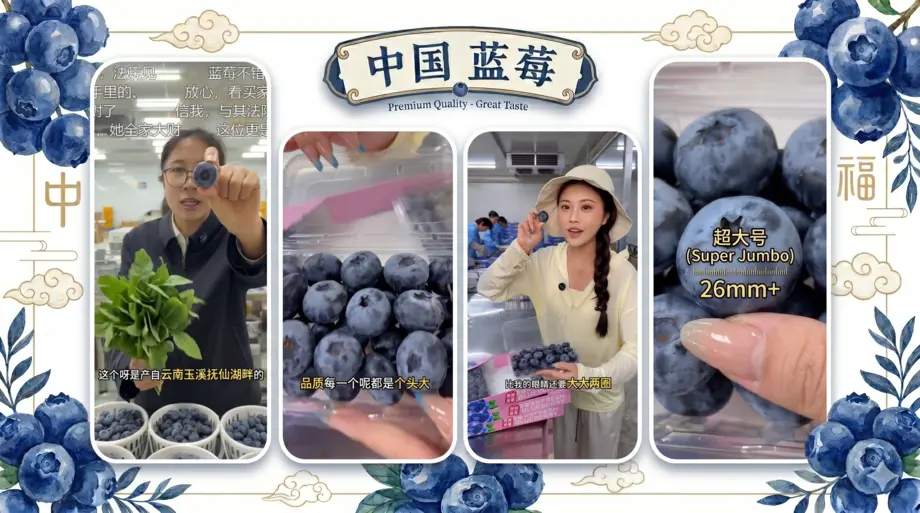
Yunnan’s strength is not only productive. It is also communicative. In videos and live rooms, recurring claims include “Yunnan blueberries”, “flower fragrance blueberries”, “freshly picked”, “direct from origin” and “next-day delivery”. The product is presented not as a generic reference, but as a combination of territory, freshness, taste and convenience.
Who sells blueberries on Douyin
Blueberry sales on Douyin are not handled only by major brands or structured platforms. A significant part of the phenomenon passes through hybrid accounts: producers, farms, small merchants, specialised live rooms and creators who build content around rural life, harvesting and the perceived quality of the fruit.
Among the accounts identified are profiles such as 云南蓝莓大师姐, which can be translated as “Yunnan Blueberry Master Sister”, presenting herself as a Yunnan blueberry grower who uses the platform to tell the story of the product and sell it.
Another significant case is 陆陆蓝莓明日达, “Liuliu Blueberries Next-Day Delivery”, an account that publishes content dedicated to Yunnan blueberries and already uses the logistics claim “明日达” — next-day delivery — in its name. According to ChanMama data, a live session connected to this account, titled “云南蓝莓大降价” — “big price drop for Yunnan blueberries” — reportedly reached 964,000 views, with estimated sales value between 5 and 10 million yuan (between 600.000 € and 1.2 million €)
Also interesting is the case of 抚仙湖蓝莓【泊果鲜仓】, an account linked to blueberries from Fuxian Lake, in Yunnan, which focuses on origin, freshness and territorial storytelling. Other accounts and live rooms use names linked to fast delivery, “flower fragrance” blueberries or direct origin from Mengzi and other blueberry-producing areas of Yunnan.
These examples show that Chinese live commerce is not just a promotional channel. It is a form of integrated commercial communication in which producer, seller, influencer and distribution channel can coincide.
The blueberry becomes a digital impulse product
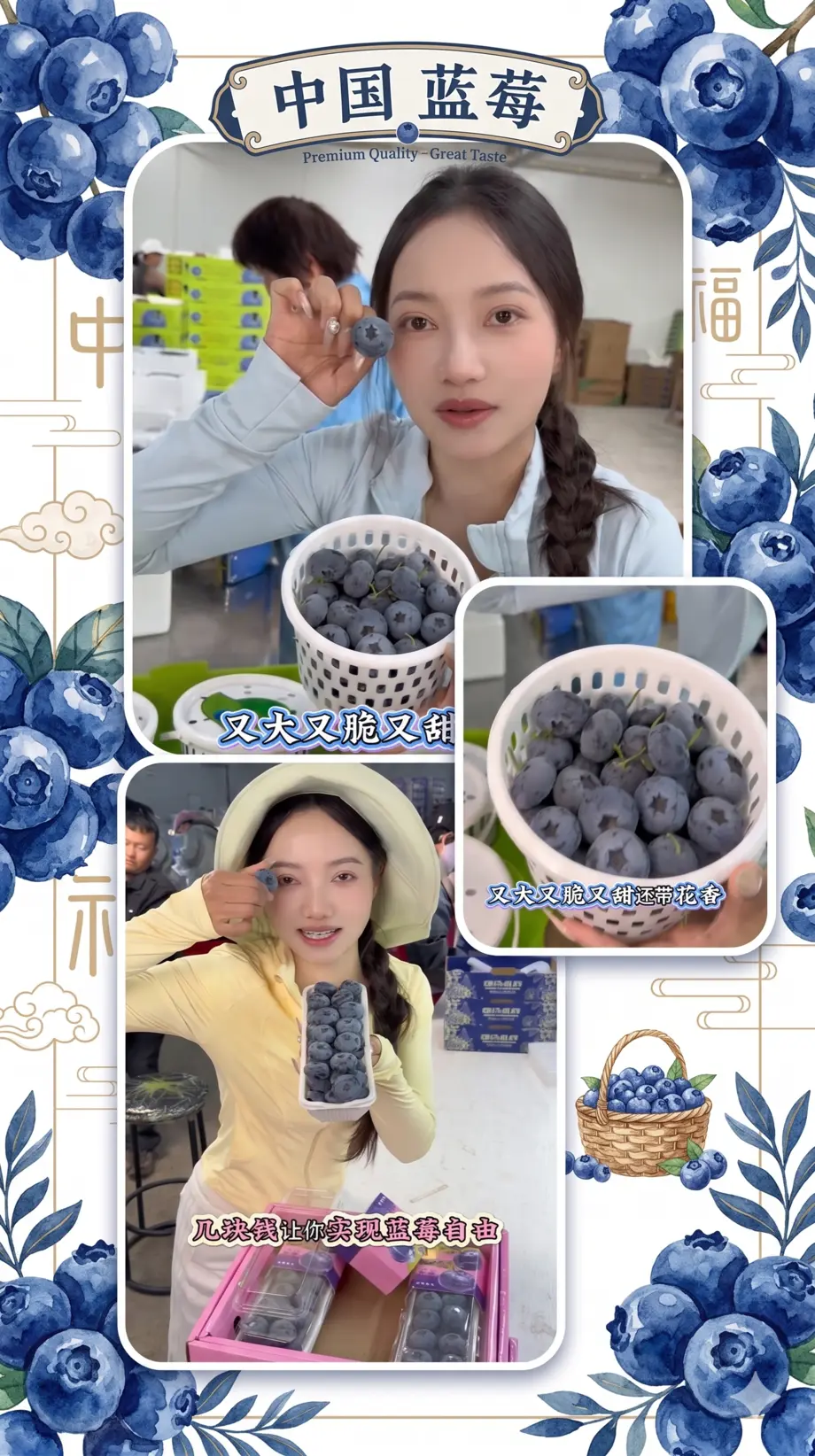
The success of blueberries on Douyin is also linked to the product’s strong visual appeal. The fruit is small, recognisable, easy to show on video and well suited to short-form content: opening packages, live tasting, comparing sizes, harvesting in the field, explaining prices, flash promotions.
Live room sales emphasise very concrete elements: sweetness, crunchiness, size, freshness, price per kilogram, delivery speed and origin. The logic is different from traditional retail: consumers do not encounter the product only on the shelf, but within a dynamic narrative, often led by a person perceived as close to the production area or source.
This approach reduces the distance between field and consumer. The blueberry is narrated while it is picked, weighed, tasted, packed or shipped. In a highly competitive digital market, origin is no longer just information on a label: it becomes content.
The “明日达” promise: what next-day delivery really means
Many Douyin accounts selling Yunnan blueberries use the expression “明日达” in their name or commercial claims, meaning “arrives tomorrow”. It is a powerful formula, because it turns the blueberry into a product for immediate purchase.
However, this promise must be interpreted correctly. In a country of continental dimensions such as China, 24-hour delivery does not necessarily mean capillary delivery to every part of the country. Rather, it means fast delivery to key areas: large cities, urban clusters, areas served by cargo airports, logistics hubs and high-density last-mile networks.
From Yunnan to cities such as Beijing, Shanghai, Guangzhou, Shenzhen, Hangzhou, Chengdu or Chongqing, distances can easily exceed 1,500 or 2,000 kilometres.
By road, 24-hour delivery would be complex, especially while maintaining product quality. The model therefore works through a hub-to-hub logic: harvesting and pre-cooling near the production area, transfer to a regional or airport hub, rapid transport to a major urban centre and final distribution to the consumer.
The 24-hour supply chain: harvesting, cold chain, hubs and last mile
The most efficient model starts with planned harvesting. Blueberries intended for e-commerce sales are harvested according to expected orders, scheduled live streams and shipping windows. This is therefore not an improvised sale, but a synchronised commercial campaign.
Immediately after harvesting, the decisive step is pre-cooling. For a delicate fruit such as the blueberry, rapidly reducing temperature is essential to preserve firmness, bloom, crunchiness and shelf life. If the product enters the cold chain too late, fast delivery alone is not enough to guarantee quality.
After sorting and packing, the packs are transferred to regional or airport logistics hubs. From there, the product can travel on rapid routes, often also by air, to major cities where the last mile is managed by urban networks already accustomed to fast deliveries of fresh products.
The 24-hour delivery of blueberries in China is therefore not logistical magic. It is the result of a supply chain designed to minimise downtime between harvesting, cooling, shipping and delivery.
The role of the cold chain
Speed alone is not enough. The critical point is temperature control. Chinese cold chain services, such as those offered by specialised operators like SF Express, combine refrigerated transport, temperature-controlled warehouses, dedicated packaging and priority delivery.
SF Express presents cold chain services for fresh products with interprovincial “next day” or “third day” deliveries, while nationwide delivery times can vary from 2 to 5 days depending on the destination. This confirms that next-day delivery is possible, but only on certain routes and with an adequate logistics network.
For blueberries, the cold chain is particularly relevant because the product has a high unit value, relatively low weight and a format compatible with e-commerce shipments. Packs of 125, 250 or 500 grams can support higher logistics costs than heavier fruits with a lower value per kilogram.
Not all of China is served in the same way
The promise of 24-hour delivery must therefore be read carefully. It is more likely in first- and second-tier cities, where demand, infrastructure, population density and last-mile capacity make the service sustainable.
In secondary cities, inland areas or remote zones, delivery times can easily extend to 48 or 72 hours. This does not reduce the value of the model, but clarifies its real perimeter: the claim “arrives tomorrow” works above all when the supply chain has already defined with precision served areas, cut-off times, product availability and logistics routes.
In other words, live sales do not promise the same logistics performance across the entire country. They promise speed where the platform, merchant and courier know they can guarantee it.
Live commerce anticipates and concentrates demand
One of the most interesting aspects of the Douyin model is its ability to anticipate and concentrate demand. A live stream is not only a communication event: it is also a commercial planning tool.
The merchant knows in advance the sales window, available product, promotional price, maximum number of manageable orders and the areas where fast delivery can be guaranteed. The live stream therefore becomes a moment of immediate demand aggregation, useful for selling large volumes in a short time.
This is particularly important for a category such as blueberries, which in some weeks can experience strong commercial pressure. When supply rises rapidly, live commerce makes it possible to turn a production peak into a high-speed sales campaign.
Price remains a decisive lever
The blueberry boom on Douyin is also taking place during a phase of strong growth in domestic Chinese supply. Produce Report reported that, at the end of March 2026, Chinese blueberries were at peak supply, with the main producing areas of Yunnan entering large-scale harvesting and prices falling sharply.
Live commerce amplifies this dynamic. Titles such as “big price drop for Yunnan blueberries” or claims of immediate convenience are frequent in live streams. The platform makes it possible to turn a temporary oversupply into a rapid sales campaign, with promotions, urgency and high volumes.
This aspect is crucial to understanding the Chinese model: Douyin is not only used to build brands, but also to move product, accelerate rotation and manage very short market windows.
Origin, freshness and price: the three levers of the Chinese model
The success of Yunnan blueberries on Douyin is based on three main levers: origin, freshness and price.
Origin is central because Yunnan is presented as a well-suited territory: favourable climate, altitude, fresh product, local harvesting. Freshness is made credible by the logistics promise: harvested today, shipped immediately, delivered tomorrow in served cities. Price, finally, is used as a conversion lever, especially during phases of abundant supply.
In many live rooms, commercial claims focus precisely on these elements: Yunnan blueberries, freshly picked product, “flower fragrance blueberries”, fast delivery, limited promotion, convenient price. The combination creates urgency and reduces the psychological distance between producer and consumer.
An increasingly industrialised supply chain
Behind the apparent simplicity of the live room lies a supply chain undergoing rapid industrialisation. In Yunnan, farms, investors, platforms and post-harvest service providers are building an increasingly integrated production system.
Among the most important operators is Noposion, which has invested heavily in blueberry production in Yunnan. According to Produce Report, in the 2024/25 season the company had 28,000 mu in production, equal to around 1,867 hectares, with sales exceeding 2 billion yuan (€ 240 millions). For the 2025/26 season, the production area increased to approximately 36,000 mu, or around 2,400 hectares.
The company has also built more than 60 farms and over 40 processing centres with cold chain facilities in several prefectures of Yunnan, including Honghe, Wenshan, Chuxiong, Pu’er, Baoshan, Dehong, Dali and Xishuangbanna.
The growth of the Chinese blueberry sector is therefore not only about increased acreage. It is about the ability to connect production, sorting, packaging, cold chain, digital communication and direct sales. It is this integration that makes an aggressive commercial promise such as 24-hour delivery possible.
Why blueberries are better suited than other fruits
Not all fruit and vegetable products are suitable for this model. Blueberries have very favourable characteristics: they are light, compact, visually recognisable, high-value per kilogram and easy to communicate on video.
In live rooms, the seller can show size, colour, bloom, crunchiness and juiciness in just a few seconds. They can taste the product live, compare different sizes, explain the origin and launch an immediate promotion. The consumer sees, listens, evaluates and buys within the same digital environment.
In this sense, 24-hour logistics is not separate from communication: it is part of the commercial promise. The message is clear: fresh product, harvested at origin, shipped quickly and delivered almost as if it were a local purchase.
What the European sector can learn
For the European berries sector, the Chinese case offers at least three points for reflection.
The first concerns logistics as part of perceived value. In Europe, origin, sustainability and quality are often discussed, but speed and precision of delivery are less frequently treated as central elements of the commercial proposition. In China, by contrast, the logistics promise is an integral part of the sales message.
The second concerns direct storytelling. Yunnan blueberries are narrated through faces, fields, crates, tastings, promotions and real-time interactions. The consumer does not see only a package, but a supply chain that puts itself on stage.
The third concerns the ability to use digital not only to communicate, but to convert demand immediately. The live room is not a showcase: it is a point of sale, a promotional channel and a volume-management tool.
For the European sector, the message is clear: the value of blueberries is not built only in the field or on the shelf, but also in the way they are narrated, shown and made purchasable.
A model that cannot be automatically replicated, but should be watched closely
The Chinese model cannot be copied wholesale in Europe. Platforms are different, consumers have different habits, modern retail has a more structured role and regulations are more fragmented.
However, the underlying principle is relevant: the future of blueberries will not depend only on agronomic quality, but on the ability to connect that quality to a fast, understandable and credible commercial supply chain for the consumer.
The 24-hour delivery of blueberries in China is not a miracle. It is the result of a supply chain that combines concentrated production, pre-cooling, cold chain, urban hubs, digital platforms and demand aggregated in real time.
In an increasingly competitive market, this integration can make the difference. Because consumers do not buy only a punnet of blueberries: they buy freshness, origin, trust and immediacy.
And in China, more and more often, all this happens live.