




Blueberry production depends heavily on pollination, a process increasingly constrained by environmental conditions and declining pollinator availability.
This study focuses on facultative parthenocarpy in blueberries, a trait that allows fruit set without fertilization and could help stabilize yields under pollination stress.
Despite its promise, breeding parthenocarpic blueberries has been limited by the complexity and cost of large-scale phenotyping, making improved genomic tools a priority.
Genetic study and breeding approaches
Published in Horticulture Research in 2025, the research was conducted by teams from the University of Florida and the Federal University of Viçosa.
The authors carried out genome-wide association studies (GWAS) on two southern highbush blueberry breeding populations to identify genetic markers linked to parthenocarpic fruit set.
They also evaluated three molecular breeding approaches: genomic selection (GS), GS de novo GWAS (GSdnGWAS), and in silico marker-assisted selection (MAS).
Key findings: 55 markers and predictive models
The study identified 55 marker–trait associations related to parthenocarpy, involving genes linked to phytohormone pathways, cell cycle regulation, and seed development.
Significant and consistent associations were found on chromosomes 6, 7, and 11 across populations.
When comparing breeding strategies, GSdnGWAS showed the highest predictive accuracy, outperforming both standard GS and MAS.
Incorporating GWAS-derived markers into genomic selection models further improved prediction performance.
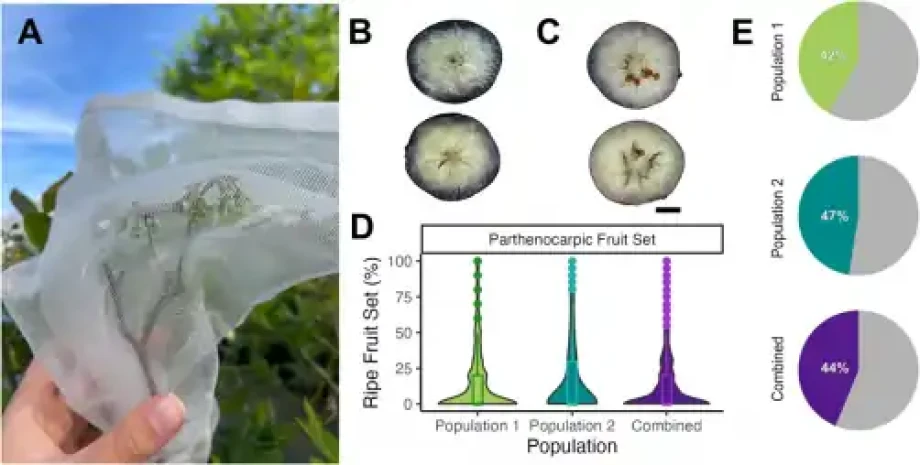
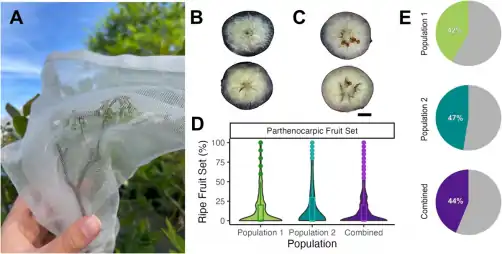 Image 1. Assessment of parthenocarpy in two southern highbush blueberry breeding populations. (A) The parthenocarpy treatment included emasculation of flowers and exclusion of pollinators for 10 flowers of each genotype to prevent any possibility of pollination or fertilization. (B) Facultative parthenocarpic genotypes yielded seedless fruits after emasculation treatment. (C) The same genotype yielded seeded fruits from open pollination in untreated flowers. (D) The raw phenotypic distribution of parthenocarpy for independent and combined populations is presented in a violin plot. (E) Pie charts illustrate the proportion of individuals in each population displaying parthenocarpic fruit set of ≥10%.
Impact on breeding and sustainability
Overall, the results demonstrate that GSdnGWAS can substantially accelerate the development of parthenocarpic blueberry cultivars.
These tools offer a more efficient and resource-saving approach for breeding programs and could support the creation of blueberry varieties better adapted to pollination shortages and climate-related challenges.
This approach reduces reliance on external pollination services while maintaining yield and reliability.
Text and image source: www.newswise.com