






Summary of the presentation "Soil or substrate? Designing a modern production system for blueberries" by Marco R. Butera (BetterBerries), delivered as part of the Berry Area 2026 event programme at Macfrut.
The transition towards intensive, high-precision production systems is now a crucial factor for the competitiveness of the Italian blueberry supply chain.
In a country where soils are often calcareous and poorly suited to the strict physiological requirements of the crop, the choice between soil cultivation and substrate cultivation can no longer be viewed as a simple agronomic option.
It has instead become one of the main drivers of financial sustainability, risk management and long-term production capacity.
Analysing blueberry root physiology, the impact of investment costs and the critical issues involved in substrate management is therefore essential for growers, technicians and investors planning to develop new orchards sustainably.
Key takeaways
1. Substrate cultivation requires more capital, but improves return on investment.
Investing in substrate cultivation involves a CAPEX approximately 40,000-50,000 euros per hectare higher than soil cultivation, but it can halve the payback period, from 12 to 7 years, and double cumulative net profit over 15 years, reaching around 360,000 euros per hectare.
2. Blueberry root physiology imposes very strict constraints.
Blueberries have no root hairs and develop ultra-fine roots that renew every 3-4 months. Planting in soils with a pH above 6.2 and active lime above 1% can reduce yields by up to 40%.
3. Substrate cultivation eliminates the buffering capacity of soil.
Substrate systems amplify both performance and errors. They require water of known quality, proportional fertigation and daily monitoring of pH and electrical conductivity to prevent immediate root damage.
4. Labour shortages must guide orchard design.
New orchards must be accessible, rationally designed and prepared for mechanised harvesting, adopting varietal diversification strategies to smooth seasonal labour peaks.
5. Copying foreign models without local adaptation is a critical mistake.
Replicating production schemes developed in other contexts without considering local hydrochemistry, or using poor-quality substrates to reduce initial costs, can lead to the technical and financial collapse of the orchard within a few years.
What emerges from the presentation
Blueberry physiology allows no compromise and represents the real architectural constraint of every new orchard.
The plant has no root hairs and relies on ultra-fine, highly sensitive roots that renew every three or four months. This characteristic makes it particularly vulnerable to water, salt and chemical stress.
This biological limitation directly clashes with the Italian soil reality. Soils genuinely suited to blueberries, with a pH between 4.5 and 5.5 and active lime below 1%, are exceptions, concentrated mainly in mountain or pre-Alpine areas.
In many growing areas, the available soil instead has characteristics that are incompatible with the crop’s requirements, making rigorous technical assessment essential before any investment.
Browse and download the original presentation
Unsuitable soil is not a secondary issue
In blueberries, unsuitable soil does not simply reduce production efficiency: it can compromise the entire economic sustainability of the orchard.
High pH, active lime, waterlogging, compaction and salinity act directly on the root system, generating chlorosis, chronic stress and yields below expectations.
Why soil can become a false saving
Persisting with planting in unsuitable soils, driven by the apparent logic of saving on initial costs, can become a strategic mistake.
In the presence of carbonates and with pH levels above 6.2, the plant struggles to absorb essential elements correctly, especially iron, resulting in chronic chlorosis and production losses.
Under these conditions, a significant part of the plant’s energy is used to try to regenerate a root system that is continuously stressed or neutralised by the soil context.
The result can be a yield collapse of up to 40%, with investment payback periods becoming difficult to sustain.
Especially in the presence of compact, alkaline soils or complex water management conditions, substrate cultivation therefore ceases to be an advanced technological option and becomes a necessary technical solution.
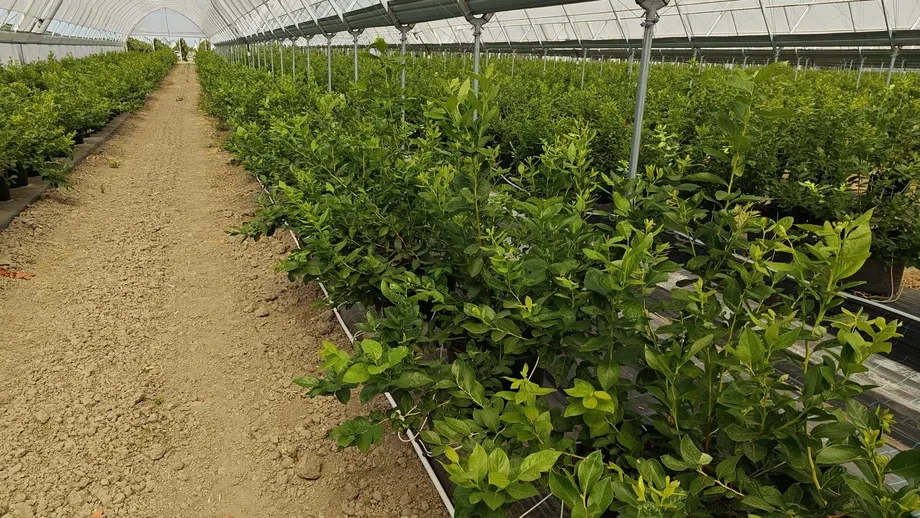
Substrate cultivation: more control, but less margin for error
The move to substrates requires a radical shift in management approach.
By eliminating soil, its buffering capacity is also removed. This means that a substrate system is far more reactive: it can generate high performance, but it immediately amplifies mistakes.
Irrigation, fertigation, pH and electrical conductivity must be managed with daily precision. A failure in the acid pump, water that has not been properly characterised, or a non-proportional nutrient recipe can cause root damage very quickly.
In this context, substrate quality becomes a determining factor. Inadequate mixes, selected only to reduce initial cost, can degrade rapidly, retain too much water, reduce oxygenation and lead to root asphyxia.
| Critical factor | Operational risk | Technical response |
|---|---|---|
| High soil pH | Chlorosis, poor nutrient uptake and reduced yields. | Preliminary soil analysis and assessment of substrate cultivation in unsuitable areas. |
| Active lime | Nutritional blockage and chronic root stress. | Avoid soil planting beyond critical thresholds; design substrate systems. |
| Uncharacterised water | Fertigation errors, salinity and pH instability. | Hydrochemical analysis, controlled acidification and proportional fertigation. |
| Poor-quality substrates | Physical collapse, root asphyxia and loss of productivity. | Use stable, tested substrates consistent with the duration of the investment. |
| Harvest peaks | Pressure on labour and increased operating costs. | Varietal diversification and orchards designed for accessibility and mechanisation. |
The economic reading: CAPEX does not tell the whole story
The integrated financial analysis clarifies the real dimensions of the choice between soil and substrate cultivation.
A complete substrate-based orchard requires an initial investment approximately 40,000-50,000 euros per hectare higher than a soil-based orchard.
Read in isolation, this figure may make substrate cultivation appear more expensive. However, the assessment changes when productivity, time to full production, soil-related risk and cumulative profit are taken into account.
Substrate cultivation can allow full production as early as the third year, reaching up to 15 tonnes per hectare, compared with around 9 tonnes per hectare estimated for soil cultivation under less favourable conditions.
This production differential reduces the capital recovery period to around seven years, compared with twelve years for soil cultivation, and can lead to an almost doubled cumulative net profit over fifteen years.
The real cost is underperformance
In blueberries, a lower initial investment does not always coincide with the most economical choice.
If the soil reduces yields, quality and orchard longevity, the initial saving can quickly be cancelled out by lower production, slower returns and greater technical instability.
Labour: designing today for tomorrow’s harvest
Agronomic and financial challenges are compounded by the labour emergency.
Blueberries remain a labour-intensive crop at harvest, and the availability of skilled workers is increasingly uncertain, especially during seasonal peaks.
For this reason, new orchards must be designed from the outset to maximise accessibility, operating efficiency and compatibility with possible mechanised harvesting systems.
Extreme slopes, poorly rationalised rows, inadequate planting densities and varieties concentrated within the same production window increase labour pressure and reduce farm flexibility.
Varietal diversification therefore becomes not only a commercial tool, but also an organisational one: it makes it possible to spread volumes, flatten harvest peaks and make workforce management more sustainable.
The risk of copying foreign models
One of the most frequent mistakes is to replicate foreign production models without adapting them to local conditions.
A system developed in a country with different water, climate, substrates, technologies and costs cannot be transferred automatically to another production context.
In substrate cultivation, local hydrochemistry is decisive. Water composition, alkalinity, acidification management and the substrate’s response over time directly affect root development and orchard stability.
Neglecting these elements means building a system that may appear modern, but is technically fragile.
Productivity starts with system design
The central message is that blueberry productivity does not derive from a single component.
It is not enough to choose a high-performing variety, buy a substrate or install a fertigation system. The result depends on the coherence of the entire system: water quality, substrate, containers, nutritional management, drainage, varieties, layout, labour and commercial objective.
In this sense, substrate cultivation can represent a highly effective platform for the Italian supply chain, but only if it is designed and managed with the right expertise.
Otherwise, the same technology that makes it possible to increase yields can accelerate errors and compromise return on investment.
In summary
The choice between soil and substrate cultivation in blueberries is a strategic decision that affects productivity, risk, invested capital and long-term profitability.
In a country such as Italy, where genuinely suitable soils are limited, substrate cultivation often emerges as the most rational solution to overcome soil constraints and achieve competitive production standards.
The higher initial capital intensity must, however, be accompanied by technical design, daily parameter control, substrate quality, accurate water management and orchards planned around labour scarcity.
Only an integrated approach can transform substrate cultivation from an additional cost into a concrete profitability lever for Italian blueberries.