










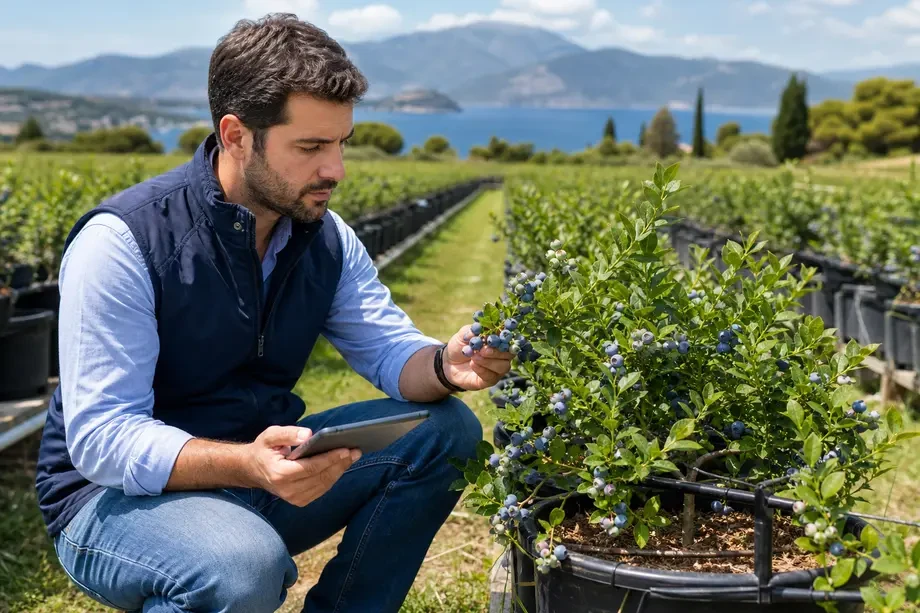
Presentation by Jorge Duarte, agronomist and owner of Hortitool Consulting, at the FRESKON 2026 Berries Workshop.
Greece is entering a new phase in the development of the berry sector. For many years, strawberries represented the country’s main berry crop, supported by structured growers, export experience and consolidated demand from European markets. Today, however, the scenario is changing: blueberries, raspberries, blackberries and other berries are gaining ground in technical discussions, commercial strategies and new investment plans.
According to Jorge Duarte, agronomist and owner of Hortitool Consulting, this evolution is not accidental. Berries are aligned with some of the strongest trends in the European market: healthy consumption, convenience in fresh fruit, premium packaging, new genetics and high-value export programmes.
In this context, the Berries Workshop at FRESKON 2026, organised in cooperation with Froutonea magazine, comes at a strategic moment for the Greek fresh produce sector. The event held on 25 April 2026 brought together technical presentations, market discussion and a final question-and-answer session with speakers and industry operators.
From industry potential to agronomic precision
Jorge Duarte’s contribution, entitled “Physiology, Stress, and Profitability in Blueberry Cultivation Systems”, focused on a key question for the future of blueberries in Greece and in other emerging production areas: how can plant physiology be translated into profitable crop management?
Blueberries are a high-value crop, but they are not a simple crop. Their profitability depends on decisions made long before harvest: variety selection, root-zone design, irrigation strategy, fertigation balance, soil or substrate management, pruning, crop load, climate control and harvest timing.
When these elements are not aligned, the plant responds with stress. This stress may later appear as weak growth, insufficient fruit size, irregular ripening, lower firmness, reduced pack-out or shorter shelf life. By the time symptoms become visible, part of the margin has often already been lost.
Stress management as an economic lever
For Duarte, the technical future of blueberries must be built around two concepts: precision and prevention. In modern berry production, stress management is not only a physiological issue, but also an economic tool.
A well-balanced plant converts resources into yield, quality and production consistency. A stressed plant, on the other hand, consumes inputs but returns less value. In other words, agronomic precision is not only about vegetative performance, but has a direct impact on profitability, commercial quality and the ability to meet market expectations.
This approach is particularly relevant for Greece. The country has several competitive advantages: proximity to European markets, experience in fresh produce exports, climatic diversity and growing interest in high-value crops. However, the expansion of berries requires technical discipline.
Increasing hectares is not enough
According to Duarte, for Greece it will not be enough simply to increase planted area. The decisive step will be the development of production systems that are technically robust, commercially realistic and adapted to local conditions.
Strawberries have already opened the door. Blueberries, raspberries and blackberries can follow, but only if agronomic decisions are consistently connected with market expectations and the economic performance of farms.
The risk for emerging areas is to interpret berries as a simple crop diversification opportunity. In reality, these are technically intensive crops, where every decision — from variety to substrate, from irrigation to harvest — contributes to determining the final result.
A growth path to be structured
The Greek berry supply chain therefore has the opportunity to move from experimentation to structured growth. This means building expertise, defining coherent production models, selecting suitable areas and systems, and linking agronomic management to commercial objectives.
The future of berries in Greece will not be defined only by how many hectares are planted. It will be defined above all by how well each crop is understood, managed and delivered to the market.
For new production areas, Jorge Duarte’s message is clear: the potential exists, but competitiveness will depend on the ability to transform plant physiology into technical precision, consistent quality and real profitability.