






Fresh strawberries once heralded the arrival of summer, while fresh raspberries and blackberries were rare products associated with specific times of the year.
Today, however, an entire pack of berries can end up in a child’s school snack even in the middle of February.
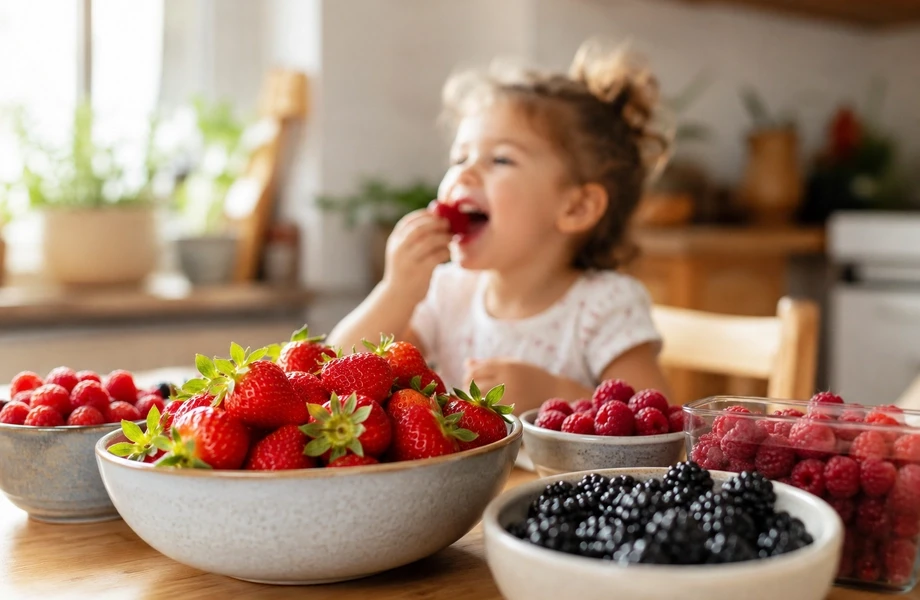
The year-round availability of berries has turned strawberries, blueberries, raspberries and blackberries into everyday snacks, particularly popular among families with children.
Behind this new eating habit are logistical innovations, international trade, new varieties and evolving consumer tastes.
But there are also high costs, compromises in sensory quality and an increasingly tenuous connection with seasonality.
The “berry budget” becomes part of household spending
In recent years, jokes about the financial burden of berries have multiplied on social media.
In April, one parent wrote on Threads that people should not have children without first setting aside an adequate “berry budget”.
In June, another user said that their son had eaten around $20 (€12.45) worth of berries in a single day.
Earlier that month, an Instagram reel showed a kitchen counter covered with strawberries and raspberries, accompanied by the caption: “Why my children will never have a trust fund.”
A cultural shift
From memes about the “berry tax” and jokes about needing to take out a second mortgage to stories of parents struggling with their grocery bills, the topic has become a recurring one.
The humour, however, reflects a much more profound change.
According to Daniel Bender, holder of the Canada Research Chair in Food and Culture and professor of food studies at the University of Toronto, the berry boom encompasses so many cultural transformations that it is difficult to identify them all.
Logistics, trade and new varieties
Over the past 20–30 years, several factors have helped turn berries from seasonal specialities into products available 12 months a year.
Bender points to new packaging technologies, the North American Free Trade Agreement, the development of varieties capable of withstanding long journeys and changing food preferences.
Greater availability, however, comes at a cost that extends beyond the environmental footprint and agricultural working conditions.
According to the professor, varietal selection and the production systems used by large companies tend to prioritise transportability and fruit resilience over flavour.
The compromise on flavour
Growers, breeders and large agricultural companies are therefore willing to sacrifice some of the strawberry’s flavour to obtain fruit capable of withstanding long-distance distribution.
The emotional relationship with food is also changing. Seasonality involves waiting and going without, but it makes the pleasure associated with a product’s return more intense.
If blackberries are also available in January, Bender observes, it becomes more difficult for children to associate them with summer.
Availability in Canada has increased by 237%
Canada does not directly measure berry consumption.
Agriculture and Agri-Food Canada does, however, track food availability, meaning the amount of a product physically present in the country and potentially intended for consumption.
According to these data, the availability of fresh berries has increased by 237% compared with 2000.
At the beginning of the period under review, an average of 3.09 kilograms of fresh berries was available per person.
Per capita availability
By 2025, this figure had reached 10.42 kilograms per capita.
Strawberries accounted for around one-third of the total berry availability in 2025.
However, the expansion was driven primarily by increases in blueberries, cranberries and the “other berries” category, which includes raspberries, loganberries, mulberries, blackberries, currants, gooseberries and Saskatoon berries.
Over the same period, other fruits traditionally found in Canadian households lost ground.
The decline of other fruits
Per capita availability of oranges fell by 6%, that of apples by 23%, while grapefruit recorded a decline of 64%.
According to a statement provided to CBC News by the International Fresh Produce Association, fresh berries continue to record strong growth in Canadian retail, supported by rising demand and increased reliance on imports.
The phenomenon is not limited to Canada. In the IFPA’s 2026 report on consumer trends, premium fruits, including berries, emerged as the best-performing category globally across the different fruit segments.
Statistics Canada confirmed to CBC News that the increase in availability was largely driven by flows of imported products.
In 2021, for example, the availability of fresh blueberries rose sharply as imports increased by 38.9% compared with 2020.
Import trends
Between 2018 and 2019, meanwhile, strawberry availability declined alongside a 16.8% year-on-year contraction in imports.
Seventy dollars a month on berries alone
For families, year-round availability does not eliminate the issue of price.
Melissa Spanjer, 37, lives in Ottawa and has three children under the age of six. They all love strawberries, raspberries and blueberries.
She told CBC News that she spends around $70 (€43.56) a month on berries alone, adding them to her grocery basket every week.
The cost and the speed at which her children eat them mean that she keeps very few for herself.
Household spending
Spanjer added that she does not even offer them to guests. On Friday, she planned to take her children berry picking, hoping to stock up and save some money.
However, she observed that summer would still put considerable pressure on the household budget. In the latest inflation data cited in the article, berry prices remained relatively stable, rising by 2.1% year on year in May.
Nevertheless, the absolute level of prices remains high. In June, the average price in Canadian supermarkets for a 454-gram pack of strawberries was $5.73 (€3.57).
The figure comes from grocerypulse.ca and was collected for the Agri-Food Analytics Lab at Dalhousie University in Halifax.
The rise in retail prices
According to Sylvain Charlebois, director of the laboratory, the retail price increased by 4.9% compared with May.
The change was mainly attributed to a normal seasonal adjustment: distributors were switching from imported strawberries to more expensive Canadian fruit, while simultaneously reducing the aggressive promotions offered during the spring.
Charlebois believes that, provided weather conditions are favourable and the domestic harvest is plentiful, strawberry prices could decline as the summer season progresses.
From bananas to strawberries: how a fruit changes
The transformation of berries is not an isolated case. According to Bender, similar dynamics have already affected fruits such as kiwifruit and pineapples.
Mandarins, too, which were once a small rarity received during the winter, are now purchased by the box.
Even bananas were once considered a delicacy: they were introduced to the North American market at the 1876 World’s Fair.
They later became a common and inexpensive food.
The memory of a luxury product
Elaborate preparations such as Bananas Foster, however, preserve the memory of a time when the fruit was still a luxury product. In the meantime, bananas themselves have also changed: varieties have been selected to withstand international transport.
According to Bender, the same transformation is now taking place with strawberries, right before consumers’ eyes.
The expansion of the berry sector demonstrates how quickly varietal innovation, logistics and international trade can reshape eating habits.
For many children, strawberries and raspberries are no longer a summer treat, but a regular part of their daily snack. Rising demand could continue to support the sector and international trade.
The challenge, however, will be to strike a balance between year-round availability, affordability, sensory quality and sustainability.
What is at stake is not only the price of a pack of strawberries, but also the meaning attributed to food and the seasons: a relationship that risks becoming increasingly disconnected from the natural rhythms of production.
Source: www.cbc.ca