





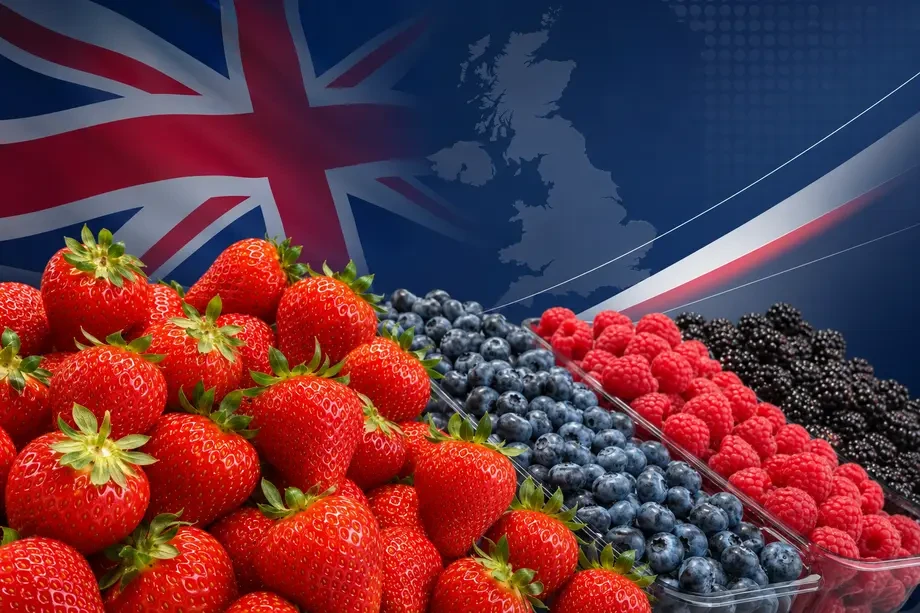
In the United Kingdom, berries continue to be one of the main drivers of growth in the fresh produce sector, supported by varietal innovation, quality, promotions, larger pack sizes and increasingly health-focused communication.
The FPJ Big 50 Products 2026 ranking, compiled by Fresh Produce Journal using Worldpanel by Numerator data for the 52 weeks ending 17 May 2026, places all the main berry categories among the most important fresh produce products in the UK market.
For the first time, strawberries have overtaken dessert apples to claim the top spot, while blueberries have entered the top five. Raspberries remain in twelfth place, while blackberries have moved up three positions, recording one of the strongest increases in the entire ranking.
Berries are worth almost £2.4 billion
Overall, strawberries, blueberries, raspberries and blackberries generate approximately £2.42 billion in retail sales.
| Product | 2026 position | Sales value | Change in ranking |
|---|---|---|---|
| Strawberries | 1st | £1.11 billion | Up 3 places |
| Blueberries | 5th | £762.8 million | Up 1 place |
| Raspberries | 12th | £455.4 million | Unchanged |
| Blackberries | 36th | £90 million | Up 3 places |
This result is particularly significant in a UK fresh produce market worth a total of £14.9 billion, up 5.5% from the previous year. The four main berry categories therefore account for more than 16% of the sector’s total value.
According to Clara Tucker of Worldpanel, berries continue to dominate fruit growth trends because they meet demand for versatile products: they can be enjoyed as a healthy snack, eaten on different occasions throughout the day and appeal to consumers of all ages.
Strawberries overtake apples thanks to the premium tier
Strawberry sales have reached £1.11 billion, making them the leading fresh produce product by value in UK grocery retail and pushing dessert apples, worth £1.05 billion, into second place.
According to David Buxcey of Angus Soft Fruits, the increase is partly due to growth in the average price, which rose by 3.6% per kilogram, but cannot be explained by inflation alone. Demand has been supported by premiumisation, better-tasting varieties and branded propositions.
Volumes also grew by almost 10%, supported by high-impact promotional activity and pack-format innovation. In particular, 600-gram and one-kilogram packs are encouraging more frequent consumption.
Improved eating quality from new-generation varieties has also reportedly contributed to a 4.2% increase in repeat purchases.
The sector is therefore moving away from growth driven mainly by price towards a model based on quality and range development. Isla Haslam of Driscoll’s UK also encourages the sector to move beyond communication focused exclusively on functional benefits, building an emotional connection with consumers through flavour, sensory experience and eating enjoyment.
Blueberries enter the top five for the first time
Blueberry sales have reached £762.8 million, moving up one position to fifth place. This is the first time blueberries have ranked among the five most important fresh produce products in the FPJ ranking.
Michela Yardley of BerryWorld attributes the result to a combination of larger pack sizes, promotions, marketing, health messaging and varietal development.
Volume growth was supported by shoppers moving towards larger pack sizes and by promotions in highly visible supermarket locations, including gondola ends. Loyalty-card discounts and deep price reductions also helped to increase purchases.
Marketing and secondary in-store displays have also linked blueberries with a growing number of consumption occasions, including breakfast, on-the-go snacking and lunchboxes. This strategy is being supported by more convenient packaging, such as snack pots and resealable shaker-style containers.
Health-related communication, including messages about fibre content, is increasing consumer awareness. At the same time, varietal innovation is improving flavour and product consistency, encouraging more frequent repeat purchases.
Raspberry growth is driven by new varieties
Raspberries remain in twelfth place, with sales of £455.4 million. The average price increased by 5.7% per kilogram, but once again, value growth is not being driven by price alone.
The market is increasingly shaped by quality improvements and genetic innovation. Better fruit supports higher price points and encourages consumers to trade up to premium tiers.
Volume growth remains more modest, but is supported by targeted promotions and stronger perceptions of value, particularly across entry-level and mid-tier packs. With penetration at just 51%, raspberries still have significant potential to reach new consumers.
Breeding programmes are developing stronger and more resilient varieties, with improvements in flavour, firmness and shelf life. The aim is to maintain premium eating quality across longer supply windows, a factor considered critical to supporting repeat purchases.
However, the import season remains challenging, as availability for the UK market is affected by demand from other European countries.
Blackberry sales rise by 26.4%
Despite starting from a smaller base, blackberries are among the most dynamic products in the entire ranking. Sales have reached £90 million, with growth of 26.4% in value and 14.4% in volume. The category has consequently moved from thirty-ninth to thirty-sixth place.
This is the second consecutive year in which value growth has exceeded 25%. Isla Haslam attributes this performance to a combination of cost pressures and strategic category management. Rising average prices have been accompanied by the sector’s commitment to delivering premium quality and reliable supply, encouraging consumers to trade up.
Demand is also benefiting from growing interest in diets based on natural and minimally processed foods. Blackberries are perceived as a low-calorie, nutrient-dense food, characteristics that may also prove particularly attractive to consumers using weight-loss medication.
Brands can also provide reassurance in a category where consumers have historically experienced variable quality. According to Haslam, growth is most effective when brands and private labels work in tandem.
Health, quality and promotions reshape the category
A common indication emerges across all four categories: growth in the UK berry market can no longer be attributed solely to inflation. The market is rewarding investment in flavour, firmness, shelf life, range and packaging convenience.
Premiumisation continues to advance despite pressure on household budgets because consumers associate better products with higher quality, longer shelf life and greater reliability. Brands can also meet this demand by providing reassurance that appeals beyond affluent shoppers alone.
Retailers are simultaneously broadening the segmentation of their ranges. Lidl, for example, has added branded berries alongside its standard and premium tiers, offering alternatives for consumers with different budgets.
Promotions, loyalty cards and larger pack sizes remain important growth drivers, but the most significant development is the gradual transformation of berries from an occasional purchase into a cross-occasion category, capable of meeting multiple consumption needs while combining health, enjoyment and convenience.