









The British strawberry market remains one of the most interesting in Europe for understanding the evolution of the category: not only price and national origin, but also declared variety, sensory profile, Brix level, packaging, producer reputation and premium positioning.
A recent test published by The Guardian on strawberries sold in the main UK supermarkets offers a particularly useful snapshot for the berries supply chain. The analysis, written by Tom Hunt, compared several references available on British shelves, assessing the strawberries on the basis of sweetness, acidity, aroma, texture, appearance, origin and value for money.
The result is not just a product ranking, but a picture of the way strawberries are now presented to the English consumer: an increasingly segmented category, in which perceived quality does not depend only on visual appearance, but on a structured set of information and attributes.
A market where the supermarket tells the variety story
One of the most interesting elements of the test is the presence, in several cases, of the variety name directly associated with the product. The products are not presented simply as “British strawberries”, but as Driscoll’s Zara, Malling Centenary, Ania, Blush, Falco, Lady Grace, MC1A.
This aspect highlights a peculiarity of the English market: strawberries are no longer treated only as a seasonal commodity, but as a product with its own varietal identity. For the more evolved consumer, the variety name can become an element of recognition, differentiation and loyalty.
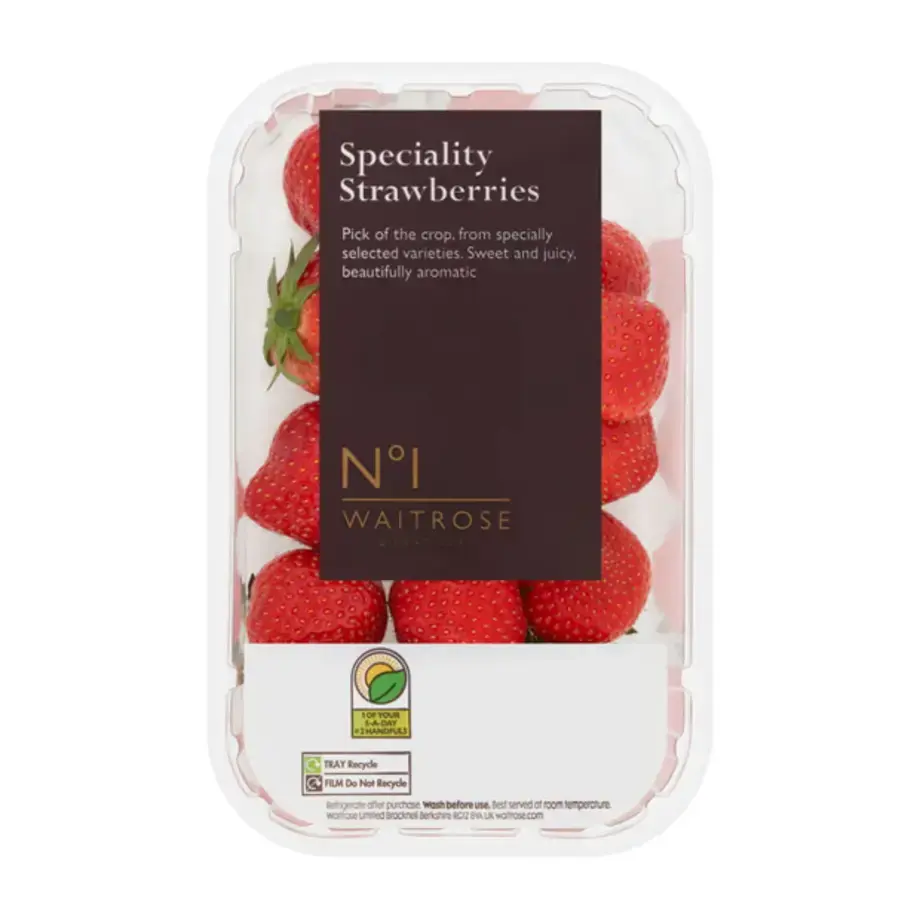
In the test, the reference rated best overall is Waitrose No 1 British speciality strawberries, with Driscoll’s Zara strawberries grown by Littywood Farm in Staffordshire. The product receives the highest score thanks to sweetness, texture and aromatic complexity, with a value of 11 degrees Brix.
British origin as a commercial lever
Another distinctive feature is the central role of national origin. Almost all the references analysed are British strawberries, meaning strawberries produced in the United Kingdom. British provenance is not a secondary detail, but a strong element of commercial positioning.
English supermarkets enhance local origin especially during the domestic season, building a narrative based on freshness, seasonality and the national supply chain. In some cases, the farm is also indicated, such as Hugh Lowe Farms in Kent, New Forest Fruit in Hampshire, S&A Produce in Herefordshire or Dyson Farming in Lincolnshire.
This transparency is significant because it shifts communication from the retailer alone to the production system. The producer does not remain invisible, but can become part of the value perceived by the consumer.
Brix enters the consumer language
The Guardian test uses a refractometer to measure the Brix level, meaning the sugar content of the fruit. It is a technical detail, but its presence in an article aimed at the general public indicates growing consumer literacy around quality parameters.
The best strawberries are not evaluated simply because they are “beautiful” or “sweet”, but because they show balance between sweetness, acidity, aroma and texture. This is a relevant step: the premium market is not built only by increasing sugar levels, but by offering a more complete sensory experience.
In the test, values vary significantly: from 11 Brix for the Waitrose reference to 5 Brix for Sainsbury’s Taste the Difference, judged disappointing, vegetal and bland. The difference shows how uneven the category can be even within apparently similar segments.
Premium does not always mean better
The English market shows strong segmentation between standard, premium, speciality, organic and advanced private label references. However, the test highlights an important point: a higher price does not automatically guarantee a better eating experience.
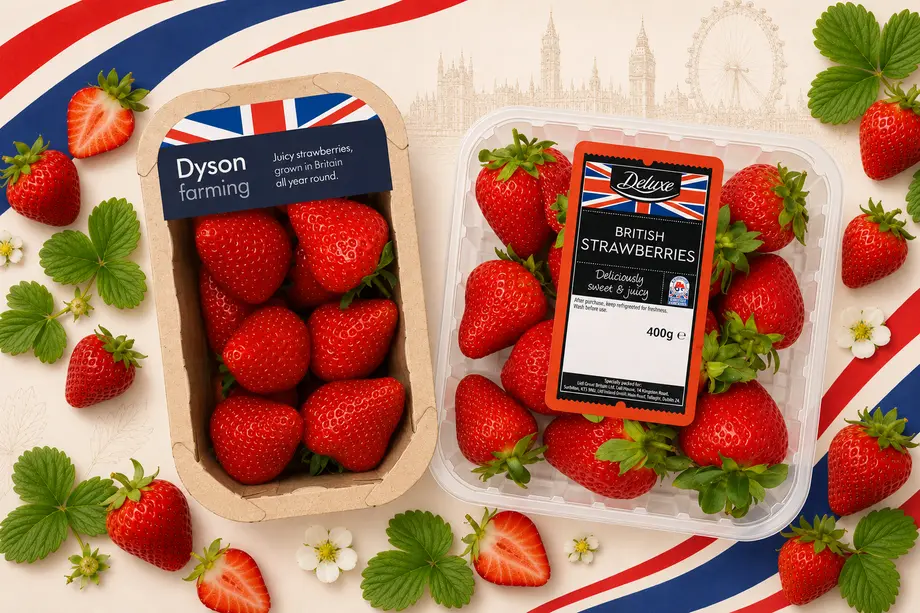
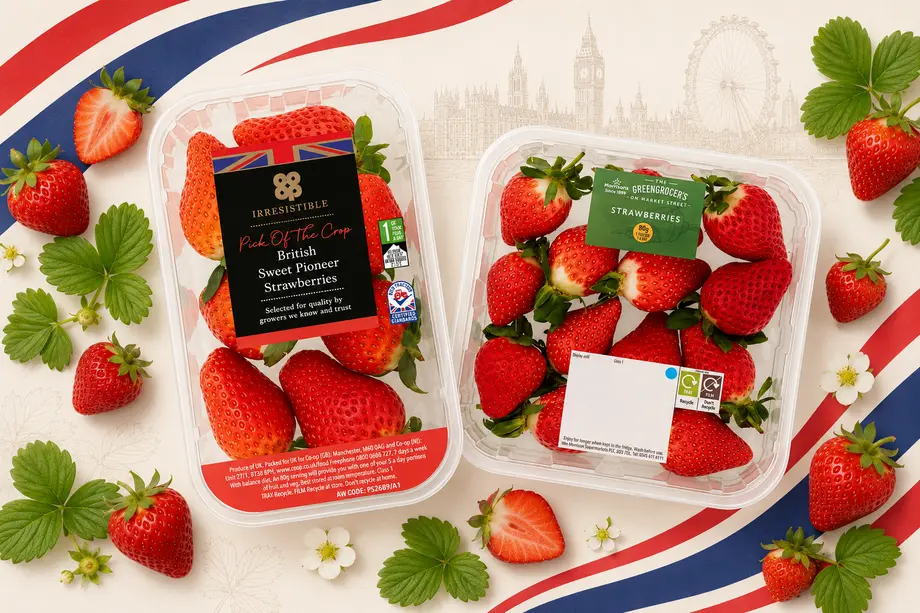
The Co-op Irresistible British Sweet Pioneer Strawberries reference, for example, is among the most expensive in the comparison, but receives an intermediate rating. The Dyson Farming strawberries, sold at a high price and produced in a large high-tech greenhouse using robotics, automation and renewable energy, also fail to reach the highest scores from a sensory point of view.
By contrast, the “best bargain” recognition goes to Morrisons British Strawberries, Malling Centenary strawberries grown in Kent, offered at a competitive price and judged very sweet, with 10 Brix.
For the supply chain, this is a clear signal: technology, packaging and premium positioning must be consistent with the real quality of the fruit. The British consumer seems willing to pay more, but expects a perceivable difference.
The role of breeders and international varieties
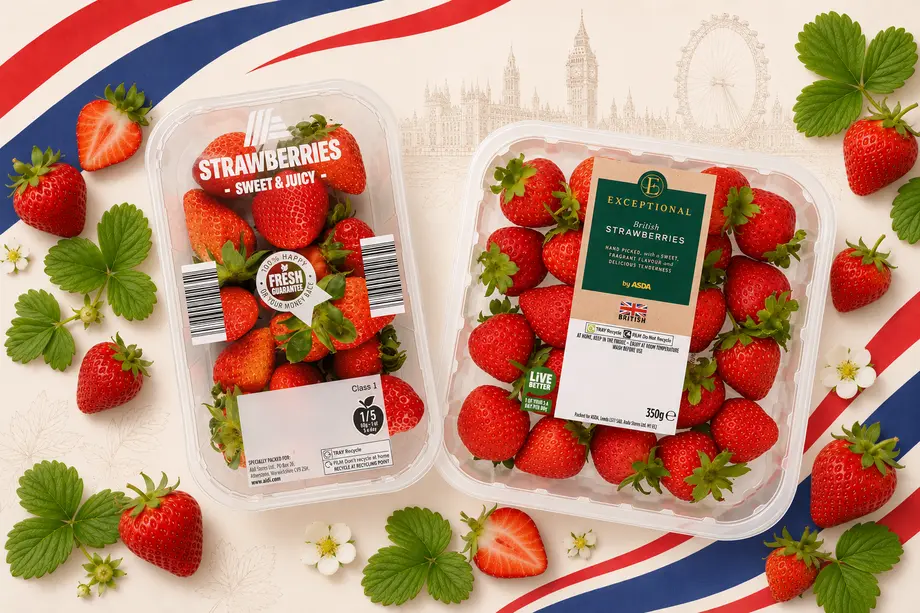
Among the peculiarities of the test, there is also the presence of varieties that are not necessarily British. The most evident case is Ania, described as an Italian variety and sold in the Exceptional by Asda line. Grown by New Forest Fruit in Hampshire, it is described as complex, floral and well balanced, with a Brix of 10.
This point is particularly interesting for the Italian Berry audience: the British market does not only enhance national production, but also integrates international genetics capable of meeting local needs in terms of taste, shelf life, productivity and commercial positioning.
The breeder, therefore, indirectly enters the consumer narrative. The variety becomes a component of marketing, even when the varietal brand is not yet fully developed as happens in other fruit categories.
Packaging, sustainability and high-tech production
Another relevant element concerns packaging and production systems. Dyson Farming strawberries are described as being produced year-round in a large 10.5-hectare greenhouse in Lincolnshire, using robotics, automation and renewable energy. The product is packed in a cardboard punnet with a film lid.
This case shows a specific direction in the British market: sustainability does not concern only the packaging material, but also the narrative around the production system. Greenhouse cultivation, automation, renewable energy and year-round supply become positioning elements.
However, the sensory judgement is not particularly positive. This creates a strong editorial theme: in the berries market, production innovation is important, but it must translate into perceivable organoleptic quality.
Organic remains a distinct niche
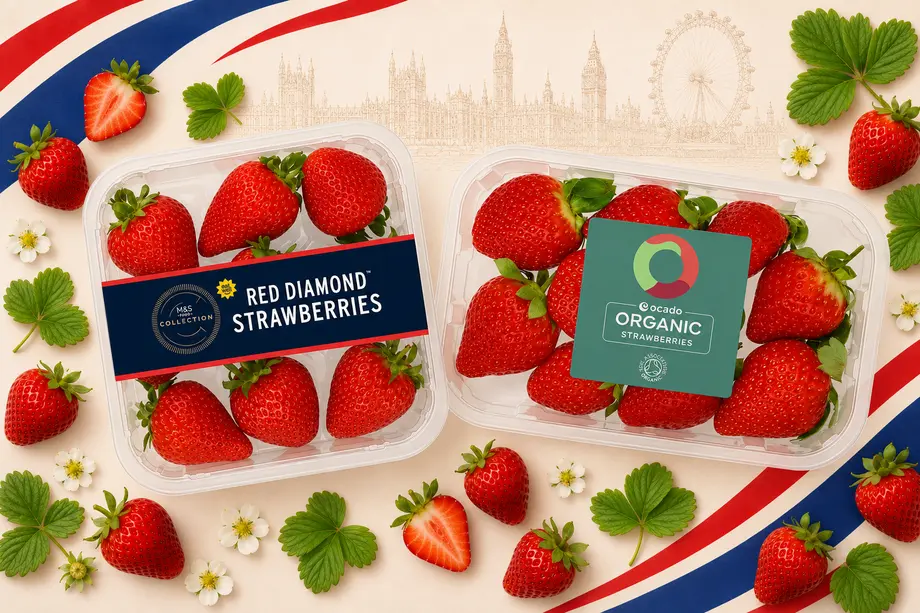
In the test, the only declared organic reference is Ocado Organic Strawberries, Soil Association-certified and produced in Belgium. It is also the only explicitly stated imported strawberry in the comparison.
This is interesting because it suggests that, during the British season, local origin can prevail over organic as a purchasing lever. The imported organic strawberry is offered at a high price, but in the test it is less sweet and more acidic than other conventional British references.
This confirms a characteristic of the UK market: organic is present, but it has to compete with a very strong, well-segmented and clearly communicated national offer.
What the English market teaches the Italian supply chain
For Italian producers and operators, the British test offers several strategic indications.
The first is that varietal transparency can become a competitive advantage. Indicating the variety, the producer and the area of origin helps build trust and differentiation.
The second is that sensory quality must be measurable and communicable. Brix alone is not enough, but it can become a useful element when integrated with aroma, acidity, texture and freshness.
The third is that premium must be justified. Elegant packaging or a high price are not enough if the eating experience is not superior.
The fourth is that the British consumer already seems accustomed to a more evolved strawberry category, in which retailers, breeders and producers contribute to building value.
A mature and well-segmented category
The Guardian test confirms that supermarket strawberries in the United Kingdom are a mature, competitive and sophisticated category. The product is segmented by origin, variety, perceived quality, production method, packaging and price positioning.
For the berries supply chain, the English case represents an interesting laboratory: it shows how strawberries can move away from the logic of an undifferentiated product and become a reference with identity, narrative and recognisable quality parameters.
The challenge, also for the Italian market, will be to transform this information into commercial value, without losing sight of the decisive point: in the end, the strawberry has to taste good.