













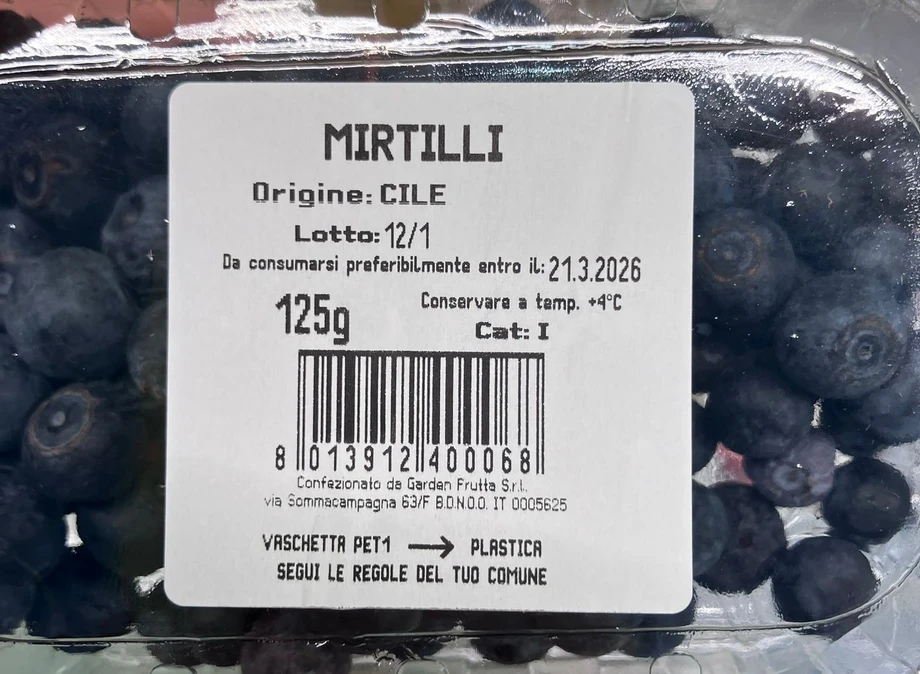
In the Italian grocery retail produce department, it is not so common to come across a pack of berries clearly showing the date by which the product should preferably be consumed. Yet this is exactly what has been spotted on March 18th, 2026 on a pack of blueberries sold by Tosano Supermercati, where the label clearly states “best before 21.3.2026”, together with the storage indication +4°C.
It may seem like a minor detail, but in fact it is a choice that touches on a central issue for the entire berries supply chain: the relationship between quality, transparency, shelf life management and waste reduction. In a highly perishable category such as berries, any additional information provided to consumers can have a concrete impact both on product perception and on the actual consumption experience.
A clearer consumption window
Berries, more than many other fresh produce categories, depend on a delicate balance. Just a few days, or improper storage, can affect texture, flavour, firmness and visual appearance. For this reason, communicating a best before date means first of all giving consumers a clear message: the product has an optimal consumption window, and that window should be respected in order to enjoy its best qualities.
From the consumer’s point of view, the advantages are evident. The first is transparency. An explicit date helps shoppers make more informed decisions, especially in a category where perceived freshness is crucial. The second advantage concerns household consumption planning: those buying a punnet of blueberries know more precisely by when they should consume it in order to avoid quality deterioration. This can be especially useful for families doing a weekly grocery shop and managing several fresh products at the same time.
There is also another positive aspect: the label takes on an almost educational role. It does not simply indicate a date, but also indirectly highlights the importance of the cold chain. The indication to store the product at +4°C reminds consumers that berry quality depends not only on the work carried out upstream by growers, packers and distributors, but also on what happens once the product gets home. In this sense, the pack becomes a tool for information and consumer awareness.
Benefits for the supply chain
For the supply chain too, this kind of choice may have interesting implications. Clearly and visibly displaying a best before date means giving value to more accurate shelf life management. It is an approach that requires strong control over harvest timing, packing, transport, warehouse handling and shelf rotation. In other words, it is a choice that can help strengthen the overall discipline of the supply chain.
In addition, this type of communication can also become a positioning signal. In berries, where consumers are increasingly sensitive to quality, origin, convenience and reliability, attention to label information can represent a distinctive element. It is not enough simply to have the product: what also matters is how it is presented and the level of trust built around that reference.
Challenges to consider
Of course, there are also possible drawbacks. For the supply chain, indicating a precise date on the label brings greater operational rigidity. If the product is delayed along the logistics chain, or if in-store rotation slows down, the remaining commercial window quickly narrows. In a delicate category such as berries, this can translate into more pressure on replenishment, markdowns and surplus management.
Another critical point concerns the risk of an overly mechanical interpretation by consumers. Faced with a printed date on the label, many shoppers may consider the product “old” as it approaches the indicated date, even though it may still be perfectly suitable for consumption and commercially sound. This psychological effect, if not accompanied by proper consumer education, may paradoxically increase waste rather than reduce it.
There is also a broader issue linked to the very nature of berries: not all batches behave in the same way. Origin, variety, harvest timing, post-harvest performance and logistics conditions can all significantly influence commercial life. For this reason, the presence of a best before date requires strong consistency between what is promised on the label and what the product can realistically guarantee all the way to the consumer’s refrigerator.
A choice that opens the debate
Overall, the choice observed at Tosano appears interesting because it introduces an element of clarity in a category where perceived quality is often judged almost exclusively by visual appearance. Making shelf life explicit means moving the discussion onto a more mature level: not only selling a punnet of berries, but also communicating how and when that product should be consumed in order to offer the best possible experience.
It is a choice that can bring benefits both to consumers and to the more structured operators in the supply chain, but it also requires precision, consistency and well-controlled logistics. In berries, where just a few days can make a difference, the date on the label is not a minor detail: it is information that speaks of organisation, responsibility and trust.