






Sweet but slightly tart, easy to eat on their own and also perfect with yogurt, porridge and fruit salads: raspberries are among the most recognizable berries. But when it comes to raspberries and health, what are the truly interesting aspects from a nutritional point of view?
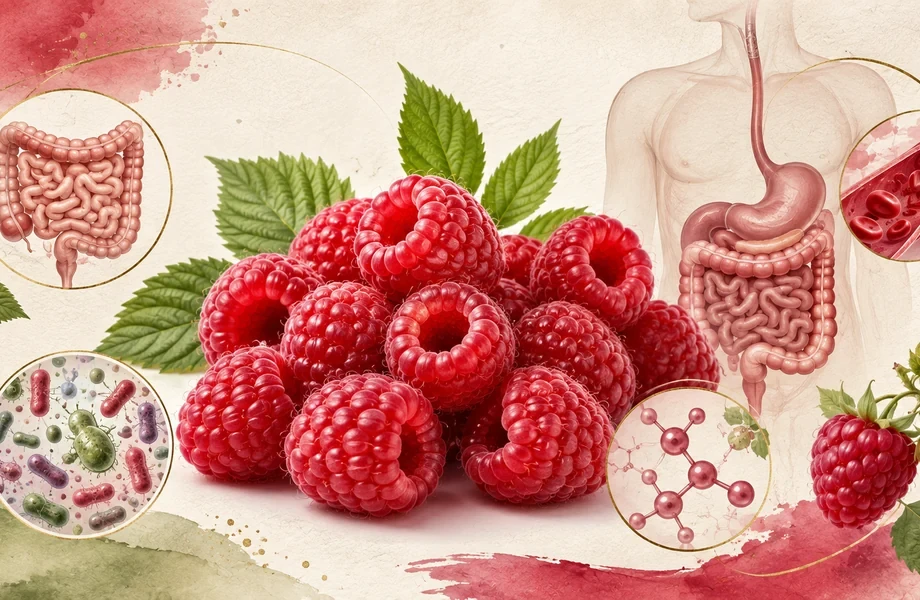
One of the most widely studied areas concerns the gut. Raspberries provide fiber and several plant compounds, including anthocyanins and ellagitannins. A study published in 2026 in Scientific Reports adds an interesting piece to the puzzle: the metabolic effects observed after raspberry consumption can vary considerably from person to person, and the gut microbiome may help explain at least some of these differences.
Why fiber is one of the strengths of raspberries
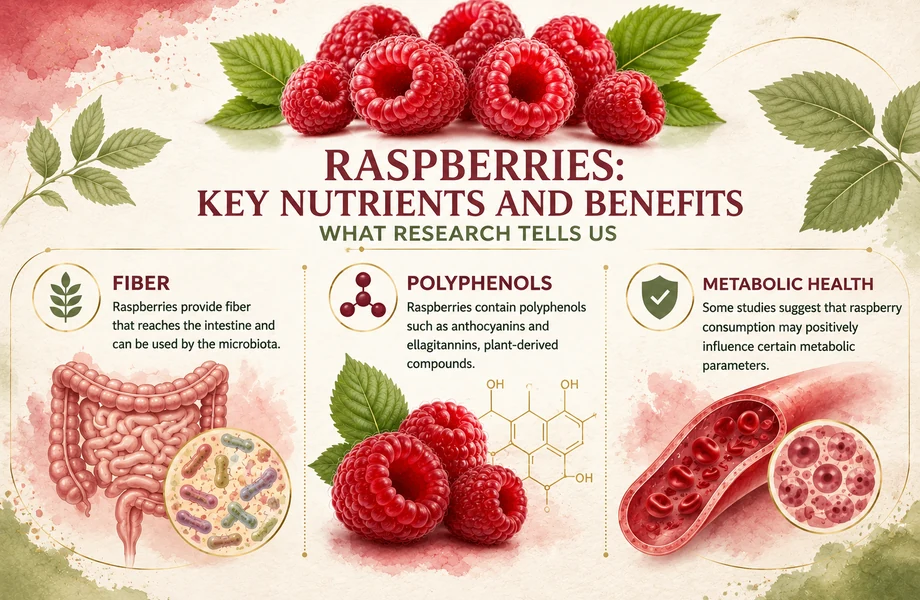
When considering the potential benefits of raspberries, it is worth starting with something very concrete: fiber.
Dietary fiber is not completely digested and absorbed in the same way as other nutrients. Some of it reaches the large intestine, where it can be used by the microorganisms that make up the gut microbiome.
This makes the consumption of whole fruits particularly interesting, because fiber is part of the food's structure itself. In the case of raspberries, their fiber content is accompanied by several polyphenols, a large family of substances produced by plants. These include anthocyanins, which are also responsible for the fruit's red color, and ellagitannins.
This does not mean that each of these substances automatically produces a specific benefit in the body. Rather, it means that the raspberry is a complex food whose components can be transformed and used in different ways, including by gut microorganisms.
And this is precisely what some of the most recent research is focusing on.
Raspberries and gut health: what role does the microbiome play?
The gut microbiome is the community of microorganisms that live in our intestines. It is not the same in everyone: its composition and functions can vary from one person to another and are influenced by numerous factors, including diet.
Some gut bacteria possess enzymes that allow them to use complex carbohydrates and components of fiber that our bodies cannot digest on their own. During these processes, various metabolites can be produced, including short-chain fatty acids, substances involved in intestinal physiology and the subject of extensive research into metabolism.
This raises an inevitable question: if two people have different microbiomes, can they respond differently to the same food?
A group of researchers from Université Laval in Canada sought to explore this question using red raspberries.
What happened after eating raspberries every day for eight weeks
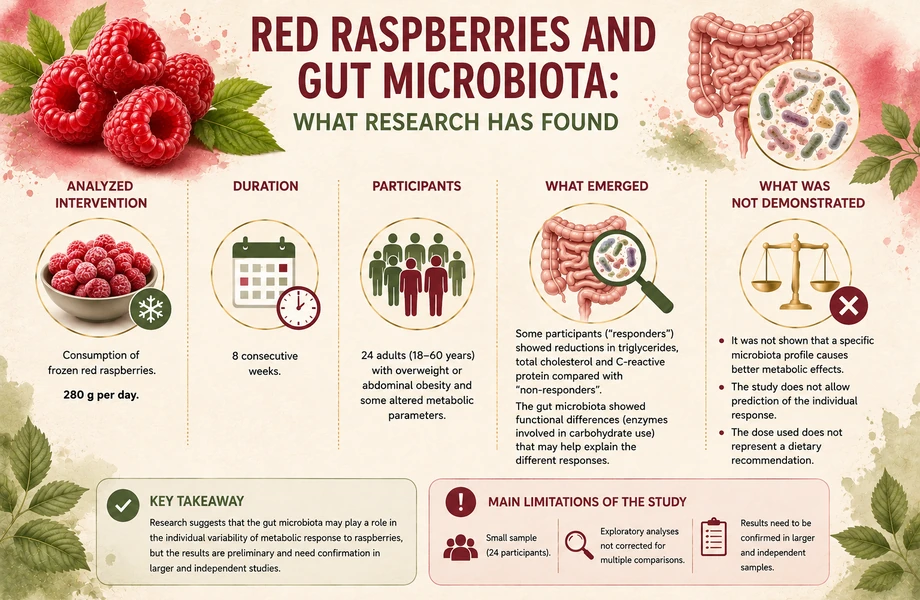
The study, published in March 2026 in Scientific Reports, re-examined data from a previous randomized clinical trial involving adults aged 18 to 60 with overweight or abdominal obesity and certain characteristics associated with metabolic risk.
In the original trial, 24 participants consumed 280 grams of frozen red raspberries per day for eight weeks. Another group continued with their usual diet.
The new research focused on the 24 people who had consumed the raspberries.
And this is where the most interesting aspect for consumers emerges: not everyone responded in the same way.
Based on previous analyses
Based on previous analyses, the researchers had identified 13 participants as “responders” and 11 as “non-responders”. After the intervention, responders showed reductions in plasma levels of triglycerides, total cholesterol and C-reactive protein compared with non-responders.
This finding does not mean that raspberries lower cholesterol or triglycerides in those who eat them. The sample is too small and specific to draw such a conclusion. The interesting part of the study is something else: understanding why, under the experimental conditions, some people showed changes while others did not.
Why the same food can have different effects
To look for an explanation, the researchers analyzed participants' fecal samples and examined certain functional characteristics of the microbiome.
In particular, they examined enzymes produced by gut microorganisms that are involved in breaking down complex carbohydrates. Some differences were observed between those who responded more strongly to the intervention and those who responded less.
The findings therefore suggest that the functional capabilities of the microbiome may contribute to differences in individual responses to foods.
However, caution is needed. The study involved only a small number of people, and some of the analyses were exploratory. In addition, the researchers analyzed the genetic potential of the microbiome, rather than directly measuring enzyme activity or all the metabolites produced.
We cannot therefore take a test
We cannot therefore take a microbiome test and determine whether raspberries will “work” for us. Research is still a long way from this kind of application.
Are raspberries good for gut health?
This is probably the most practical question. And it requires an answer that is less sensational, but more accurate.
Raspberries are a plant food that provides fiber and can therefore contribute to overall dietary fiber intake. A diet that includes adequate amounts of fiber from fruit, vegetables, legumes, whole grains, nuts and other plant foods is important for normal bowel function.
However, based on this study, we cannot conclude that raspberries alter the microbiome in a universally “better” direction.
The 2026 research tells a more complex story: what we eat interacts with a gut ecosystem that has individual characteristics. As a result, the response to the same food may also differ from person to person.
Do we need to eat 280 grams of raspberries a day?
No. It is important to distinguish the dose used in a study from a recommendation for everyday life.
Participants in the research consumed 280 grams of frozen raspberries every day because the scientific protocol required a standardized amount. The authors themselves point out that this dose should not be interpreted as a dietary recommendation.
There is therefore no need to weigh out 280 grams of raspberries or eat them every day in the hope of reproducing the results observed in the study.
For consumers, it is much more reasonable to simply consider them one of the many choices available within a varied fruit intake. They can be eaten fresh when in season or frozen, either on their own or together with other foods.
Fresh or frozen? The study used frozen raspberries
Another interesting detail concerns the form of the product. The researchers did not use extracts, capsules or concentrated supplements: participants consumed frozen red raspberries.
This is an important distinction because results obtained with a highly concentrated extract cannot automatically be attributed to the whole fruit.
In this case, the research concerns a food that is also familiar to consumers. This does not mean that fresh and frozen raspberries are identical in every respect, or that any amount will produce the same results as those observed in the study, but it does make the experiment closer to a real-life dietary situation than research conducted exclusively with isolated compounds.
Raspberries and health: what can we take away from the research?
Research into raspberries and health is showing, above all, how reductive it is to attribute the same effect to a single food for everyone.
Raspberries have interesting nutritional characteristics, starting with their fiber and polyphenol content, and can easily be included in a varied and balanced diet. However, the new study adds an important piece of information: the metabolic response to their consumption may also depend on individual characteristics of the microbiome.
For now, this observation mainly raises new scientific questions. We still do not know how to identify who will respond in a particular way, nor can we attribute therapeutic effects on cholesterol, inflammation or metabolism to raspberries.
For those who enjoy them as part of their diet, the message can remain much simpler: there is no need to look to the raspberry as a solution to a health problem. It is a fruit that contributes to dietary variety and provides fiber and plant compounds. And research reminds us that, when it comes to nutrition, what matters is not only what we eat, but also the overall context of our diet and our individual characteristics.
The information contained in this article is for educational purposes only and is not a substitute for advice from doctors, dietitians or nutritionists.
🫐 Well-being & Health with Berries 🍓This article is part of the editorial series Wellness & Health with Berries, which brings scientific research closer to everyday life, promoting berries as allies for well-being. The series offers clear, up-to-date, and evidence-based content designed to inform consumers and support all operators in the berry supply chain. |
Italian Berry Editorial Team
Source: Barbe V., de Toro-Martín J., Garneau V., Couture P., Roy D., Couillard C., Marette A., Vohl M.C., “Functional gut microbiome signatures underlying interindividual variability in metabolic responses to red raspberry consumption”, Scientific Reports, 2026, 16, 10685. DOI: 10.1038/s41598-026-45955-7
Italian Berry - All rights reserved