





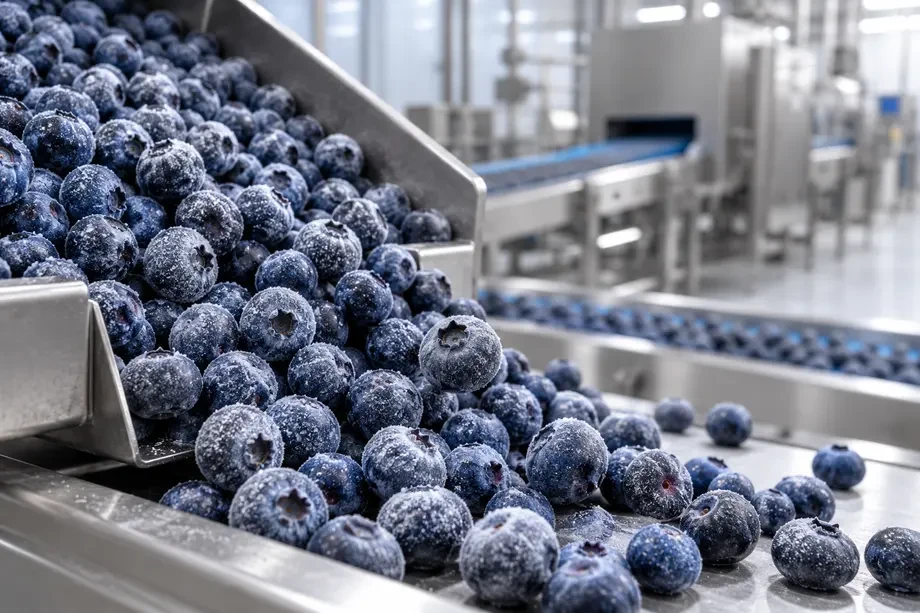
How the processing industry is growing in established hubs (the Pacific Northwest) and emerging regions (southern China), driven by ready-to-use blends and bakery applications.
For a long time, the processed blueberry channel was considered simply an outlet for fruit unsuitable for the fresh market. Today, however, processing is undergoing a genuine strategic and economic redefinition. According to the IBO Global Blueberry Report 2026, global production of cultivated blueberries destined for processing reached an all-time high of 546,420 tonnes in 2025.
The report (294 pages, in English) can be downloaded free of charge from the IBO website.
Supported by stable prices, limited inventories and rapidly expanding retail demand, the IQF (Individually Quick Frozen) and industrial ingredients sector is establishing itself as a fundamental pillar of profitability across the global supply chain.
The two hubs of industrial production: the Pacific Northwest and southern China
Blueberry production for processing rests on two profoundly different geographical and operational models, located on opposite sides of the Pacific Ocean:
- The Pacific Northwest (USA and Canada): This is the industry's historical heartland, dominated by large, highly mechanised farms. The United States and Canada account for approximately 207,740 tonnes of blueberries for processing. In Washington State, for example, around 70% of total production is destined for processing. Similarly, in British Columbia (Canada), 65% of the harvest (equivalent to 51,823 tonnes) is directed to industrial frozen channels.
- Southern China: This represents the new emerging processing hub, based predominantly on small and medium-sized farms. Asia has reached 190,870 tonnes of blueberries for processing, driven by Chinese provinces such as Guizhou, where as much as 66,100 tonnes out of total production of 105,700 tonnes is destined for the local processing industry.
The substitution effect and the IQF boost: blends, bakery and smoothies
The frozen sector has benefited from favourable market conditions linked to a severe shortage of wild blueberries (lowbush) in North America (caused by drought) and Europe (due to weak harvests in Scandinavia, the Baltic States and Ukraine). The shortage of wild fruit has pushed up lowbush prices, making cultivated highbush blueberries extremely competitive in industrial markets.
This dynamic has stimulated consumption across several key segments:
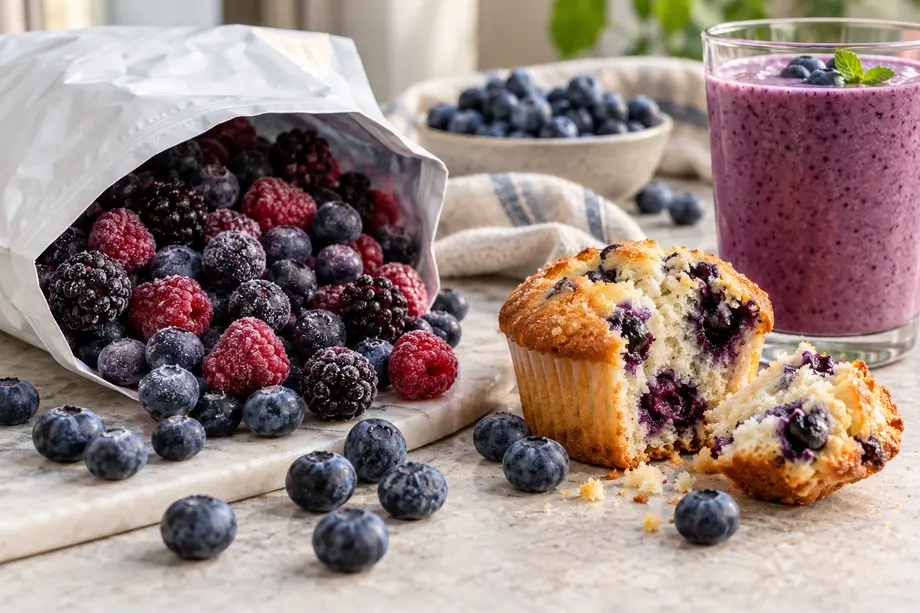
- Retail and club store formats: Large frozen bags (polybags) and ready-to-use blends (particularly triple-berry blends, which are very popular in superstores) are gaining ground for home preparation and smoothies.
- Bakery and patisserie: Blueberries remain a key ingredient in baked goods, muffins and cakes, providing baking stability and colour.
- Functional processed products and snacking: The industry converts the raw fruit into purées and concentrates for yoghurt, smoothies, beverages, protein bars and chocolate coatings.
Sorting and technology: the 12.5 mm threshold and the price floor for fresh fruit
The pursuit of quality has also become a decisive factor in the processing market. IQF buyers are demanding increasingly strict size grading: the standard threshold for premium frozen fruit is set at 12.5 mm (0.5 inches), while the growing adoption of ultra-high-precision optical sorters now allows fruit to be separated with millimetre-level precision.
From an economic perspective, the processing market plays a crucial role in fresh blueberry production, particularly in regions growing varieties with high chilling requirements (high chill):
- It provides a minimum price floor (pricing floor): When fresh market prices fall below profitability thresholds or hand-harvesting costs become unsustainable, growers can choose to harvest mechanically and send the fruit for processing.
- It adds value to fruit damaged by weather events: Fruit intended for the fresh market whose skin has been damaged by frost or rain can be recovered for the production of purées, juices or dried products.
B2B prospects: creating added value along the supply chain
Historically, most of the added value in processed blueberries has been captured by multinational consumer packaged goods (CPG) companies. However, the IBO report highlights how farms and drying facilities themselves are beginning to develop proprietary products: from dried and infused blueberries to new "ready-to-eat" frozen lines offering superior firmness and flavour.
In a global context where overall volumes continue to increase, the ability to maximise the value of every portion of the harvest through advanced industrial channels is an essential tool for ensuring the economic sustainability of farming businesses in the years ahead.
Italian Berry - All rights reserved