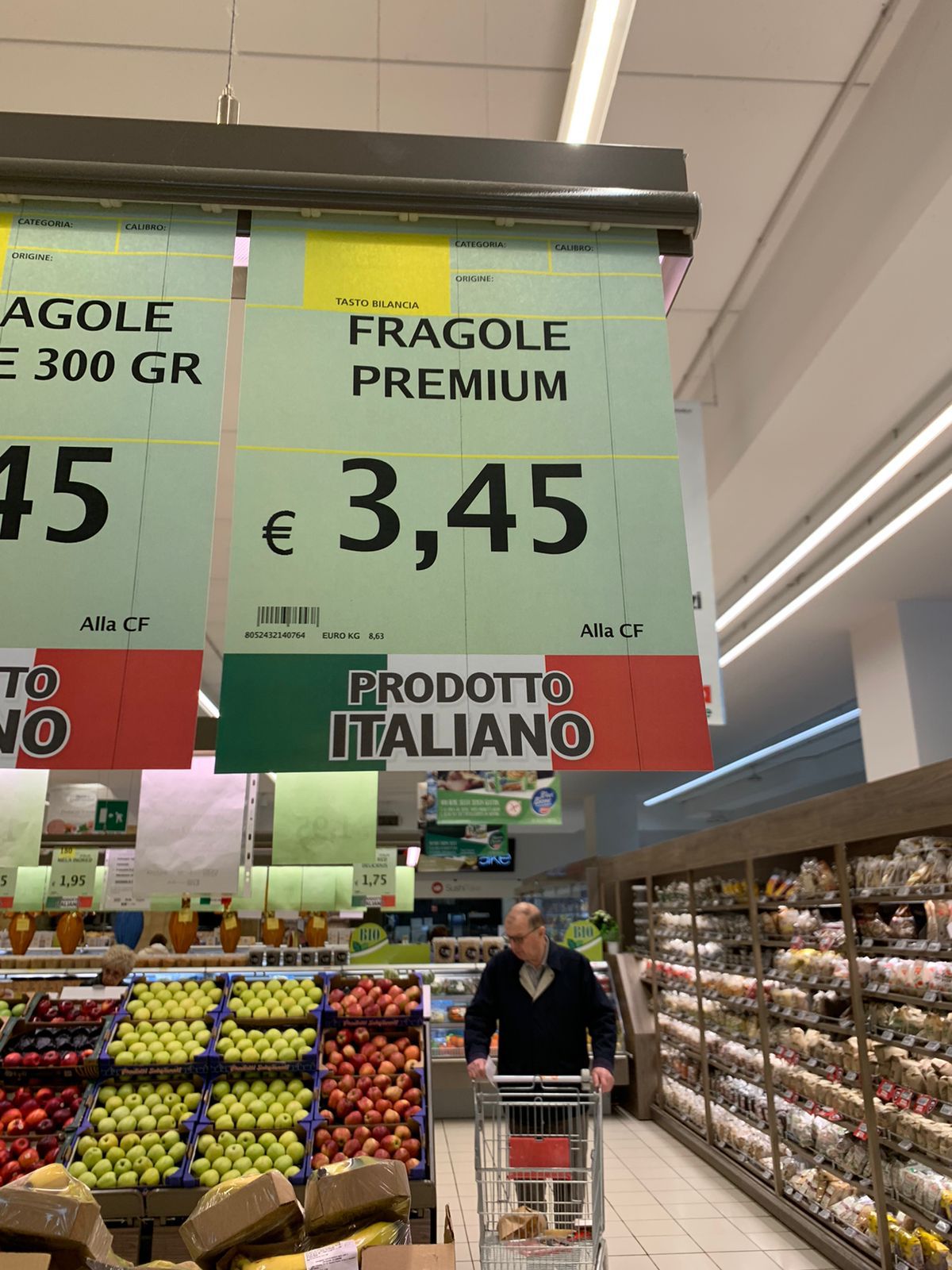









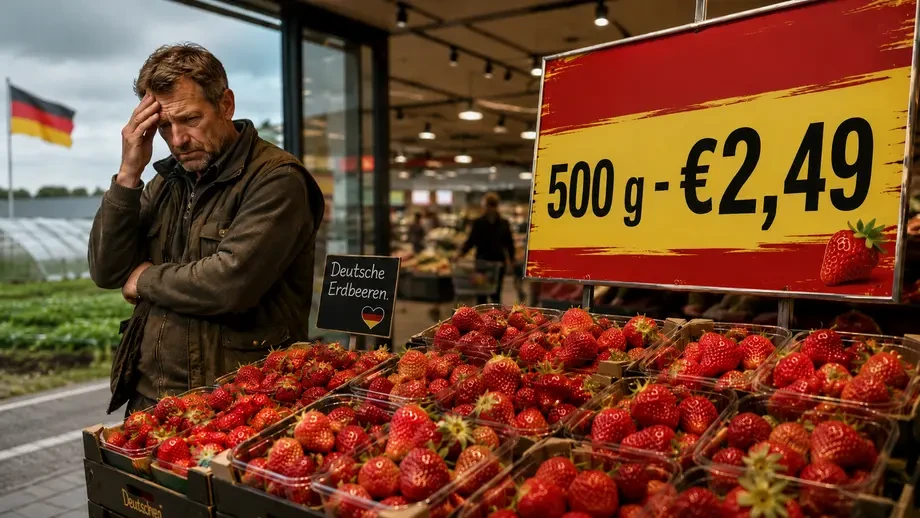
In Germany, on the eve of “Tag der deutschen Erdbeere”, the Bundesfachgruppe Obstbau is denouncing aggressive promotions by the discounter Netto: 500 grams of strawberries at €2.49, a price considered insufficient to cover the actual production costs.
In brief
- The discounter Netto promoted German strawberries at €2.49 for 500 grams, triggering a reaction from the Bundesfachgruppe Obstbau.
- According to the German fruit growers’ organization, the price does not even come close to covering the production costs estimated by the Landwirtschaftskammer Nordrhein-Westfalen.
- The sector is warning of a “race to the bottom” effect, with other retailers ready to align with similar promotional price levels.
- The central issue is labor cost: harvesting, plant care, sorting and packing remain highly labor-intensive manual operations.
- The long-term risk is a further decline in German self-sufficiency, with an increase in imports, especially from Spain.

On May 24, Germany celebrates Tag der deutschen Erdbeere, the day dedicated to the national strawberry. But for many German growers, there is not much to celebrate this year. At a particularly delicate stage of the season, the discounter Netto launched a promotion on strawberries in 500-gram packs at €2.49, prompting a strong response from the Bundesfachgruppe Obstbau, the organization representing German fruit growers.
According to the Bundesfachgruppe, the price advertised by Netto is far below the actual costs borne by German producers. The organization refers to calculations by the Landwirtschaftskammer Nordrhein-Westfalen, according to which a promotional level of this kind would not even come close to covering production costs. The problem, the sector warns, does not concern a single retailer only: other chains have reportedly started moving in the same direction, fueling a real race to the bottom.
A promotion at the most sensitive point of the season
The criticism comes at a particularly sensitive moment. The cool spring has delayed the harvest, reducing the availability of domestic product precisely when demand tends to increase. The Pentecost weekend traditionally represents one of the peak consumption periods for strawberries in Germany: a phase in which, according to growers, the market should enhance the value of German origin, not use it as a loss leader.
Claus Schliecker, chairman of the Bundesfachgruppe Obstbau, described the strategy as “completely irresponsible”. According to the organization, the point is that strawberries cannot be treated as just another promotional commodity. Their production requires a high level of manual labor, from crop care to harvesting, from sorting to preparing the product for the market.
The cost issue: labor weighs increasingly heavily
Strawberries are among the most labor-intensive fresh produce items. Mechanical harvesting, at least for fruit destined for the fresh market, is not a viable large-scale solution, because quality, ripeness and fruit integrity still depend decisively on manual picking. This makes labor cost a structural and non-compressible component.
Over the past ten years, German growers point out, the statutory minimum wage in Germany has almost doubled. Farm costs have therefore increased significantly, while the prices paid to producers have not followed the same trend. The result is growing pressure on margins, with the risk that some farms may reduce investments, shorten the season or progressively abandon cultivation.
Rising imports and declining self-sufficiency
The issue is part of a broader picture: Germany already imports a growing share of strawberries, particularly from Spain. The national self-sufficiency rate has been declining for years and, according to the Bundesfachgruppe Obstbau, overly aggressive commercial policies by retailers risk accelerating this trend even further.
The point raised by German growers is not only economic, but also strategic. If consumers want regional strawberries, grown according to high environmental standards and with wages compliant with German legislation, they must accept that this model has a price. Permanent promotional pressure, by contrast, weakens precisely the local production that retailers often use as a marketing lever.
Strawberries as a loss leader: a risk for the entire supply chain
The request made by the Bundesfachgruppe Obstbau to the retail sector is clear: do not use strawberries as a loss leader. Not now, in the middle of the national season. And not structurally, because systematic below-cost promotions risk undermining the economic sustainability of the crop.
For the berry sector, the German case is an important signal beyond national borders. Strawberries, blueberries, raspberries and blackberries are high-value categories, but also highly complex to produce. Consumption growth and the central role of the fresh produce department cannot be built on continuous pressure on farm-gate prices. Without proper remuneration across the supply chain, local origin becomes increasingly fragile and the market ultimately becomes dependent on foreign supplies.
The issue, therefore, is not just the price of a 500-gram punnet. It concerns the development model of the European berry sector: a supply chain capable of sustaining quality, labor and production standards, or competition based on aggressive promotions and the progressive shift of supply towards lower-cost areas.
Source: Fruchthandel