




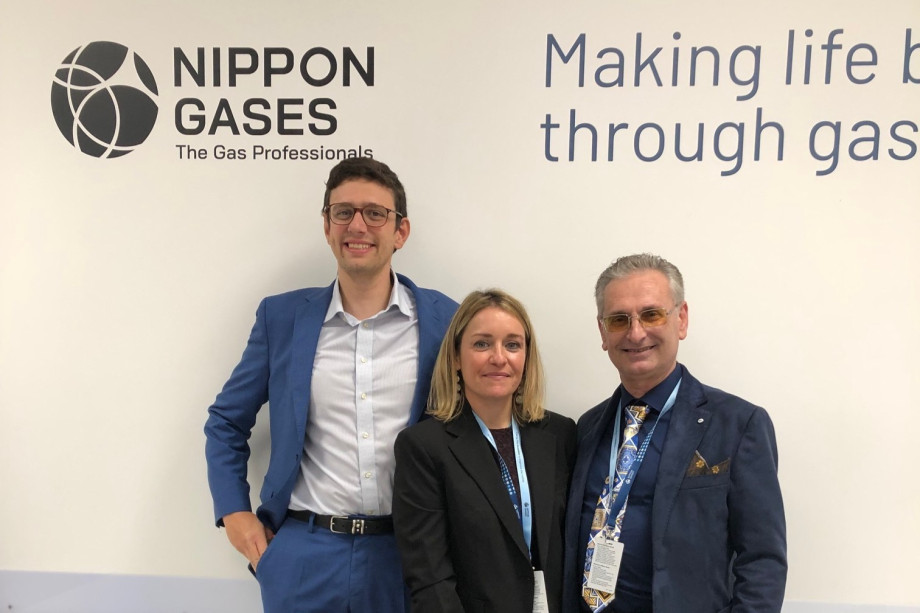
Extending the shelf life of berries, and by a considerable margin, is possible. And the credit goes entirely to a specially developed gas mixture. This is the outcome of trials conducted by Nippon Sanso Industrial, a leading company in industrial, medical, refrigerant and food-grade gases, in collaboration with the Department of Pharmacy at the University of Salerno and Vito Gambina's A Piccoli Frutti, a Sicilian company specialising in berry cultivation.
The project, recently presented at Nippon Sanso's facility in Anagni (the largest gas cylinder filling plant in central and southern Italy, with over 125,178 cylinders processed in the first 11 months of 2026), was carried out over three months between late 2025 and early 2026. It demonstrated the effectiveness of a specific gas mixture in the modified atmosphere packaging (MAP) of wild strawberries.
These are non-climacteric fruits (like all berries), without a thick protective skin and with a water content exceeding 90%, making them particularly susceptible to crushing, loss of firmness and rapid fungal attacks.
FOODSENSE® 3 AG: quality preserved for up to 13 days
The tailor-made mixture used in the trials, named FOODSENSE® 3 AG, resulted in improved preservation of wild strawberries, reduced proliferation of yeasts and moulds, and maintained fruit quality for up to 13 days after packaging.
Once commercially implemented, this could pave the way for a longer commercial shelf life across the entire sector, while also reducing food waste.
An encouraging prospect for growers? Absolutely.
Postharvest challenges for growers
“The postharvest stage is the most challenging period for us,” explains Vito Gambina, owner of A Piccoli Frutti. “Between packaging, storage and transport, even the slightest defect can lead to complaints from the market.
During our nine-month production season, when we harvest more than 450,000 kg of fruit, particularly hot or humid years can result in 10 to 15% of the product being rejected. This means not only a loss of revenue but also reduced credibility in the eyes of buyers. Hence the need for alternative solutions that could provide practical tools to protect growers' work.”
With 10 hectares of greenhouses in the Marsala area, a large traditional Sicilian farm complex dedicated to processing operations and, above all, a strong commitment to innovation (Gambina recently patented a new environmentally friendly punnet made from moulded cellulose pulp), A Piccoli Frutti immediately proved to be the ideal partner for the trials, conducted with the University of Salerno and funded by the Japanese multinational.
The research: modified atmosphere versus conventional packaging
The study, conducted by Daniela Eletto, Associate Professor of Microbiology at the Department of Pharmacy of the University of Salerno, compared wild strawberries in conventional packaging with those packaged under a modified atmosphere, both refrigerated at 4 °C. In the latter, the air inside the packaging was replaced with a mixture of food-grade gases.
The tests, which included microbiological analyses and sensory assessments, demonstrated the inhibition of microbial growth and the almost complete elimination of moulds (such as Botrytis cinerea).
In particular, while yeast and mould counts in conventionally packaged samples exceeded microbiological acceptability limits as early as the fourth day, all the main spoilage indicators (total mesophilic count, yeasts and moulds) remained within acceptable parameters in the samples packaged under a modified atmosphere.
Sensory assessments (odour, colour and texture) also confirmed the clear superiority of the MAP system. Subsequent visual observations revealed the absence of mould after nine days in MAP samples, with fruit appearance remaining significantly better preserved than in the control samples even on the thirteenth day.
Combating Botrytis cinerea
But what are the effects of Botrytis cinerea?
“In the specific case of wild strawberries, the main issue is not so much the risk to human health as the deterioration of the fruit caused by the pathogen, which is much more evident in wild strawberries than in other fruits,” explains Professor Eletto.
“Why? Because wild strawberries provide the ideal environment for botrytis, thanks to their high water and sugar content. Within 24–48 hours, the fruit becomes covered in mould, which begins to proliferate, forming a sort of powdery cotton ball full of airborne spores. The fruit ultimately deteriorates beyond recovery.”
Hence the importance of modified atmosphere treatments.
Shelf life after opening the packaging
But that is not all. The trials also assessed the so-called secondary shelf life, namely the product's ability to withstand deterioration once the packaging has been opened by the consumer.
A modified atmosphere package opened on the ninth day and left exposed to air in a refrigerator for a further five days – for a total of fourteen days after harvesting – maintained the integrity of the wild strawberries.
To the point where the effect could almost be described as bactericidal rather than merely bacteriostatic…
Four gases for a tailor-made mixture
The key role is therefore played by the food-grade gas mixture developed by Nippon Sanso's experts, the industry's very own “gas tenders”. But which gases are most commonly used?
Carbon dioxide has bacteriostatic and fungistatic properties, while nitrogen, an inert gas, is used to physically displace oxygen and maintain the volume of the package, preventing it from collapsing.
Oxygen allows the product to respire and inhibits the growth of anaerobic bacteria. However, it should generally be avoided in most food products, as it causes oxidative rancidity.
Argon is effective in displacing oxygen and helps preserve the product's sensory qualities.
“We do not actually have a thousand ingredients at our disposal; essentially, there are only four,” explains engineer Luca Moseneder-Frajria of Nippon Sanso Italia. “The skill lies in assessing their effects on each product and finding the right proportions, also taking the packaging into account.
The most difficult food product to treat? Alongside certain fried foods, wild strawberries, given their delicate nature, have certainly presented some challenges. But we are nearing the finish line: the patent for the new mixture is now imminent.”
From trials to industrial application
However, one final step is needed to put the results of the trials into commercial practice: implementing machinery capable of heat-sealing berry packaging under a modified atmosphere.
This equipment has been developed by Tecno Group Lab, another Sicilian company specialising in the design and manufacture of equipment for the fresh produce industry. The machine removes the air from pre-packed containers and introduces the new FOODSENSE® 3 AG mixture.
The fully automated process delivers high-quality, sustainable packaging (heat-sealing is carried out using Naturflex film) with an extended shelf life.
The innovation journey continues.
Rossella Cerulli
Italian Berry - All rights reserved