




Summary of the presentation "Digital phenotyping: a new frontier for strawberry selection?" by Patrizia Zamberletti (Hiphen), presented as part of the Berry Area 2026 event programme at Macfrut.
Technological innovation is redefining the paradigms of varietal selection in the strawberry supply chain, a sector historically slowed down by the crop's complex genetic architecture and exceptionally long development cycles.
The adoption of digital phenotyping is emerging within this agricultural ecosystem as an essential tool to overcome the operational bottlenecks linked to traditional manual scoring, both in field activities and in the delicate post-harvest phase.
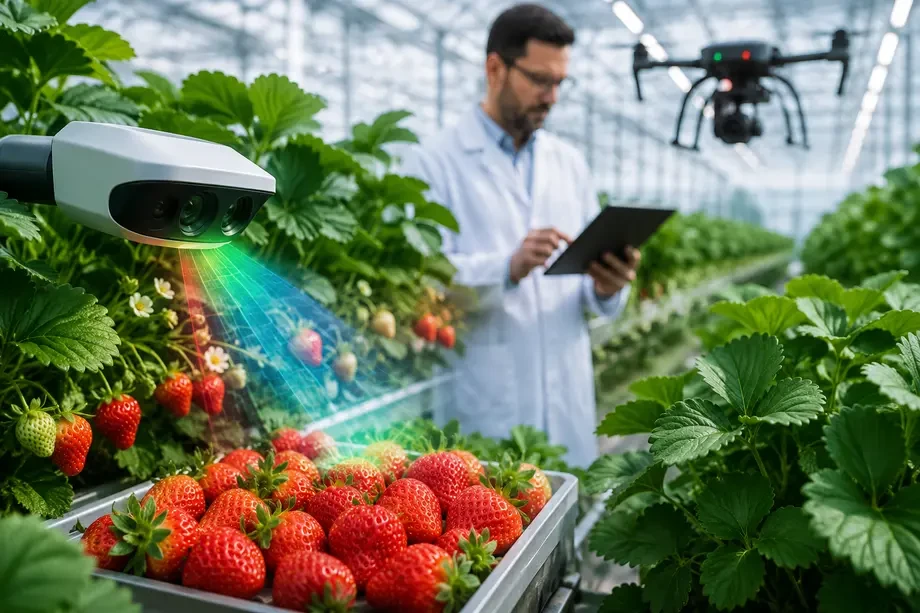
By leveraging an infrastructure of multispectral sensors, advanced detection devices and data analysis software platforms, breeders and industry operators can accelerate the development of predictive models and turn large volumes of information into operational decisions.
This transition towards predictive breeding makes it possible to manage large populations of genetic material, standardize quality controls and narrow the gap between applied research, varietal development and supply-chain decisions.
Key takeaways
1. Strawberry breeding remains a long and complex process.
Varietal selection requires cycles of 8-10 years, due to the complexity of the octoploid genome and the persistent negative trade-off between agronomic yield and fruit quality, especially sugar content.
2. Digital phenotyping optimizes early-stage selection.
The integration of digital phenotyping and predictive breeding models makes it possible to screen large batches, up to 100,000 plantlets, directing manual inspection resources only towards the most promising candidates.
3. Field monitoring integrates scalable technologies.
From drones for rapid large-scale screening to industrial Phenomobile machines and Literal backpacks, the approach combines RGB, thermal and NIR sensors that can also be used in greenhouses and tunnels.
4. Optical analysis standardizes post-harvest and shelf-life assessment.
Digital solutions make it possible to measure berry size, loss of brightness, colour anomalies and the incidence of storage diseases such as botrytis and powdery mildew, making quality assessment more objective.
5. Software platforms turn data into breeding value.
Data aggregation through specialized software ecosystems makes it possible to convert measured metrics into decision-making indicators, useful for comparing agronomic treatments, genetic lines and varietal performance.
What emerges from the presentation
The complex genetic architecture of strawberries is one of the main factors slowing down varietal innovation.
The octoploid genome imposes on breeders a long, costly and observation-intensive selection process, which normally takes eight to ten years before a registerable and commercially usable cultivar can be obtained.
Within this process, one of the most significant challenges is balancing agronomic yield and fruit quality.
Sugar content, for example, can show a negative correlation with productivity: increasing yield does not automatically mean obtaining fruit with better organoleptic quality.
Faced with these limitations, digital phenotyping emerges as a strategic lever to make the selection flow more efficient, reducing dependence on manual assessments alone and enabling large volumes of genetic material to be managed more scientifically.
From observational breeding to predictive breeding
The technological leap is not just about collecting more images or more data, but about turning measurements into useful predictions.
Digital phenotyping makes it possible to identify the most promising candidates early, reducing the number of plants to be assessed manually and focusing resources on the lines with the highest potential.
Browse and download the presentation
Managing the selection funnel
In strawberry breeding programmes, selection often starts from very large populations.
In the pre-breeding stages, the funnel can involve up to 100,000 candidates, which must be progressively narrowed down until the very few lines with real commercial potential are identified.
Digital phenotyping makes this phase more selective, faster and more objective.
Through predictive models, companies can filter plantlets based on measurable parameters, directing human inspection towards genotypes already classified as statistically relevant.
This approach does not eliminate the breeder's role, but increases its efficiency, allowing expertise and experience to be focused on the candidates that deserve in-depth evaluation.
Drones, Phenomobile and portable sensors
On the agronomic monitoring front, data acquisition now relies on a combination of modular hardware technologies.
Drones enable fast mapping of open-field crops, offering a rapid reading of vegetative status and differences between plots.
This solution is particularly useful for large-scale screening, although it has limitations related to visual resolution and the depth of detail that can be detected.
For more precise measurements, tools such as sensor-equipped Phenomobile machines and portable Literal devices come into play, capable of operating also in protected environments such as greenhouses and tunnels.
The integration of RGB, thermal and NIR sensors makes it possible to quantify fundamental structural and physiological indicators: plant height, vegetative biovolume, flower count, plant health status and overall vigour.
| Technology | Main function | Impact on breeding |
|---|---|---|
| Drones | Rapid screening over large areas and experimental plots. | Enable initial mapping of vigour and field differences. |
| Phenomobile | High-precision industrial detection with integrated sensors. | Generates structured data on growth, biovolume and plant status. |
| Literal backpacks | Portable data acquisition in the field, greenhouse or tunnel. | Allows flexible measurements even in complex production contexts. |
| RGB and NIR sensors | Visual and multispectral analysis of plants and fruit. | Support objective assessments of vigour, quality and stress. |
| Software platforms | Aggregate field, post-harvest and varietal performance data. | Transform metrics into breeding value and decision-making indicators. |
Post-harvest: digitalizing shelf life and commercial quality
Digitalization is not limited to the field phase.
A strategic part of the innovation concerns post-harvest and shelf-life analysis, variables on which the marketability of the product directly depends.
Digital tools, from optical applications usable via smartphone to industrial sorting stations, make it possible to objectively track fruit deterioration over time.
Sensors can autonomously recognize quality characteristics such as berry size, shape anomalies, colour alterations and loss of brightness.
At the same time, they allow the incidence and progression of specific storage diseases, such as botrytis and powdery mildew, to be monitored.
This approach makes it possible to build stronger, comparable varietal description sheets that are less dependent on the subjectivity of the observer.
Shelf life becomes a measurable datum
For strawberries, quality does not end at harvest.
The ability to maintain colour, brightness, shape, health and texture during storage becomes a central component of the variety's commercial value.
From raw data to breeding value
The operational core of these innovations is not data acquisition alone, but its transformation into decision-making assets.
Through specialized software ecosystems, professionals in the fruit and vegetable sector can aggregate information from fields, greenhouses, tunnels, post-harvest and varietal analyses.
These metrics are processed to generate what is known as breeding value, a synthetic indicator of the potential value of a genetic line in relation to the objectives of the selection programme.
The availability of structured data also makes it possible to quickly perform comparative analyses, assessing the effectiveness of agronomic treatments, plant nutrition programmes and varietal responses in different contexts.
In this way, data does not remain confined to research, but becomes an operational tool for making faster decisions along the supply chain.
Genome, environment and cultivation practice
The value of digital phenotyping fully emerges when it is used to read the interactions between genome, cultivation practices and environmental variations.
A variety may behave differently depending on the production system, climate, nutritional management, greenhouse, tunnel or phytosanitary pressure.
Digitally measuring these responses makes it possible to understand not only which genotype is most promising overall, but which one is best suited to a specific production context.
This step is particularly important for strawberries, where organoleptic quality, productivity, shelf life and adaptability must coexist in a very tight balance.
In summary
Digital phenotyping is one of the most concrete levers for accelerating the evolution of strawberry breeding.
In a crop characterized by long selection cycles, a complex genome and strong trade-offs between yield and quality, the integrated use of sensors, software platforms and predictive models makes the process faster, more objective and more selective.
From drones to Phenomobile machines, from sensor-equipped backpacks to post-harvest optical analysis, the new frontier is not just measuring more, but measuring better.
For breeders, growers and supply-chain operators, competitive advantage will increasingly depend on the ability to turn agronomic and quality data into timely decisions, guiding varietal development towards strawberries that are more productive, better tasting and more reliable on the market.