










A series of viral social media posts in recent months has revived the claim that Driscoll’s-branded strawberries may be dangerous to health and could cause cancer due to the presence of pesticides. The issue, which originated in the United States, quickly moved beyond technical debate and became a food communication case: a mix of analytical testing, complex scientific terminology, environmental activism and high-impact emotional messages on social media.
The available independent checks, however, call for a much more cautious interpretation. The fact-checking site Snopes described as misleading the claim that Driscoll’s strawberries had been “linked to cancer”. The point is not to deny the existence of residues detected in some tests, but to distinguish between the analytical presence of residues, compliance with legal limits, real dietary exposure and environmental issues related to the use of pesticides in production areas.
Where the case originated
The controversy started with a report published in May 2026 by Mamavation, a US consumer monitoring platform. The organization stated that it had sent two packs of Driscoll’s strawberries purchased in a store in Southern California to an EPA-certified laboratory: one pack of conventional strawberries and one pack of organic strawberries.
According to Mamavation, the conventional strawberry sample contained residues of 12 pesticides, while the organic sample showed no detectable residues. The substances listed included, among others, flonicamid, fludioxonil, flupyradifurone, fluxapyroxad, indoxacarb, novaluron, tetraconazole, cyprodinil, pyrimethanil, quinoxyfen and THPI. The report also highlighted that some of these molecules are fluorinated, presenting them as “PFAS pesticides” or “forever pesticides”.

This is precisely the point that fueled the most alarmist part of the narrative. In viral content, the term PFAS — associated in public opinion with so-called “forever chemicals” — was often used as a communication shortcut to suggest a direct and immediate risk for people who eat strawberries. From a regulatory and toxicological point of view, however, the issue is more complex: the presence of fluorine in a molecule does not automatically mean that the substance falls within the category of regulated PFAS or that it has the same persistence and bioaccumulation profile as the best-known substances in this family.
Residue does not automatically mean risk
The key point for correctly interpreting the case is the difference between “detection” and “risk”. Modern laboratory techniques can identify residues at very low levels, often expressed in parts per billion. The presence of a residue does not automatically mean that safety limits have been exceeded, nor does it constitute proof of cancer risk for consumers.
In the United States, the EPA sets tolerances, i.e. the maximum residue levels allowed on food, based on assessments that consider the toxicity of the substance, the quantity applied, the frequency of use, the expected residue at the time of marketing and dietary exposure levels. The agency states that a tolerance is established only when it can make a finding of “reasonable certainty of no harm”.
Official monitoring data also provide a less alarming picture than the social media narrative. In the USDA Pesticide Data Program 2024, more than 99% of the samples analyzed had residues below the reference levels set by the EPA. In Europe, the latest EFSA report on pesticide residues in food shows that 98.2% of the samples from national control programs complied with maximum residue limits, with an overall assessment of low risk to consumer health based on estimated exposure.
The PFAS issue and the regulatory battle
The issue of fluorinated pesticides remains relevant and cannot simply be dismissed as alarmism. In the United States, there is an ongoing heated debate over the definition of PFAS as applied to pesticides, the environmental persistence of certain fluorinated molecules and the need for stricter rules. Environmental organizations such as the Environmental Working Group argue that a significant share of conventional fruit and vegetable products analyzed in California contains residues of pesticides classified as PFAS under broader criteria than those adopted by the EPA.
The EPA, by contrast, explicitly distinguishes certain compounds with only one fluorinated carbon from regulated PFAS, arguing that they do not have the persistence and bioaccumulation properties typical of “forever chemicals”. This divergence shows that the issue is still open and is likely to have a growing impact on supply chain communication, especially for high-value and highly visible crops such as strawberries, blueberries, raspberries and blackberries.
For consumers, however, the regulatory debate on PFAS does not automatically justify the conclusion that eating strawberries compliant with legal standards increases cancer risk. This is a subtle but fundamental distinction: discussing the sustainability of using certain molecules in agriculture and their environmental impact is one thing; stating that a fresh product purchased at retail is carcinogenic is another.
Strawberry consumption and exposure in agricultural areas: two different levels
Another element that contributed to the virality of the case concerns the Pajaro Valley in California, one of the symbolic areas of US strawberry production. In this region, where suppliers connected to major berry brands also operate, activists, residents and researchers have for years raised concerns about the use of pesticides and fumigants near schools and residential areas.
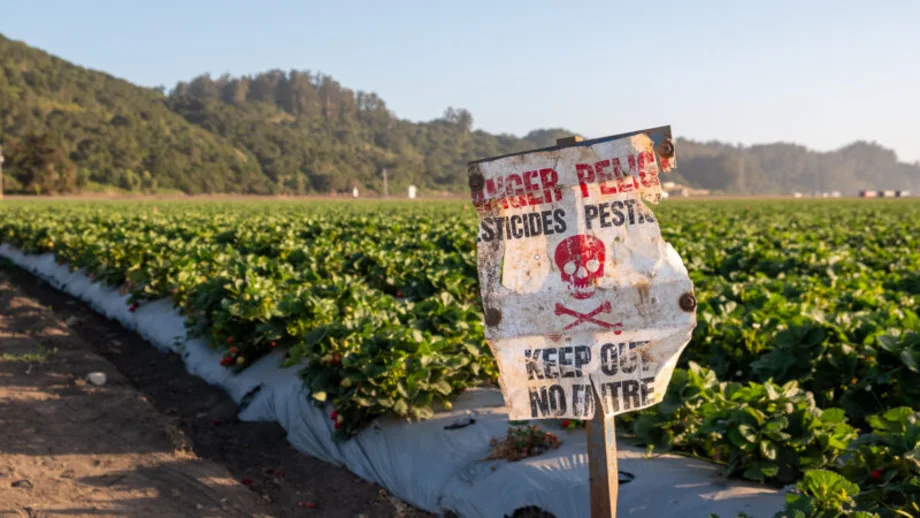 A sign in a strawberry field in the Pajaro Valley, California - Source: Santa Cruz Local
According to local analyses, in some areas of Santa Cruz County, applications of potentially hazardous pesticides have been recorded near schools and agricultural communities. The issue concerns in particular the chronic environmental exposure of workers, residents and children to substances used in fields, including soil fumigants such as 1,3-dichloropropene and chloropicrin, which are the focus of strong concern among environmental groups and local communities.
This problem is real and deserves attention, but it is not the same as the risk associated with eating strawberries. The confusion between environmental exposure in production areas and the ingestion of residues on fruit that complies with legal limits is one of the most frequent errors in viral content. For the supply chain, ignoring the first issue would be short-sighted; but turning it into a message such as “eating strawberries causes cancer” is scientifically incorrect.
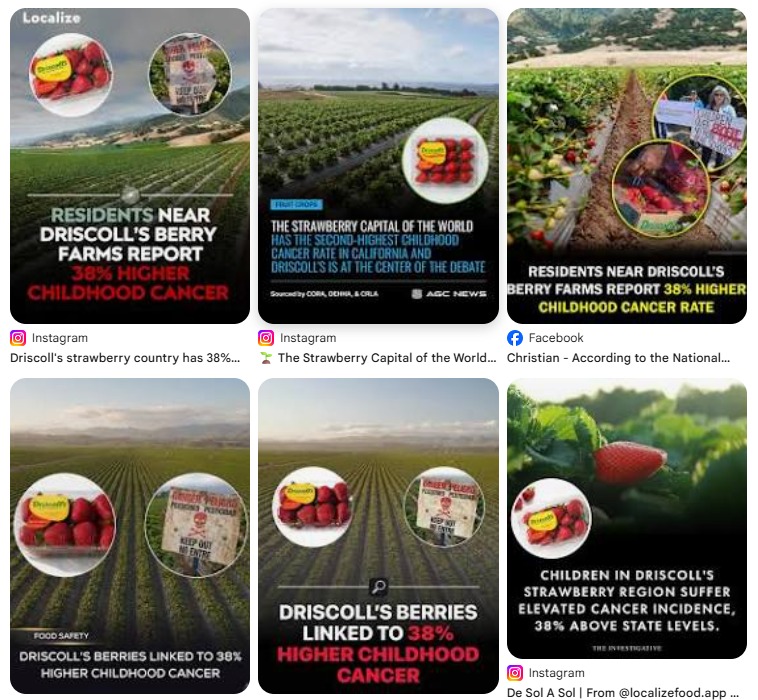 The accusations against Driscoll's quickly went viral
Driscoll’s response and the issue of trust
Driscoll’s rejected the accusations, emphasizing that its production complies with US food safety standards. The company also referred to its commitment to organic production and to working with independent growers to progressively improve agricultural practices.
From a reputational point of view, however, the case shows how fragile consumer trust can be when pesticides, children’s health and major food brands come into play. Berries are perceived as healthy, fresh, natural products suitable for family consumption. For this very reason, any message questioning their safety has a very high potential for amplification.
For brands, simply declaring regulatory compliance is no longer enough. Compliance is the starting point, but it is not always sufficient to reassure consumers exposed to simplified and polarizing content. What is needed is transparency, clarity on controls, an explanation of residue limits, understandable communication about the difference between hazard and risk, and a credible narrative about efforts to reduce the environmental impact of cultivation.
What this means for the berry sector
The Driscoll’s case directly concerns strawberries, but it speaks to the entire berry sector. Berries and health are now closely linked in consumers’ minds: antioxidants, convenience, naturalness and taste are the main pillars of the category’s success. This communication strength, however, makes the sector more exposed to reputational crises when issues emerge related to residues, chemicals or environmental sustainability.
For growers, exporters, retailers and brands, the lesson is twofold. On the one hand, defensive or dismissive reactions should be avoided: consumer interest in residues, organic production, the environment and health is set to grow. On the other, incorrect simplifications must be countered, because an unfounded alarm can damage the entire category and discourage the consumption of fresh fruit, with negative effects also from a nutritional perspective.
The most effective communication will therefore need to hold together three messages. First: the presence of residues within legal limits does not equate to a proven health risk. Second: the sector must continue to reduce the use of the most controversial substances, improve integrated pest management techniques and invest in organic production, varietal innovation and lower-impact production systems. Third: food safety and environmental sustainability are connected issues, but they are not interchangeable, and they need to be explained precisely.
A crisis to be managed with more science and fewer slogans
The case of Driscoll’s strawberries shows that the future of the berry category will not depend only on organoleptic quality, shelf life or product availability, but also on the ability to manage trust. In an information environment dominated by social media, a single test, a technical term such as PFAS or a local statistic on childhood cancers can be recombined into a viral narrative capable of generating fear.
The response cannot be silence, nor can it be denial of the problem. The sector must be able to distinguish between unfounded alarms and real issues, better explain control systems and take a more active role in the public debate on residues and sustainability. Because trust today is not built only by complying with legal limits: it is built by making consumers understand why those limits exist, how they are monitored and how the supply chain is working to go beyond simple compliance.