





Summary of the presentation "Advanced protocols for organic blueberry fertilization in open field and soilless systems" by Michele Ghezzi, presented as part of the Berry Area 2026 programme.
The nutritional management of blueberries now requires a technical paradigm shift to combine optimal yields, fruit quality and genuine agronomic sustainability.
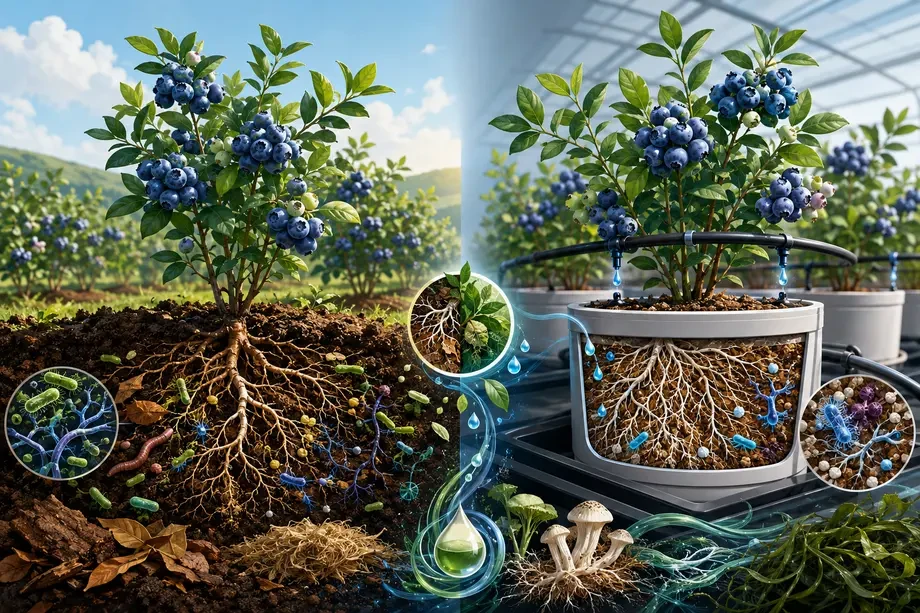
The presentation by agronomist Michele Ghezzi outlines advanced protocols for organic fertilization, clearly differentiating the strategies for open-field cultivation and soilless systems.
The approach moves beyond the logic of merely pushing quantitative growth through macronutrients, focusing instead on the targeted use of microbial inoculants, complex biostimulants and pure organic matrices within extremely rigorous phenological calendars.
For operators in the berry supply chain, the standardization of these practices provides an operational roadmap capable of protecting the integrity of the soil-plant system and optimizing vegetative and productive development, while reducing physiological stress in intensive plantations.
Key takeaways
1. Organic fertigation requires an alternating rhythm.
The application of liquid preparations follows a strict schedule on three alternate days, for example Monday, Wednesday and Friday. This pattern prevents overload of the root system and encourages direct synergistic mixtures, such as combining organic liquid blood meal with 10% Bacillus solutions.
2. In soilless systems, initial substrate imprinting is crucial.
In potted plantations, spring start-up requires the incorporation of 100% pure worm humus and the addition of a granular biological shield based on Beauveria bassiana and Metarhizium anisopliae, to rapidly colonize the restricted root volume and protect the roots.
3. In open field, soil bioregeneration is the priority.
In the extended soil-based cycle, March applications focus exclusively on the soil component through PGPR bacteria and bioregenerating microorganisms. No traditional fertilizer is applied before the soil microbiome has been fully reactivated.
4. August must become a physiological pause.
The open-field protocol imposes a complete stop to fertigation in August. This phase is essential to promote tissue lignification and ensure winter survival, avoiding late and damaging vegetative pushes.
What emerges from the presentation
The architecture of the new organic protocols for blueberries marks a clear evolution compared with conventional fertilization practices.
The focus is no longer simple mineral nutrition, but the complex management of the microbiome, root functionality and the physiological balance of the shrub.
The strategy is built around a precise alternating-day fertigation schedule, an essential operating pattern to avoid root overload and to build specific synergies between the different biological matrices.
This scheduled rhythm is the prerequisite for maximizing the effectiveness of a diversified biological toolkit, which may include NPK fertilizers at pH 4.5, mycorrhizae, free amino acids, algae, beneficial bacteria and liquid organic preparations.
Organic nutrition is not improvisation
The organic protocol requires precise timing, sequences and combinations.
Its effectiveness does not depend on the amount of product applied, but on the ability to intervene at the correct physiological moment, respecting the rhythm of the plant and its root system.
Browse and download the full presentation
The alternating schedule as the basis of the protocol
One of the most relevant operational elements is the fertigation rhythm.
The application of liquid preparations does not take place continuously or indiscriminately, but according to an alternating-day sequence, typically three times a week.
This approach distributes inputs in a more physiological way, avoiding excessive accumulation in the root volume and reducing the risk of plant stress.
In blueberries, a species characterized by a sensitive and superficial root system, managing the nutritional load is particularly delicate.
The alternating schedule also makes it possible to build targeted mixtures, such as combining organic liquid blood meal with 10% Bacillus solutions, with the aim of simultaneously strengthening nitrogen nutrition and microbiological activity.
Soilless systems: colonizing the substrate immediately
In soilless plantations, organic management starts from a fundamental technical premise: the artificial substrate is a restricted, intensive root environment, more vulnerable than natural soil.
For this reason, the spring start-up requires true biological imprinting of the substrate.
The incorporation of 100% pure worm humus enriches the matrix with stable organic matter, beneficial microorganisms and compounds capable of improving the biological functionality of the root volume.
This is combined with a granular shield based on Beauveria bassiana and Metarhizium anisopliae, beneficial fungi used to protect the rhizosphere and promote timely biological colonization.
In a potted system, where the plant cannot compensate for errors by exploring a large volume of soil, the quality of the initial imprinting becomes decisive for the entire production cycle.
| Cultivation system | Technical priority | Key intervention |
|---|---|---|
| Soilless | Rapidly colonize the restricted substrate. | Pure worm humus and biological shield with Beauveria and Metarhizium. |
| Open field | Reactivate the soil microbiome before nutrition. | PGPR and bioregenerating microorganisms in March. |
| Spring cycle | Support vegetative restart without overloading the roots. | Alternating fertigation with liquid preparations and biostimulants. |
| Summer in open field | Avoid late vegetative pushes. | Complete stop to fertigation in August. |
| Autumn | Prepare the plant for winter dormancy. | Microbial recall and closing copper treatment. |
Amino acids and biostimulants in the intensive cycle
In soilless systems, the vegetative cycle is more intensive and compressed, especially between March and June.
The plant must support vegetative restart, root development, flowering, fruit set and berry growth over a short period.
In this context, the use of free amino acids and complex biostimulants plays a physiological support role.
It is not simply a matter of supplying nutrients, but of helping the plant better manage the phases of greatest metabolic demand.
The goal is to support vegetative and productive development without excessively forcing the balance of the shrub, preventing nutritional stimulation from turning into stress.
Open field: first the soil, then nutrition
The open-field protocol follows a deeply different logic.
In natural soil, the first objective is not to feed the plant directly, but to reactivate the biological ecosystem that supports root uptake.
March applications therefore focus exclusively on the soil component, through the use of PGPR bacteria and bioregenerating microorganisms.
Before the soil microbiome is reactivated, no traditional fertilizer is applied.
This choice highlights a fundamental principle of the organic approach: fertility is not only the chemical availability of elements, but the soil's ability to make them dynamically and functionally accessible to the plant.
August: the stop that prepares the plant for winter
The most strategic phase of the open-field protocol concerns the late-summer period.
In August, fertigation is stopped completely.
This pause is not a random suspension, but a precise physiological choice.
At this stage, the plant must gradually reduce vegetative growth and direct its resources towards tissue lignification.
Late fertilization, especially if capable of stimulating new vegetation, would risk producing tissues that are too tender and vulnerable to winter cold.
The August pause therefore becomes a technical tool to promote wood hardening and improve plant survival during winter dormancy.
Sometimes feeding less means managing better
In blueberries, organic nutrition does not mean continuously pushing growth.
The summer pause in open-field systems shows that correct management also means knowing when to stop inputs, at the moment when the plant must lignify and prepare for winter.
Closing the biological cycle in autumn
After the summer pause, the biological cycle is closed progressively and rationally.
In September, a microbial recall is scheduled, useful to support the biological balance of the soil and accompany the plant towards the final stage of the season.
In October, the closing copper-based treatment helps seal wounds and prepare the plantation for winter dormancy.
This sequence shows how the protocol is built not only around the production phase, but around the plant's entire physiological cycle.
The profitability of the plantation also depends on the ability to preserve the plant in the long term, reducing stress, decline and restart problems in the following season.
High-precision organic nutrition
The overall picture shows that organic blueberry fertilization cannot be interpreted as a simple replacement of conventional fertilizers with organic products.
It is instead a high-precision technical system, in which timing, dosages, matrices and physiological objectives must be consistent.
The use of microorganisms, humus, amino acids, algae, liquid preparations and closing treatments requires a careful reading of phenological stages and plantation type.
Soilless and open-field systems cannot be managed with the same calendar, because they respond to different agronomic logics.
In the first case, control of the restricted substrate dominates; in the second, the priority is soil regeneration and respect for the physiological timing of the shrub.
In summary
Advanced organic blueberry fertilization protocols indicate a clear direction: nutrition must become a tool for balance, not only for production stimulation.
The alternating rhythm of fertigation, biological imprinting of the soilless substrate, preventive soil bioregeneration and the physiological August pause are all components of a broader approach.
The real goal is to build a more resilient soil-plant system, capable of supporting productivity, fruit quality and plantation longevity.
For berry growers, the operational lesson is clear: high profitability increasingly depends on precise biological protocols, planned and consistent with blueberry physiology.