





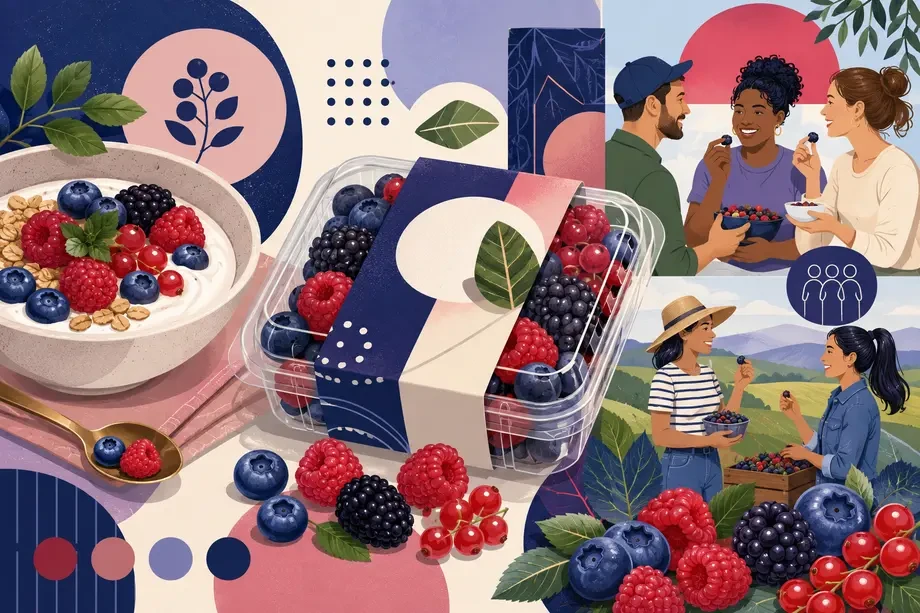
In the berry market quality remains crucial, but it is no longer enough to create value. New branding trends point in a precise direction: the strongest brands do not simply sell products, but build identity, rituals and belonging.
For years, branding in the fruit and vegetable sector focused on a few concepts: origin, freshness, naturalness, safety, sustainability and health. These are all important elements, but today they are increasingly less distinctive. In the case of berries, the risk is clear: blueberries, raspberries, blackberries and redcurrants are perceived as high-value products, but on the shelf they often end up competing mainly through price, format, fruit appearance and brand.
The problem is that many brands tell more or less the same story. They are all good, all natural, all healthy, all sustainable. But when everything communicates the same values, differentiation becomes weaker. Contemporary branding is moving beyond this: it no longer simply aims to build brand loyalty, but seeks to create recurring behaviours, communities and cultural recognisability, as analysed by Gianluca Diegoli in "Brand, cults and tribes in the age of the algorithm" (2026).
From brand to ritual
According to Diegoli, one of the most relevant shifts in new branding is the move beyond simple loyalty. The traditional brand asked consumers to recognise and prefer it. The contemporary brand instead seeks to enter everyday habits, becoming a consumption ritual.
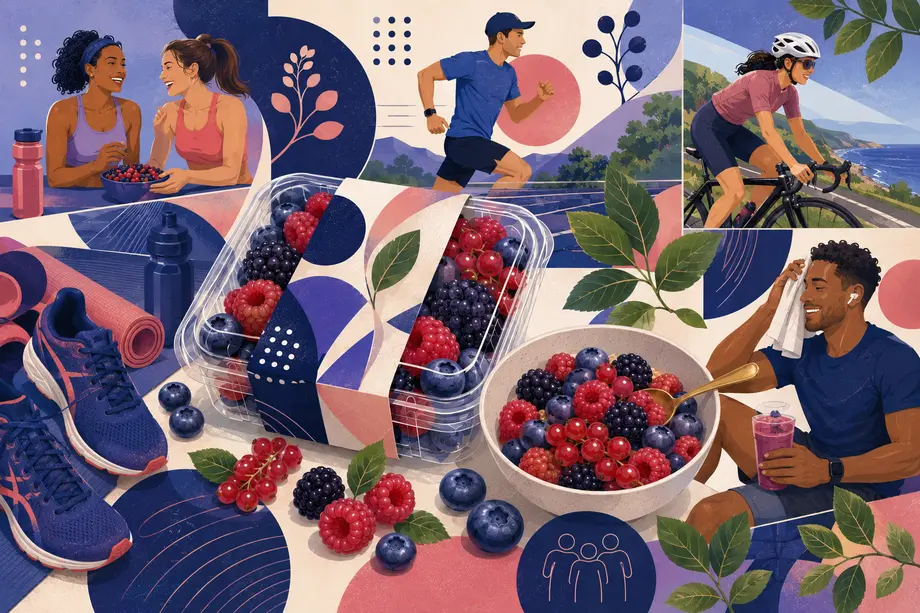
For berries, this perspective is particularly interesting. The product lends itself to many occasions: breakfast, office snacks, children’s snacks, post-workout consumption, toppings for yogurt and porridge, light desserts. The point is no longer simply to say “these blueberries are good”, but to build a context in which that consumption becomes recognisable, repeatable and shareable.
A blueberry brand can work on the morning routine; a raspberry brand can occupy the area of fresh and light pleasure; a berry mix can become the symbol of a healthy and colourful break. Packaging, social content, point of sale and tone of voice must converge towards the same goal: turning an occasional purchase into a habit.
Wellness: not just health, but lifestyle
Wellness has become one of the major codes of contemporary consumption. It is no longer just about diet and fitness, but includes energy, balance, longevity, mental wellbeing, performance and self-care. Berries have a natural position within this universe, but they must avoid overly generic communication.
Saying that berries are healthy is no longer enough. Consumers are looking for messages closer to their lifestyles: products for those who do sport, for those who want a practical snack, for those looking for alternatives to traditional sweets, for those preparing visually appealing breakfasts or for those buying for their children.
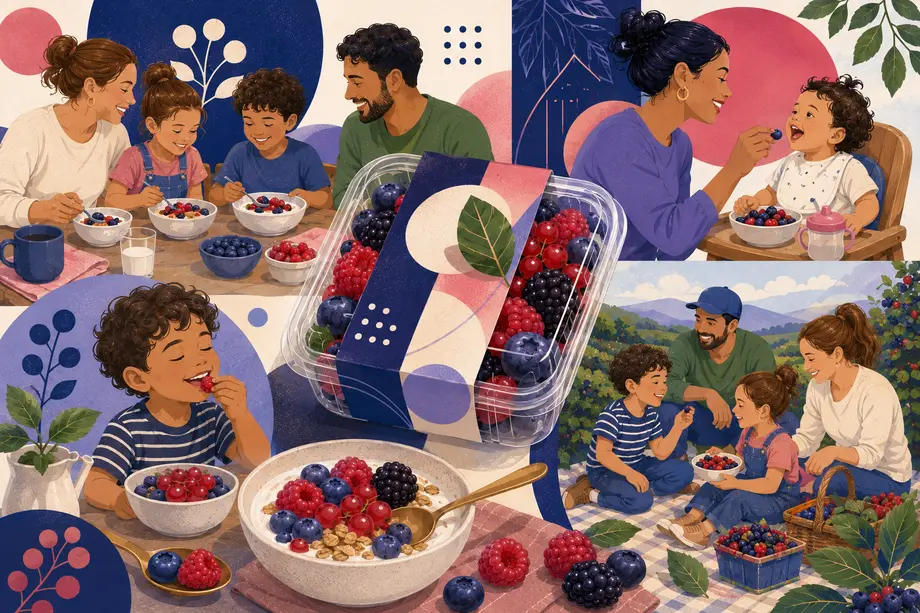
The future of branding in berries will therefore not be based only on health claims, but on a true lifestyle positioning: not just a healthy product, but a product that helps consumers feel part of a way of living.
Community as a competitive advantage
Another central trend is the growth of brands built around communities. Not simple social audiences, but groups of people who share languages, habits, values and content. In the world of berries, this dimension is still underdeveloped, but it offers major opportunities.
The community can emerge around many territories: families, athletes, cooking enthusiasts, nutritionists, runners, premium consumers, people interested in longevity or plant-based cooking. Each group requires different codes. Speaking to someone who buys blueberries for their children is not the same as speaking to someone who uses them in a protein smoothie after training.
This is why generalisation is one of the main enemies of marketing. An effective brand should not speak to everyone in the same way. It must choose a territory, build a coherent language and allow people to adopt it, interpret it and spread it.
Packaging as media
In packaged fresh produce, packaging remains one of the main branding tools. For berries, often sold in transparent punnets and standardised formats, the challenge is even more complex: communication space is limited and visual competition on the shelf is strong.
Precisely for this reason, packaging must become more selective. It cannot say everything. It must choose one main message and make it immediately recognisable: a taste promise, a usage occasion, an origin, a consumption function or a varietal identity.
Effective packaging should work on three levels: shelf visibility, clarity of benefit and brand memorability. Transparency remains essential, because consumers want to see the fruit. But around transparency, a stronger visual system must be built, consistent across packaging, website, social media and point of sale.
From variety to storytelling
In the berries sector, genetics is becoming increasingly important. New varieties promise greater sweetness, crunchiness, size, shelf life, colour and aroma. However, many of these innovations remain confined to the technical language of the supply chain and reach the final consumer only weakly.
Branding can turn variety into storytelling. This does not necessarily mean communicating the varietal name in a technical way, but translating the characteristics of the fruit into an understandable experience: sweeter, crunchier, more intense, larger, more suitable for snacking or breakfast.
The variety is not only an agronomic or commercial asset. It can become an element of perceived differentiation, if it is communicated in a simple, coherent and recognisable way.
The brand in the age of the algorithm
Today, consumers increasingly discover brands through content distributed by algorithms: short videos, recipes, creators, reviews, in-store experiences, spontaneous posts. For berries, this means that content cannot be merely institutional.
Simple, repeatable and recognisable formats are needed: recipes lasting a few seconds, breakfast ideas, storage tips, suggestions to avoid waste, preparations for children, pairings with yogurt, cereals, desserts or protein products.
The brand should not simply publish content, but build a system that makes it easy for others to talk about the product. If consumers photograph a punnet, share a recipe or use a hashtag, they are contributing to brand building.
Fewer slogans, more proof
In food, authenticity is an increasingly delicate issue. Consumers are exposed to many messages about sustainability, naturalness and origin, but they are also more sceptical of overly generic formulas. This is why brands must move from slogans to proof.
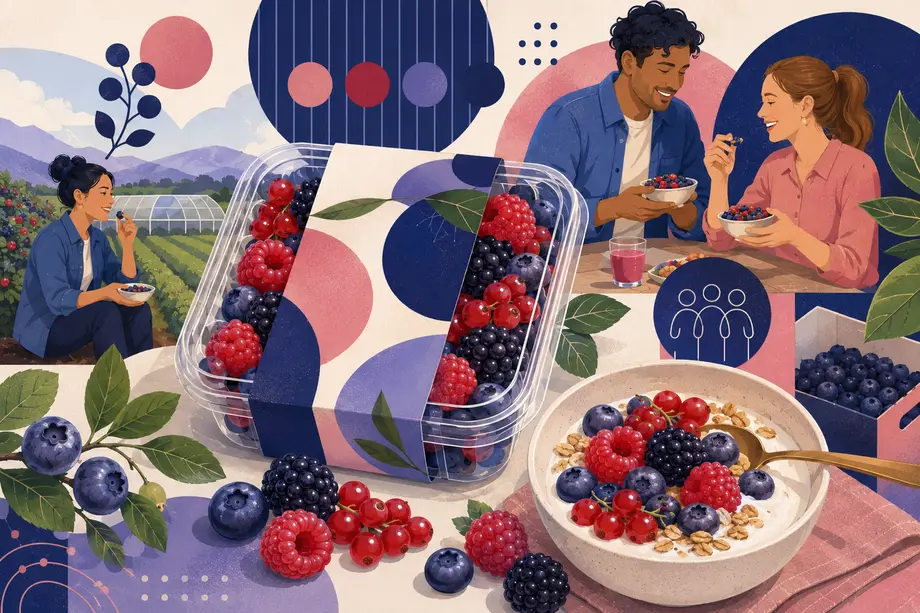
In the case of berries, proof can be very concrete: the faces of growers, production areas, seasonality, harvesting techniques, quality management, waste reduction, shelf life, packaging materials, traceability and water use.
Not everything has to be on the packaging. But everything must be accessible, coherent and verifiable. A QR code can be useful only if it leads to content truly designed for the consumer, not to generic or overly technical pages.
How to apply these trends to berries
To apply the new branding trends to berries, companies should start from a simple question: what behaviour do we want to create in the consumer? Buying once? Remembering the brand? Repeating the purchase? Using the product in a routine? Sharing it?
Operational choices follow from this question. A brand focused on breakfast will have to build images, recipes, packs and messages consistent with that moment of the day. A brand for children will have to work on practicality, safety, sweetness and portioning. A premium brand will have to focus on variety, taste, origin and texture.
The brand does not have to cover the entire market. It must occupy a clear mental space. It is better to be highly relevant to a specific group of consumers than generically present for everyone.
Conclusion: from berries as a product to berries as identity
New branding trends point in a clear direction: consumers are not looking only for products, but for meanings, habits and belonging. For berries, this is a major opportunity, because the category already has many elements that are consistent with new consumption styles: health, colour, freshness, practicality, pleasure, naturalness and versatility.
The challenge is to move beyond generic communication and build brands that are more recognisable, more specific and more capable of entering people’s everyday lives. Berries should not be described only as good and healthy fruits. They must become gestures, rituals, symbols and consumption occasions.