













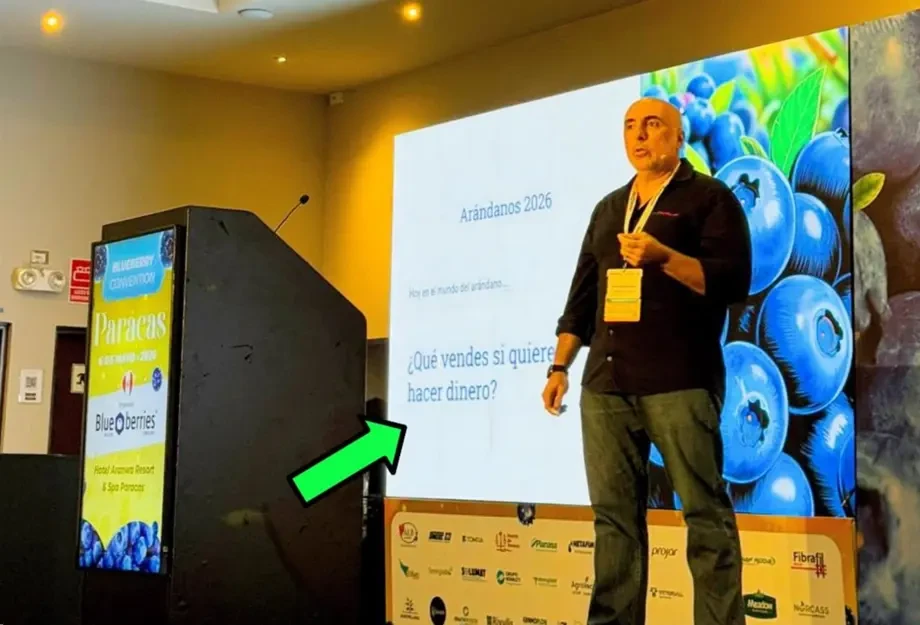
According to Diego Castagnasso, founder of Drip Consulting and author of the “DC’s B-Side” newsletter, the global blueberry business has entered a new phase: after the era of availability and the era of quality, today the real competitive lever is synchronization between production, demand, logistics and the commercial moment.
The global blueberry market is no longer what it was twenty years ago. This is highlighted by Diego Castagnasso, international consultant in the sector and founder of Drip Consulting, in the latest edition of the “DC’s B-Side” newsletter, published after his presentation at Blueberry Consulting in Paracas, Peru.
The central thesis is clear: the blueberry business has changed completely. But, Castagnasso notes, for many operators the underlying objective remains very concrete: bringing home the economic result. “The blueberry business changed… completely”, he writes in the newsletter, adding that “getting the bread home” remains one of the main objectives for much of the supply chain.
From a market of availability to a market of quality
According to Castagnasso’s reconstruction, in 2006 the business was relatively simple: there was not enough product, the commercial windows were wide and clearly defined, and genetics were still basic. In that context, availability was already a competitive advantage. “If you had blueberries available, you could sell them”, the author summarizes.
The next phase, broadly placed around 2016, was instead dominated by quality. The arrival of new genetics, the evolution of consumer expectations and the growing attention of retailers to parameters such as firmness, bloom, shelf life and presentation changed the rules of the game. It was no longer enough to produce blueberries: it was necessary to produce good blueberries.
For some years, this logic worked. Quality made it possible to differentiate the offer, support higher prices and build premium segments. But according to Castagnasso, this phase too is now showing its limits.
When everyone is premium, nobody really is
The critical point is that in 2026, quality alone is no longer enough. Many producers now have good genetics, or are replacing old varieties with cultivars that are more aligned with current market demand. Everyone talks about crunch, size, premium varieties and superior quality.
Castagnasso frames the issue very directly: “Everybody has ‘premium’ varieties. Everybody claims to have great quality. And when everyone is ‘premium’… nobody really is”. In other words, what was once a distinguishing factor tends to become a minimum standard for market access.
This reading is particularly relevant for growers, exporters and breeders: competition is no longer only about the ability to produce a better fruit, but about the ability to place it on the market at the exact moment when that value is recognized and paid for.
The new keyword is synchronization
According to Castagnasso, the real competitive lever today is timing. Not just producing fruit, and not even producing excellent fruit, but synchronizing every element of the supply chain: production, demand, logistics, quality and the commercial window.
“We no longer sell blueberries. We sell timing”, the author writes. This is perhaps the sentence that best summarizes the paradigm shift: the market no longer simply rewards production effort or declared quality, but the commercial relevance of the product at the moment it reaches its destination.
The consequence is a much more severe market. A delay of just a few days, a temporarily oversupplied destination, a logistical problem or a sudden change in global flows can turn a theoretically premium blueberry into an undifferentiated product. “That ‘premium’ fruit that looked so profitable on paper… becomes just another blueberry”, Castagnasso observes.
The China case: premium versus domestic product
One of the examples discussed in Paracas concerns China, a market that for years was considered an almost unlimited destination for exported premium blueberries. But the scenario changes when expensive imported product positioned in the high-end segment arrives in a market already saturated with large-sized domestic Chinese blueberries.
In that case, Castagnasso explains, the exported product may find itself competing with fruit sold in much simpler packaging, even in plastic bags, but with a similar visual impact in the eyes of the consumer. “Same size. Same visual impact. Very different cost structure”, he writes.
The issue is not only price. It is the market’s ability to rapidly reduce the premium granted to imported product when the perceived difference is not strong enough or does not arrive at the right time. The consumer, Castagnasso underlines, does not always reward the difference that the exporter expected.
The market does not reward effort, it rewards relevance
The conclusion of the newsletter is particularly useful for reading the current phase of the sector: the market does not automatically reward those who produce well, but those who manage to be relevant at the right moment. “The market no longer rewards effort. It rewards relevance”, Castagnasso writes.
The formula proposed is only apparently simple: the right fruit, with the right quality, in the right place, at the right time. It is this combination, not quality in isolation, that determines what is actually paid for.
For this reason, Castagnasso warns that those who continue to base their strategy on the idea that “good fruit sells itself” may already be operating with an outdated commercial model. “If your strategy still assumes that ‘good fruit sells itself’… you may already be operating with an outdated commercial model”.
Morocco, Russia, China and the United States: when timing changes everything
In the final part of the newsletter, Castagnasso also refers to the case of Morocco and the Russian market. Here, the change is not described with generic formulas: “Let’s stop calling it geopolitical unrest… It was war”, he writes, referring to the effects of the conflict on costs, logistics and trade flows.
According to the analysis reported in the newsletter, rising costs and logistical difficulties made the arrival of Moroccan product in Russia more complex. Meanwhile, Chinese premium blueberries were already present on the market, at a more competitive price. At the same time, the US market suddenly found itself with a major supply gap caused by a frost event in Florida.
The result was a rapid shift of Moroccan product towards the United States. For Castagnasso, this is not just a case of efficient logistics: “That is pure timing”. The ability to read the market, change destination and intercept a sudden window thus becomes a strategic competence.
A new phase for the blueberry supply chain
The reflection by Diego Castagnasso captures an increasingly central theme also for the European and Italian system: the growth of blueberries cannot be managed only through genetics, quality and increased production. These factors remain essential, but they are no longer enough to guarantee margins.
The new competition requires planning capacity, market reading, flow management, decision-making speed and commercial consistency. In an increasingly efficient and responsive global market, quality retains value only if it arrives in the place and at the time when the market is willing to pay for it.
As Castagnasso summarizes, “The right fruit. The right quality. In the right place. At the right moment”. This is today’s new competitive grammar of the global blueberry business.
Source: Diego Castagnasso, Drip Consulting, “DC’s B-Side” newsletter, edition following his presentation at Blueberry Consulting, Paracas, Peru.