











Blueberries during pregnancy are of interest not only because of their nutitional profile, but also because they contain anthocyanins and other polyphenols studied for their potential effects on metabolism. A small randomized clinical trial conducted in the United States investigated this possibility in a particularly vulnerable group: women with obesity and at high risk of developing gestational diabetes.
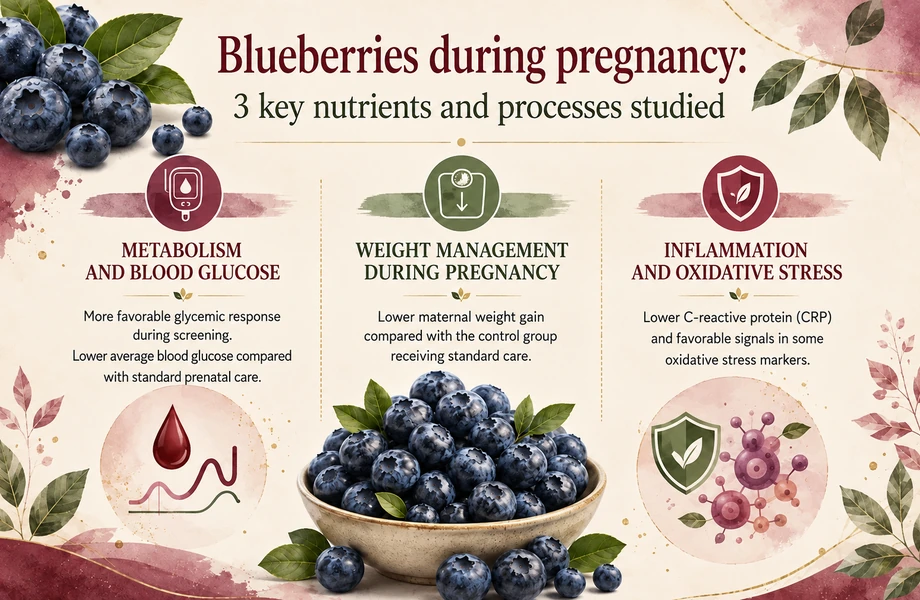
For 18 weeks, participants assigned to the intervention consumed 280 grams of whole blueberries every day together with 12 grams of soluble fiber. Compared with the group receiving standard prenatal care, the researchers observed lower weight gain during pregnancy, lower blood glucose levels in the screening test and a lower concentration of C-reactive protein, a marker of inflammation.
A second study involving the same group also identified favorable changes in certain markers of oxidative stress.
Why metabolism and blood glucose are important during pregnancy
Pregnancy involves profound metabolic changes. These include a physiological reduction in insulin sensitivity, which also helps ensure an adequate supply of nutrients to the fetus. In some women, however, the body has greater difficulty maintaining blood glucose within an appropriate range.
Pre-pregnancy obesity, a history of gestational diabetes and certain dietary patterns may contribute to an increased risk.
It is in this context that diet is of particular interest to researchers. Fruit, vegetables and other plant-based foods provide fiber and numerous bioactive compounds, including polyphenols. Blueberries are particularly rich in anthocyanins, the pigments that give the fruit its characteristic blue-purple color and that are being studied for their interaction with metabolism, vascular function and inflammatory processes.
This does not mean that a single food can control gestational diabetes. Rather, clinical studies are designed to determine whether including specific foods in the diet may help modify certain measurable indicators.
Blueberries during pregnancy: how the study was conducted
The trial, published in 2021 in The Journal of Nutrition by Arpita Basu and colleagues, involved 34 pregnant women with obesity, with a mean age of 27 years and a mean body mass index of 35.5 kg/m². Approximately 56% had previously experienced gestational diabetes, while around 79% of the participants were of Hispanic origin.
The women were recruited before the twentieth week of pregnancy and randomly assigned to two groups. The intervention group consumed 280 grams of whole frozen blueberries every day, corresponding to two cups (approximately 473 ml) according to the US protocol, together with 12 grams of soluble fiber in the form of partially hydrolyzed guar gum.
The control group received standard prenatal care. Both groups also participated in a nutrition education program.
The intervention continued for approximately 18 weeks, extending into the later stages of pregnancy. Weight, blood pressure, blood test results and metabolic parameters were assessed at baseline, between weeks 24 and 28 and again between weeks 32 and 36.
Lower weight gain and a more favorable blood glucose response
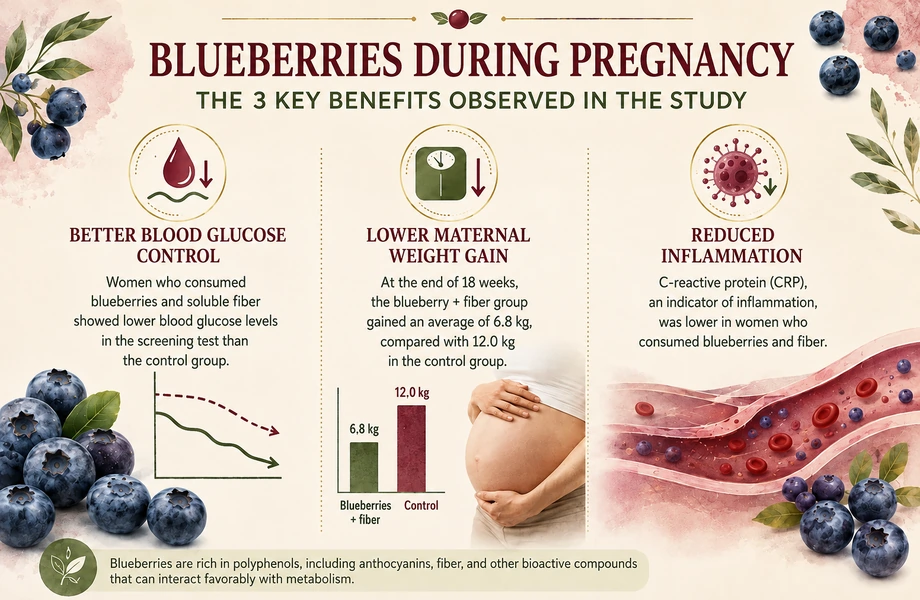
One of the clearest findings concerned maternal weight gain. At the end of the study, women in the blueberry and fiber group had gained an average of 6.8 ± 3.2 kg, compared with 12.0 ± 4.1 kg in the control group. The difference was statistically significant.
The test used to assess the glucose response also showed a difference: mean blood glucose levels were 100 ± 33 mg/dL in the intervention group and 131 ± 40 mg/dL in the control group. The results therefore suggest a more favorable blood glucose profile among women who followed the dietary intervention.
Another interesting finding concerned C-reactive protein (CRP), a blood marker used to assess inflammatory status. At the end of the intervention, it was 5.5 ± 2.2 mg/L in the blueberry and fiber group, compared with 9.5 ± 6.6 mg/L in the control group.
However, not all parameters changed. Total cholesterol, LDL, HDL and triglycerides showed no significant differences between the groups. No differences were observed in the babies’ birth weight either.
Antioxidants and oxidative stress: further favorable signs
The same researchers subsequently conducted a more detailed analysis of the blood samples collected during the trial. A second article, published in Antioxidants, reported favorable differences in certain indicators of oxidative stress.
In the group receiving blueberries and fiber, levels of reduced glutathione and serum antioxidant capacity increased, while malondialdehyde, a marker of lipid peroxidation, decreased. Reductions were also observed in PAI-1 and visfatin, two biomarkers studied in relation to adipose tissue function and metabolic processes.
The anthocyanins and other blueberry polyphenols may have contributed to these results. According to the analysis reported by the authors, the fruit used in the study provided approximately 1,600 mg of total polyphenols and 700 mg of anthocyanins per day.
However, the underlying mechanisms still need to be clarified. Referring generically to an “antioxidant effect” does not mean that anthocyanins simply act by neutralizing free radicals in the blood. Current research also considers their conversion into metabolites, their interaction with the gut microbiota and their modulation of different cellular pathways.
An important limitation: blueberries and fiber were studied together
The most important point to bear in mind is that the study does not make it possible to separate the effects of blueberries from those of the added soluble fiber.
The participants consumed not only 280 grams of blueberries, but also 12 grams per day of partially hydrolyzed guar gum. Fiber itself can influence satiety, blood glucose response, the microbiota and metabolism. The authors explicitly acknowledge that the results cannot be attributed precisely to only one of the two components of the intervention.
The importance of this distinction is also supported by more recent research on fiber during pregnancy. A 2026 trial involving 98 women at high risk of gestational diabetes found that supplementation with soluble fiber alone improved certain parameters of the blood glucose response and altered the gut microbiota.
This reinforces the need to consider blueberries and fiber as a combined intervention, rather than as proof of an isolated effect of the fruit.
Study limitations
There are also other limitations: only 34 participants, a highly specific population and the absence of a food placebo comparable to blueberries. The results are therefore promising, but require larger studies and interventions capable of distinguishing the contribution of the different dietary components.
What these findings suggest for daily consumption
The study is also interesting from a supply chain perspective: it used whole frozen blueberries, rather than a concentrated extract or capsule. The research therefore evaluated the fruit as part of an actual dietary intervention, although it was combined with supplemental fiber.
However, the amount studied, 280 grams per day, is high compared with occasional consumption and should not be interpreted as a recommended intake for all pregnant women. Nutritional requirements during this stage of life depend on individual circumstances and should be assessed with the healthcare professionals overseeing the pregnancy.
The most useful message is a broader one. These findings add to the evidence supporting interest in plant-based foods rich in fiber and polyphenols as part of balanced dietary patterns. In particular, this small trial suggests that an intervention including blueberries during pregnancy may contribute to a more favorable metabolic profile in women with obesity and a high metabolic risk.
Future research
It is not yet possible to determine how much of the observed benefit depends specifically on blueberries, but the findings concerning weight gain, blood glucose, CRP and oxidative stress warrant further investigation.
Blueberries can be included in a varied and balanced diet during pregnancy, without attributing unproven therapeutic or preventive properties to a single fruit. This article is for informational purposes only and is not a substitute for advice from doctors, dietitians or nutritionists.
🫐 Well-being & Health with Berries 🍓This article is part of the editorial series Wellness & Health with Berries, which brings scientific research closer to everyday life, promoting berries as allies for well-being. The series offers clear, up-to-date, and evidence-based content designed to inform consumers and support all operators in the berry supply chain. |
Sources:
- Basu A., Feng D., Planinic P., Ebersole J.L., Lyons T.J., Alexander J.M., “Dietary Blueberry and Soluble Fiber Supplementation Reduces Risk of Gestational Diabetes in Women with Obesity in a Randomized Controlled Trial”, The Journal of Nutrition, 2021, 151(5):1128-1138. DOI: 10.1093/jn/nxaa435. PMID: 33693835.
- Basu A., Crew J., Ebersole J.L., Kinney J.W., Salazar A.M., Planinic P., Alexander J.M., “Dietary Blueberry and Soluble Fiber Improve Serum Antioxidant and Adipokine Biomarkers and Lipid Peroxidation in Pregnant Women with Obesity and at Risk for Gestational Diabetes”, Antioxidants, 2021, 10(8):1318. DOI: 10.3390/antiox10081318. PMID: 34439566.
- Machairiotis N., Vasilakaki S., Minns L., Malakasis A., “Nutrients that modulate gestational diabetes mellitus: A systematic review of cohort studies Jan 2019-Jan 2020”, International Journal of Clinical Practice, 2021, 75(8). DOI: 10.1111/ijcp.14033. PMID: 33480127.
- Zhang et al., “Dietary fiber supplementation mitigates gestational diabetes risk and preterm birth via gut microbiota modulation: a randomized controlled trial”, Frontiers in Endocrinology, 2026, 17:1794560. DOI: 10.3389/fendo.2026.1794560. PMID: 41982769.