






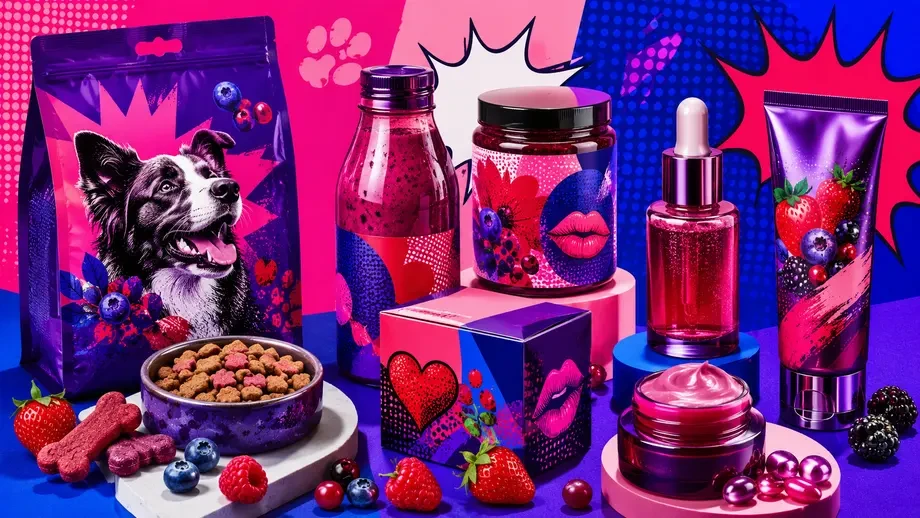
Berries are no longer just a category in the fresh produce aisle. Blueberries, raspberries, strawberries, blackberries, cranberries, blackcurrants, açai, aronia and other berries are becoming ingredients, flavours, natural colours, functional extracts and symbols of naturalness in an increasingly wide range of sectors: beverages, snacks, yogurt, desserts, supplements, cosmetics, food service, pet food and industrial ingredients.
With the new column “Berries as ingredients”, Italian Berry is launching an observatory dedicated to this evolution. The aim is not simply to collect curious products or new items on the shelf, but to analyse how berries are used to generate value: taste, colour, functionality, premiumisation, storytelling, naturalness and innovation.
From punnet to ingredient
In the fresh market, berries are mainly assessed on visual quality, flavour, shelf-life, origin, format and price. But when they enter other products, their role changes. The berry is no longer just a fruit: it becomes a narrative ingredient, a positioning lever and, in many cases, a product claim.

In a functional beverage, blueberry can evoke antioxidants and wellbeing. In a gummy, it can connect taste with beauty-from-within. In a cosmetic product, cranberry can become a botanical extract or an upcycled ingredient. In a snack, raspberry or strawberry can provide colour, acidity and a perception of naturalness. In a mix for horeca, blackcurrant can bring complexity, intense colour and a more adult flavour profile.
This transformation matters because it expands the economic and cultural perimeter of berries.
The value of the category does not end with fresh consumption, but continues across many other supply chains: food & beverage, nutraceuticals, cosmetics, food service, ingredients and lifestyle.
Why observe berries as ingredients
The food market and the wellness market are converging. Consumers are looking for products that are good, appealing, natural, functional and easy to understand. In this scenario, berries have a clear competitive advantage: they are immediately recognisable, have distinctive colours, are strongly associated with health and naturalness, and lend themselves to many industrial applications.
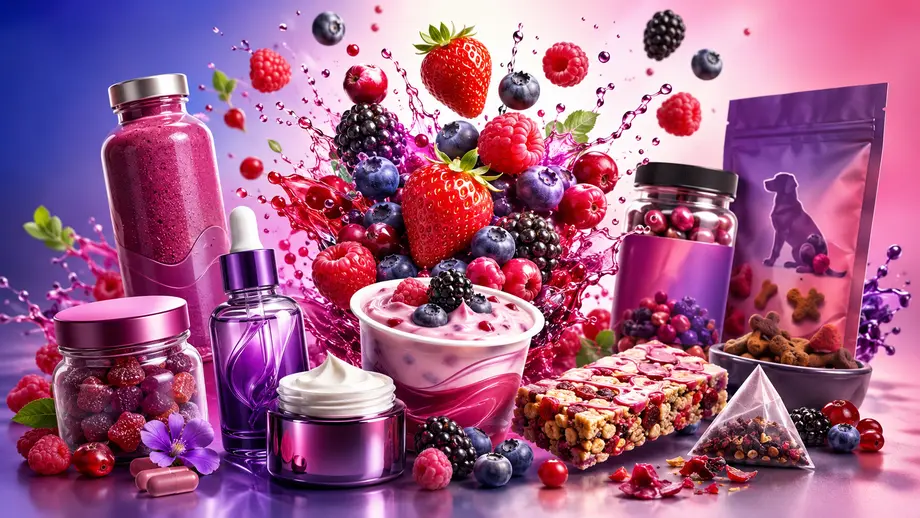
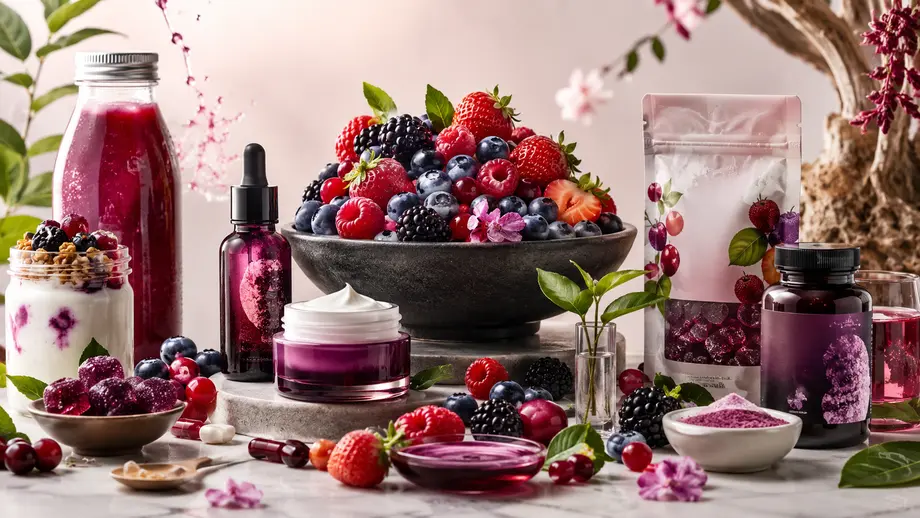
It is no coincidence that the most interesting innovations are often found outside the fresh produce aisle. Ready-to-drink beverages, iced teas, smoothies, bars, yogurt, ice creams, gummies, supplements, cosmetic serums, creams, pet snacks and horeca preparations increasingly use berries as an element of differentiation.
The key point is to understand what function the berry performs in the product. Is it there for taste? For colour? For the health claim? For perceived naturalness? To communicate premium positioning? To intercept a trend such as antioxidants, gut health, beauty-from-within, clean label or plant-based?
Industrial forms: much more than the whole fruit
When berries enter industry, they take on many different forms. They can be used fresh as toppings, frozen as a base for processing, as purée, juice, concentrate, powder, freeze-dried product, standardised extract, natural flavour, crunchy or soft inclusion, seed oil, natural colour or botanical component.
This variety of uses raises new questions for the supply chain. Which varieties work best for colour, acidity or aroma? Which product can be destined for processing? Which by-products can be valorised? Which berries have the greatest potential in cosmetics, supplements or beverages? Which claims are genuinely credible and which risk being just marketing?
For growers, breeders, processors and commercial operators, analysing berries as ingredients can therefore offer concrete insights. Not only to sell fresh product, but to understand where the value of the category is moving.

The sectors to monitor
The “Berries as ingredients” column will continuously track the applications of berries across different sectors.
- Beverages: juices, smoothies, functional drinks, energy refreshers, kombucha, iced teas, flavoured waters, cocktails and mocktails.
- Dairy and desserts: yogurt, kefir, ice creams, chilled desserts, toppings, creams and plant-based products.
- Snacks and bakery: bars, cereals, biscuits, bakery products, freeze-dried inclusions, confectionery and chocolate.
- Supplements and nutraceuticals: gummies, capsules, powders, antioxidant blends, products for immunity, skin, vision, energy and the microbiome.
- Cosmetics and personal care: botanical extracts, seed oils, antioxidant ingredients, creams, serums, masks, scrubs and hair products.
- Pet food: snacks and functional foods for pets with cranberry, blueberry or other berries.
- Horeca and mixology: purées, syrups, infusions, cocktails, toppings and professional preparations.
- B2B ingredients: flavours, natural colours, powders, concentrates, extracts and functional systems for industry.
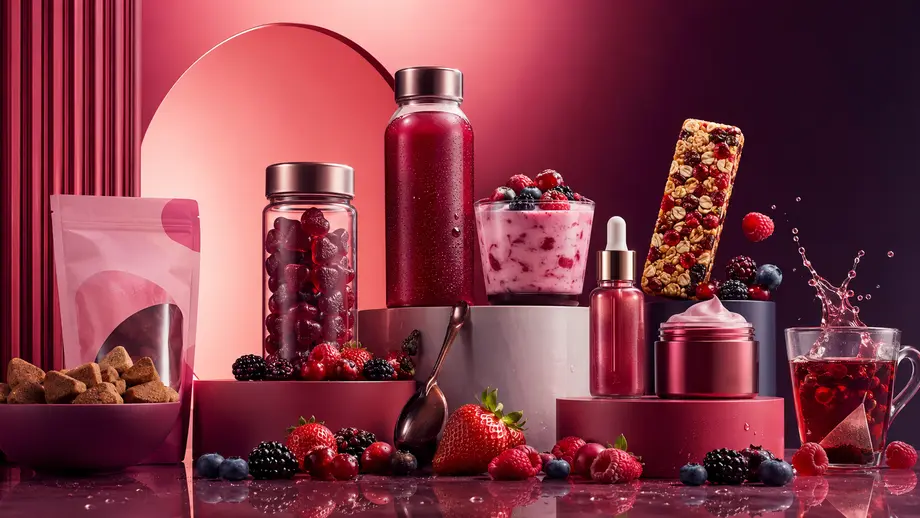
From product cases to market signals
Some recent cases clearly show the direction of travel. Blackcurrant, for example, has been named by McCormick as Flavor of the Year 2026, an interesting signal for a berry with an intense, dark, tart and sophisticated flavour profile. It is not just a fruit: it can become a premium taste code for beverages, desserts, cocktails, bakery products and sauces.
In the beauty-from-within segment, the launch of functional gummies based on blueberry and pomegranate, enriched with collagen, polyphenols and ceramides, shows how berries can enter hybrid products between snacks, supplements and ingestible cosmetics. Here, blueberry does not work only as a flavour, but as an ingredient consistent with a promise of wellbeing and skin care.
In personal care, cranberry is also interesting for the theme of upcycling. Extracts obtained from by-products of juice processing can become cosmetic ingredients for formulations focused on skin renewal, naturalness and sustainability. This is a significant example because it moves the berry outside food and into a completely different supply chain.
These cases suggest that innovation is not only about the finished product, but also about the way the berry is reinterpreted: as taste, as colour, as a functional principle, as a natural ingredient, as a valorised by-product or as a cultural signal.

A column with a method
To avoid becoming a simple collection of new products, Italian Berry will use a stable monitoring grid. Each case will be analysed according to consistent criteria: brand, country, category, berry used, ingredient form, main claim, target, value for the supply chain and editorial relevance.
The monthly report will select the most significant cases, prioritising products and ingredients that show a real capacity to indicate trends. Not every “berry-flavoured” product deserves attention: the most relevant cases will be those in which the berry performs a clear and recognisable function in the positioning.
The column will include three main formats:
- Scenario analysis: in-depth articles on the main categories, trends and opportunities for the supply chain.
- Monthly report: a reasoned selection of 5-7 international cases, with a focus on trends, category of the month and berry of the month.
- Case sheets: short analyses dedicated to individual products, ingredients, brands or particularly interesting applications.
New insights for the berry supply chain
Looking at berries as ingredients means observing a part of the category’s value that is often less visible, but increasingly strategic. For growers, it can open up reflections on new destinations for the product. For breeders, it can indicate which aromatic, chromatic or functional profiles may become more in demand. For processors, it can suggest high value-added applications. For retailers and brands, it can offer new languages to communicate naturalness, wellbeing and innovation.
Moreover, the use of berries in other sectors can also strengthen the fresh product. When a fruit becomes a protagonist in beverages, cosmetics, supplements, snacks and premium products, its cultural recognition grows. Consumers encounter it in different contexts and associate it with values that can also be useful in the fresh produce aisle: taste, health, colour, quality, pleasure and modernity.
Beyond fresh, without losing the link with fresh
“Berries as ingredients” was created to follow the journey of berries when they leave the punnet and become ingredients, claims, experiences and innovation. It is not a move away from fresh, but a way to interpret its evolution within a broader market.
Berries are already one of the most dynamic categories in fresh produce today. The question now is to understand how much value they can generate even outside their traditional perimeter. Italian Berry will follow this path with a dedicated monthly observatory, selecting cases, trends and signals that are useful for the entire supply chain.
Because the future of berries is not played out only in the refrigerated aisle. It is also played out in beverages, snacks, supplements, cosmetics, menus, industrial formulations and in all those products where a small fruit can become a major lever of value.