










In Belgium, strawberry crop protection is entering a new phase: fewer chemicals, more technology and a growing role for UV-C light in preventing fungal diseases. It is a solution that has already reached commercial scale and, according to the sector, is changing the way tabletop strawberries are grown in greenhouses in Flanders.
From research to commercial cultivation
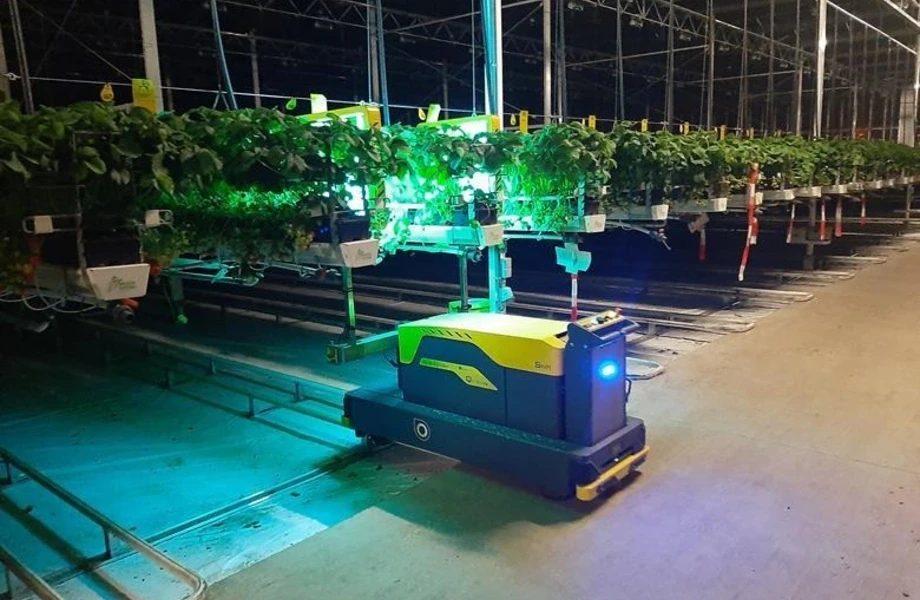
Strawberries are delicate fruits and particularly vulnerable to powdery mildew, a persistent fungal disease that can compromise both quality and yield. For years, crop protection required targeted chemical treatments, but a group of Belgian growers has chosen a different path: using autonomous UV-C light robots to neutralise fungi before they spread.
The system, tested since 2017, has reached full commercial application this season. The robots move autonomously through greenhouses at night, treating plants with ultraviolet-C light when conditions are most suitable for the intervention.
In Flanders, the technology is already being used on a large scale
According to VLAM, adoption is progressing rapidly in the Belgian strawberry sector. Since March 2026, 40% of strawberry growers in Belgium have already been using this technology, which covers around half of the area dedicated to tabletop strawberry cultivation.
“Capacity has doubled compared with last year, so this technology is becoming a central part of our infrastructure,” said Nele Van Avermaet, fruit and vegetables marketing manager at VLAM.
Fewer fungicides and stronger plants
The night-time use of UV-C robots has enabled growers to reduce fungicide use by up to 80%. Combined with beneficial insects for natural pest control, the technology has also halved the number of crop protection products required.
According to growers, the result is a cleaner, more resilient and better-looking strawberry. A grower from Coöperatie Hoogstraten said that, since the introduction of UV-C robots, the difference in the greenhouse is visible every morning: the plants remain strong, the crop looks more vigorous and the fruit shows a particularly glossy finish.
“For us, this is not just about efficiency,” the grower explained. “It means offering a strawberry that looks and tastes like a premium berry, with the reassurance that it has been grown sustainably.”
An advantage for the UK market too
The technology could also have positive effects on distribution. Growers believe that Belgian strawberries will reach retailers in better condition during this season.
The United Kingdom is an important market: demand for strawberries exceeds the short window of local production, and European imports remain essential to meet consumption. The geographical proximity of Flanders to the UK market, just across the Channel, reduces the time between harvest and shelf.
“This means Belgian strawberries are the closest thing to our own domestic production, as natural and fresh as possible,” said Gary Marshall of Bevington Salads. “Even while we wait for the peak of local production, every day can be a good day for a strawberry.”
Looking to the future
The Belgian case shows how sustainability in strawberry cultivation can be achieved through concrete solutions that are already available: automation, UV-C light and integrated biological control. If adoption continues to grow, reducing fungicide use could become not only an environmental goal, but also a new competitive standard for premium strawberries destined for European markets.
Text and image source: www.fruitnet.com