









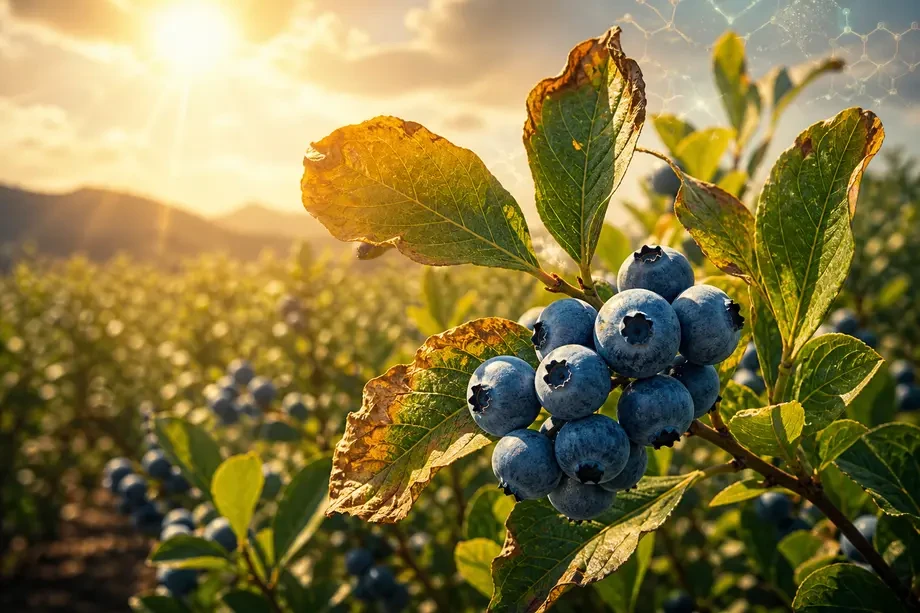
Summary of the presentation on abiotic stress management in blueberries held by Fernando Diez Fontecilla (Nutraktis) at the Berry Area (Macfrut 2026).
The management of abiotic stress in blueberries is becoming an increasingly relevant technical lever to maintain productivity and quality in more unstable climate scenarios.
The presentation by Fernando Diez Fontecilla for Nutraktis at the Berry Area of Macfrut 2026 connected solar radiation, temperature, photosynthesis, oxidative stress and stomatal functionality, proposing glycine betaine and specific polyphenols as tools to support the plant's physiological response.
Listen to the full presentation on Spotify
The focus is not only on protection from visible damage, but on preserving photosynthetic efficiency, sugar production, membrane stability and the plant's ability to transform its genetic potential into commercial yield.
Key takeaways
1. Abiotic stress reduces yield and commercial quality.
In blueberries, it does not appear only as vegetative damage, but directly affects yield, fruit set, size, firmness, quality and sugar accumulation in the fruit. The reduction in productive potential — fewer buds or fewer fruits per node — is linked to the loss of physiological efficiency in the plant under stress.
2. Excessive solar radiation compromises photosynthesis.
Excessive solar radiation, particularly the UV-B component, can compromise the Calvin-Benson cycle, reduce Rubisco activity, damage DNA and activate lipid peroxidation processes in cell membranes. The critical issue is therefore not simply “too much light”, but the loss of photosynthetic functionality.
3. Extreme temperatures and intense radiation converge on oxidative stress.
High or low temperatures and intense radiation activate a common mechanism: ROS production and damage to proteins, lipids and DNA. The plant has enzymatic and non-enzymatic antioxidant systems, but when the pressure exceeds its detoxification capacity, productive damage occurs.
4. Polyphenols are functional tools, but not generic ones.
Polyphenols are presented as tools to modulate ROS scavenging, protect membranes and support tolerance to salt stress, drought, UV-B, high and low temperatures, heavy metals and phytosanitary treatments. Their effectiveness, however, depends on the specific type of compound and on the physiological objective.
5. Glycine betaine protects the photosynthetic engine.
Glycine betaine is described as an osmolyte and biostimulant with effects on gene expression, cell division, antioxidant activity, photosynthetic capacity, thylakoid membrane stability and Calvin cycle activity. Its key function is to support photosynthesis during stress periods.
6. VPD becomes an operational indicator of climate stress.
Vapor pressure deficit is indicated as a parameter for estimating climate stress: in blueberries, the cited optimal range is 0.5-1.5 kPa, while high values lead to stomatal closure, water stress, increased ABA and ROS, lower calcium and magnesium uptake and reduced reserve accumulation.
What emerges from the presentation
The central message of the presentation is that abiotic stress in blueberries should first of all be interpreted as a loss of physiological efficiency.
The plant may simply appear to be “under pressure”, but behind the reduction in buds, fruits, sugars or firmness lies a progressive blockage of photosynthetic processes.
Radiation, temperature and water imbalance do not act as isolated factors: they converge on the thylakoid membrane, photosystem II, Rubisco activity and the Calvin cycle, the structures that transform light and CO₂ into energy and carbohydrates.
Browse and download the full presentation
UV-B radiation and photoinhibition: when light becomes a limiting factor
The presentation places strong emphasis on the role of UV-B radiation and excess PAR. When light intensity exceeds the plant's capacity to use it, the risk of photoinhibition increases: photosystem II is damaged, the D1 protein is degraded and a significant share of energy is spent by the plant on defence rather than production.
The speaker's oral explanation makes the operational point clear: if the first stage of photosynthesis does not work, the “sugar factory” also stops.
For blueberries, this means lower dry matter accumulation, more fragile organoleptic quality and greater exposure to production defects.
The physiological issue
The problem is not only exposure to light, heat or water stress, but the loss of functionality in the structures that regulate photosynthesis. When the photosynthetic system slows down, the plant's ability to produce sugars, support fruit growth and maintain commercial quality also declines.
Oxidative stress: the convergence point of climate factors
Oxidative stress is the connecting point between the different climate factors. ROS are a normal part of plant metabolism, but they become harmful when they exceed the plant's control capacity.
This is where polyphenols play a role, not as a generic solution, but as a family of compounds with differentiated activities: some are associated with tolerance to salinity, others with protection from UV, high temperatures, drought or treatment-related stress.
The proposed logic is to choose the tool according to the physiological problem to be corrected, avoiding indistinct approaches to biostimulation.
Glycine betaine: protecting photosynthesis at critical moments
Glycine betaine is presented as a cross-cutting support during stress periods. Its action involves several levels of plant physiology: thylakoid membrane stability, antioxidant activity, gene regulation, cell division and photosynthetic capacity.
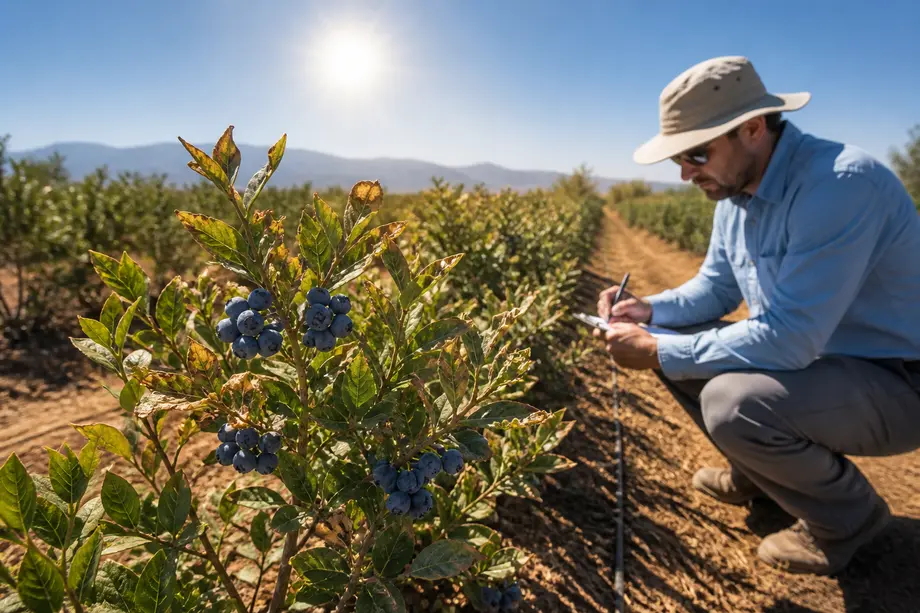
The most concrete data comes from the case cited in Sinaloa, under extreme conditions above 46 °C and humidity around 20%. In the comparison shown, treatment with glycine betaine and polyphenols produced higher stomatal conductance than the control: over 450 mmol/m²/s compared with approximately 200-250 mmol/m²/s.
| Stress factor | Physiological effect | Production impact |
|---|---|---|
| UV-B radiation / high PAR | Photoinhibition, damage to photosystem II, reduced photosynthetic activity. | Lower sugar accumulation, more unstable quality, reduced production efficiency. |
| High temperatures | ROS production, damage to proteins, lipids and DNA, stomatal closure. | Reduced yield, size, firmness and fruit-filling capacity. |
| Low temperatures | Oxidative stress and slowdown of metabolic processes. | Lower physiological efficiency and possible reduction in productive potential. |
| High VPD | Stomatal closure, increased ABA and ROS, lower calcium and magnesium uptake. | Reduced reserve accumulation, more fragile quality and greater vulnerability to stress. |
VPD as an operational indicator
One particularly interesting element for technical management is the reference to vapor pressure deficit. VPD is indicated as an operational parameter for estimating climate stress and interpreting the plant's stomatal response.
In blueberries, the cited optimal range is between 0.5 and 1.5 kPa. When values increase, the plant tends to close its stomata to limit water loss, but this defence mechanism has a cost: CO₂ intake is reduced, photosynthesis decreases and the ability to feed the fruit worsens.
VPD is therefore not only a climate measurement, but an indicator that helps interpret the relationship between atmosphere, transpiration, water status and carbohydrate production.
Towards more preventive stress management
For the berry supply chain, the implication is clear: stress management cannot rely only on reacting to symptoms.
Climate indicators such as VPD, physiological measurements such as stomatal conductance and targeted strategies are needed to protect photosynthesis, redox balance, cell division and sugar production.
In a context of hotter summers, more aggressive radiation and more exposed production windows, the commercial quality of blueberries will increasingly depend on the ability to manage these processes before the damage becomes visible.
In summary
Abiotic stress in blueberries is not only a problem of external damage or visible symptoms. It is above all a loss of efficiency in the processes that support photosynthesis, sugar accumulation, fruit growth and commercial quality.
Specific polyphenols, glycine betaine, VPD monitoring and interpretation of stomatal conductance therefore become part of a more preventive management strategy, aimed at protecting the plant's productive potential before stress compromises yield and quality.