










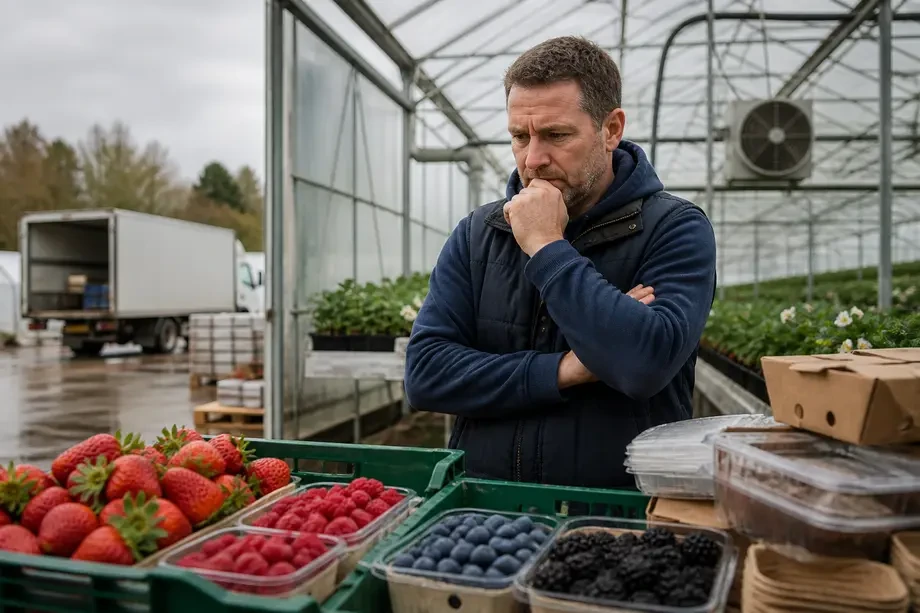
British berry growers are facing a new phase of strong cost pressure, just as the 2026 season gets underway in the United Kingdom. According to a new analysis released by British Berry Growers and prepared by independent consultants Andersons, increases are affecting the main production cost items across the board.
The trend concerns the entire berry category — strawberries, raspberries, blueberries and blackberries — and affects different production systems, from open-field cultivation to protected production and heated greenhouse systems.
Widespread increases in fertilisers, packaging, transport and energy
The data highlight a rapid and significant increase in the main agricultural inputs. Among the most affected items are fertilisers and crop protection products, with increases ranging from 30% to 40%. Packaging has also risen by 10% to 25%, while transport costs have increased by 15% to 25%.
Particularly significant is the impact of energy: electricity has increased by 10% to 40%, while natural gas has risen by around 60% since early March.
| Cost item | Estimated increase |
|---|---|
| Fertilisers and crop protection | +30% / +40% |
| Packaging | +10% / +25% |
| Transport | +15% / +25% |
| Electricity | +10% / +40% |
| Natural gas | around +60% |
Greenhouses and heated production under greater pressure
Pressure is particularly acute for businesses operating in greenhouses or using heated production systems. In these cases, the simultaneous increase in electricity and natural gas adds to an already high cost base, worsening the economic sustainability of production.
The rise in natural gas, estimated at around 60% in just a few weeks, represents one of the most critical factors for protected production, especially at a seasonal stage when the availability of British product is beginning to increase.
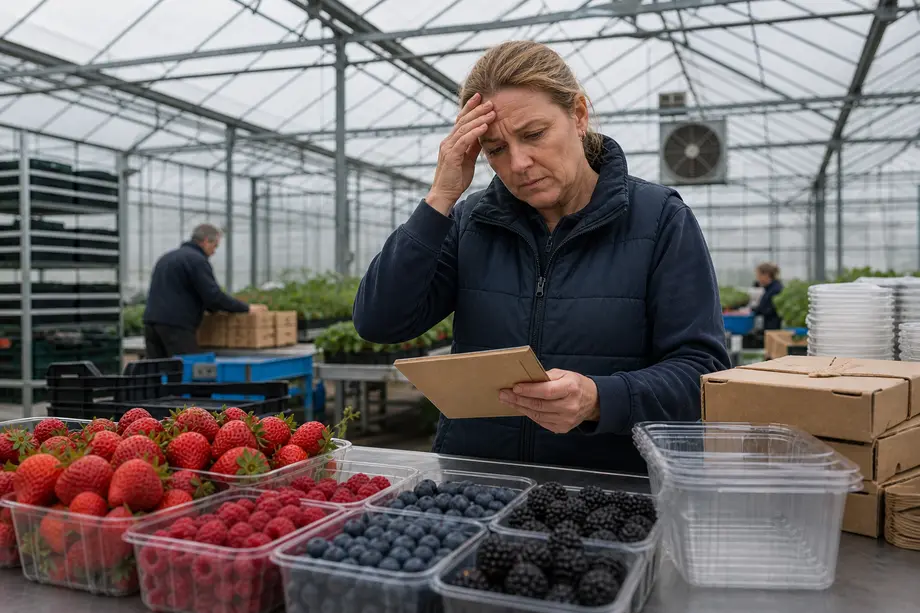
Nick Marston: “These pressures must be recognised across the supply chain”
According to Nick Marston, Chairman of British Berry Growers, the sector is once again facing significant increases driven by global dynamics beyond the direct control of producers.
“British berry growers are once again dealing with significant cost increases driven by global events outside our control,” Marston said.
The most significant point, according to the organisation’s chairman, is the combination of the scale and the speed of the increases. “We’ve seen sharp rises across fertilisers, packaging and transport in a matter of weeks, just as the UK season gets underway,” he stressed.
For greenhouse production, Marston added, rising electricity prices and especially gas prices introduce “a further layer of cost at an already high base”.
A direct impact on the production cost of British berries
British Berry Growers points out that these are not marginal costs, but essential inputs for berry production. When fertilisers, crop protection, packaging, transport and energy move at this level, the impact on the final production cost becomes immediate.
“These are core inputs,” Marston noted. “When they move at this level, it has a direct impact on the cost of producing British berries.”
The message to the supply chain is clear: as the sector moves towards the seasonal peak, these pressures must be recognised throughout the supply chain, from the field to distribution.
A signal also for the European market
The British case confirms a broader trend affecting the European berry sector: growth in demand and the strengthening of the category are increasingly confronted with a fragile cost structure, exposed to energy, logistics, packaging materials and agronomic inputs.
For producers, the challenge concerns both technical efficiency and the supply chain’s ability to transfer and properly recognise higher costs in a market where quality, continuity of supply and local origin remain central elements of competitiveness.