






Summary of the presentation "Sant'Orsola: another way to put our berries into pots" by Daniela Mott (Sant'Orsola), presented as part of the Berry Area 2026 event programme at Macfrut.
Competitive innovation in the berry sector increasingly depends on the integration of genetic material control, distributed production capacity and a direct connection with international scientific research.
The strategy of Sant'Orsola, emerging from the presentations delivered at Macfrut, highlights a profound transformation of the Trentino-based cooperative: from a producer organization into a true applied research hub serving the supply chain.
Through its own micropropagation laboratory, its structural collaboration with the Fondazione Edmund Mach and the co-organization of the 2027 ISHS International Symposium on Rubus and Ribes, the group aims to oversee the most critical stages of varietal development.
The result is a hybrid model in which production, breeding, plant material health, field testing and scientific research converge to support a high-value premium offer.
Key takeaways
1. Season extension supports year-round market presence.
The extension of production areas from Northern to Southern Italy, with 650 members operating on almost 600 hectares, enables Sant'Orsola to serve the market throughout the year, supporting strategic commercial assets such as the Residuo Zero line, now also extended to blackberries.
2. Internal micropropagation protects genetic fidelity.
The laboratory operates with rigorous protocols: in vitro cultures use minimal quantities of hormones and short subculture cycles, reducing the risk of mutations and providing a solid back-up for the breeding programme.
3. Nursery research reduces external dependence.
The structure constantly manages around 5,000 plantlets in the growth chamber for development purposes, with the capacity to produce up to 10,000 already acclimatized units for field testing of advanced selections.
4. The ISHS 2027 Symposium sets an international precedent.
The assignment to Sant'Orsola of the International Symposium on Rubus and Ribes in 2027 represents an unprecedented step: it is the first time a private company has hosted the event, with the aim of bringing global scientific research closer to the operational needs of growers.
5. The partnership with Fondazione Edmund Mach accelerates innovation.
The collaboration provides access to advanced expertise in genomics, transcriptomics and post-harvest technologies, creating a fundamental axis for developing varieties better suited to climate change and retail requirements.
What emerges from the presentation
The analysis of the materials shows an industrial architecture oriented towards control of the entire supply chain, from propagation material to the retail shelf.
Sant'Orsola's structural growth, also embodied in the 16-hectare Berry Village hub, is based on a distributed agricultural system capable of combining very different territories.
Browse and download the presentation
From Sicily to Trentino, this production geography makes it possible to extend the commercial calendar and guarantee market presence throughout the twelve months of the year.
Territorial capillarity therefore becomes a competitive advantage that is not only productive, but also commercial: it makes it possible to manage high-value programmes, build supply continuity and support lines with rigorous quality standards.
From product to supply-chain platform
The Sant'Orsola model does not simply organize the production of its members.
It integrates genetic material, micropropagation, varietal testing, scientific research and commercial positioning, transforming the cooperative into an innovation platform for berries.
Extended production to serve the market all year round
Season extension is one of the central elements of the strategy.
The presence of grower members in different production areas makes it possible to distribute production windows throughout the calendar, reducing dependence on a single territory and a single seasonal phase.
This approach is particularly relevant for a category such as berries, where continuity of supply is increasingly required by large-scale retail.
The ability to serve the market for twelve months also supports the development of complex commercial assets, such as the Residuo Zero line.
This type of offer requires not only commercial capacity, but also agronomic control, uniform plant material, shared technical standards and constant monitoring of field practices.
Micropropagation: genetic quality before volumes
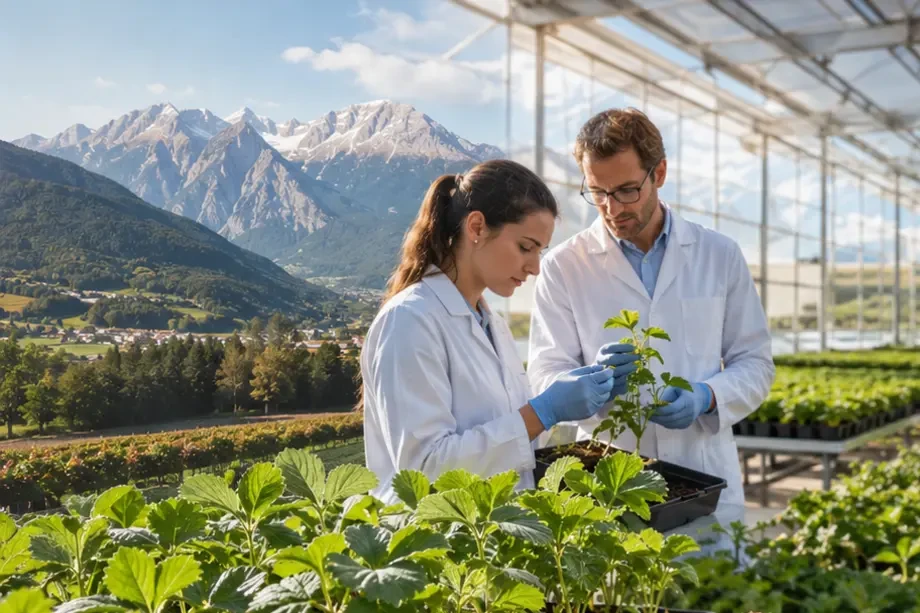
A particularly important technical element is the internal micropropagation laboratory.
Established in 2010 to facilitate the exchange of patented material outside Europe, the laboratory has progressively been converted into a strategic hub for the breeding programme.
Its role is not to produce undifferentiated nursery material at scale, but to guarantee genetically faithful, healthy material consistent with selection objectives.
The operational choices indicate a strongly quality-oriented approach: the use of culture media with minimal hormone input and the management of short in vitro cycles limit the risk of undesired variants.
This methodological rigour makes it possible to provide members with more reliable material for field testing, reducing uncertainty when evaluating new selections.
| Strategic asset | Function in the supply chain | Competitive impact |
|---|---|---|
| Production areas from North to South | Extend the production and commercial calendar. | Enable market presence for 12 months. |
| Micropropagation laboratory | Guarantees controlled and genetically faithful plant material. | Reduces external dependence and agronomic risk in varietal tests. |
| Residuo Zero | Enhances a commercial line with high agronomic standards. | Strengthens premium positioning and market recognizability. |
| Fondazione Edmund Mach | Provides scientific expertise in genomics, transcriptomics and post-harvest. | Accelerates varietal development and climate adaptation. |
| ISHS 2027 Symposium | Connects international research and growers’ operational needs. | Strengthens Sant'Orsola’s role as a scientific-applied hub. |
A growth chamber serving breeding
The research structure constantly manages around 5,000 plantlets in the growth chamber for varietal development.
This capacity represents a relevant operational asset because it makes it possible to keep the genetic material required for evaluation phases alive and available.
In addition, the ability to produce up to 10,000 already acclimatized units for field testing of advanced selections reduces dependence on external nursery suppliers.
For a breeding programme, this aspect is crucial: it allows greater control over timing, material status, genetic fidelity and the quality of plants delivered to members for agronomic trials.
The laboratory therefore becomes an infrastructure serving breeding, but also a risk-reduction tool in the most delicate phase: the stage in which a promising selection has to be tested under real production conditions.
ISHS 2027: a scientific event within a production supply chain
The assignment to Sant'Orsola of the International Symposium on Rubus and Ribes in 2027 represents a particularly significant step.
For the first time, a private company is hosting the event, traditionally held in academic or institutional settings.
This signals a transformation in the relationship between scientific research and the production world.
The berry supply chain needs solutions that are applicable, rapid and consistent with growers’ operational needs: new varieties, greater climate resilience, improved shelf life, consistent quality and agronomic sustainability.
Bringing an international scientific symposium inside a production organization means reducing the distance between basic knowledge and practical adoption.
Scientific research and the field need to interact more
The value of varietal innovation is measured by the ability to turn scientific knowledge into agronomic and commercial solutions.
The ISHS 2027 Symposium represents an opportunity to connect researchers, breeders, technicians and growers around the concrete challenges of Rubus and Ribes.
Fondazione Edmund Mach: the scientific multiplier
The partnership with Fondazione Edmund Mach acts as a technological multiplier.
While Sant'Orsola brings to the collaboration its understanding of market needs, the experience of its members and the ability to validate selections in the field, the Foundation provides the support of basic and applied science.
Expertise in genomics and transcriptomics makes it possible to read plant behaviour in greater depth, identifying markers, physiological responses and useful traits to accelerate varietal improvement.
At the same time, studies on post-harvest, shelf life and sensory analysis make it possible to link genetics not only to productivity, but also to the commercial value of the fruit.
This integration is decisive in a context where climate change requires more resilient varieties, while retail demands continuity, visual quality, flavour and performance along the logistics chain.
A hybrid model for the future of berries
The Sant'Orsola case shows how future competitiveness does not depend on a single factor.
Having a good variety, a laboratory, a production territory or a strong brand is not enough. What is needed is a system capable of integrating all these elements into a coherent strategy.
The cooperative is building a model in which member production, internal micropropagation, breeding, scientific research and commercial positioning mutually reinforce each other.
From this perspective, control of genetic material becomes a strategic asset because it reduces external dependencies, protects quality and enables a faster response to market needs.
In summary
Sant'Orsola is evolving towards an integrated supply-chain model in which production, research and varietal innovation combine to support the competitiveness of Italian berries.
The presence of 650 members over almost 600 hectares, season extension from Northern to Southern Italy, the internal micropropagation laboratory and the partnership with Fondazione Edmund Mach are the pillars of this strategy.
The assignment of the ISHS Symposium on Rubus and Ribes in 2027 further strengthens this positioning, bringing international research into an organized production supply chain.
For the berry sector, the message is clear: the next competitive phase will increasingly require genetic control, scientific capacity, production organization and an integrated commercial vision.