











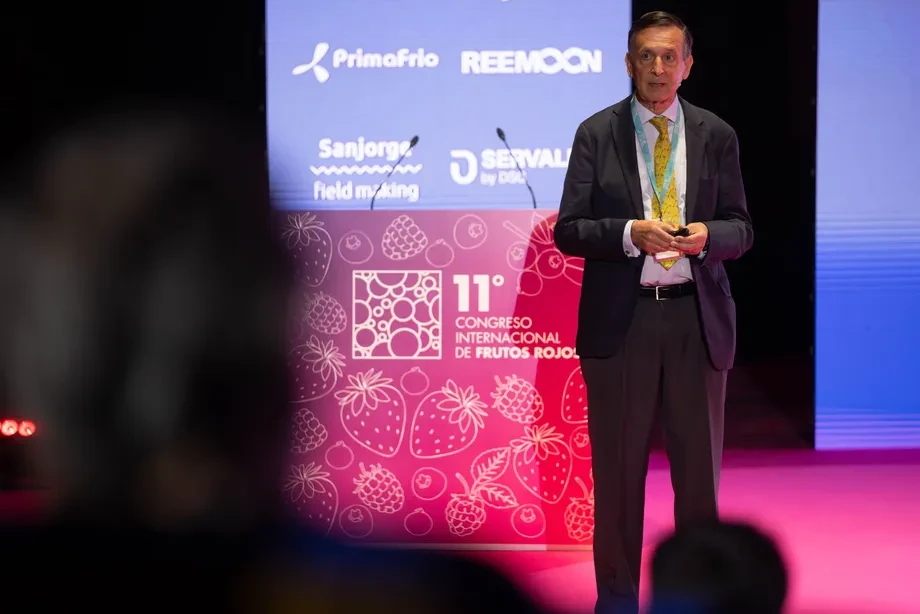
On the occasion of the 11th International Berry Congress, organized by Freshuelva on 17 and 18 June in Huelva, Mario Steta, President of the International Blueberry Organization, shared the organization’s estimates on the evolution of global blueberry production and presented his view on the main trends and challenges facing the sector in the coming years.
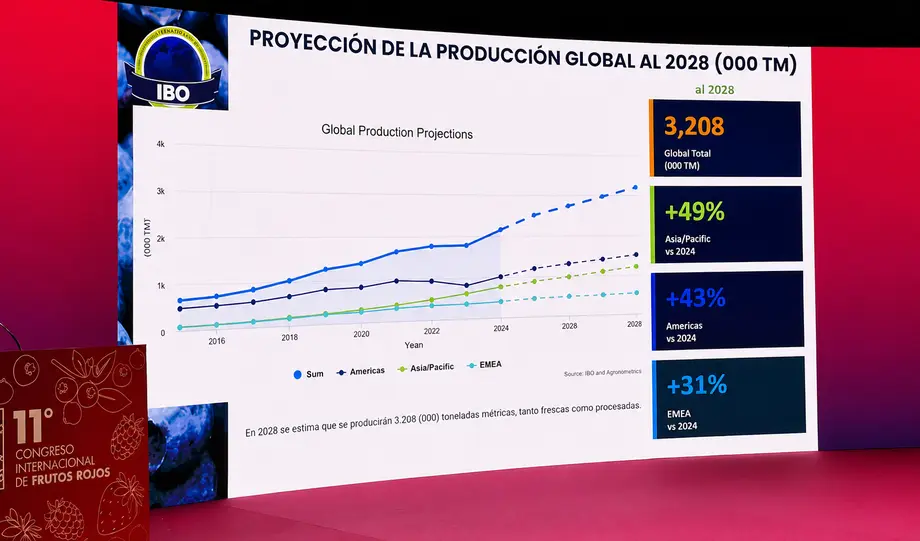
According to IBO projections, following the growth trend recorded in recent years, by 2028 global blueberry production will increase compared with 2024 by:
🔹 +31% in the EMEA region (Europe, Middle East and Africa)
🔹 +49% in the Asia-Pacific region
🔹 +43% in the Americas
These are estimates that, as Steta himself pointed out, must be interpreted with caution. However, the figures confirm the strong dynamism of the sector and the significant development opportunities for the entire supply chain at global level.
The main conclusions presented by Mario Steta
In his presentation, Steta highlighted a series of trends and critical issues that are reshaping the global blueberry market.
1. Reliability and continuity of supply
The ability to ensure reliability and consistency in production and supply will become increasingly decisive in maintaining competitiveness on international markets.
2. Growth in consumption
Global demand continues to grow, with a trend considered solid and structural, particularly in Europe, Asia and the Middle East. In the United States, a now mature market, the challenge will be to further increase per capita consumption.
3. Value growth and “bimodal” prices
Market evolution will lead to a greater distinction between:
- a premium segment, where product quality and recognizability allow for higher value creation;
- a segment more oriented towards a commodity logic, with inevitable pressure on prices.
New packaging formats and greater ease of consumption will contribute to value creation.
4. Consumer expectations not always met
According to the IBO analysis, the sector still needs to improve in several areas:
- organoleptic quality (taste, shelf life and appearance);
- sustainability (packaging, water use, biodiversity and pesticide residues);
- working conditions and social impact;
- food safety and perceived value for the consumer.
The risk of exclusion was also highlighted for producers or production areas that fail to adapt to market evolution.
5. The role of genetics
Genetics and global breeding programs will have an increasing impact on the competitiveness of companies and their ability to meet market demands.
6. Peru’s leading role
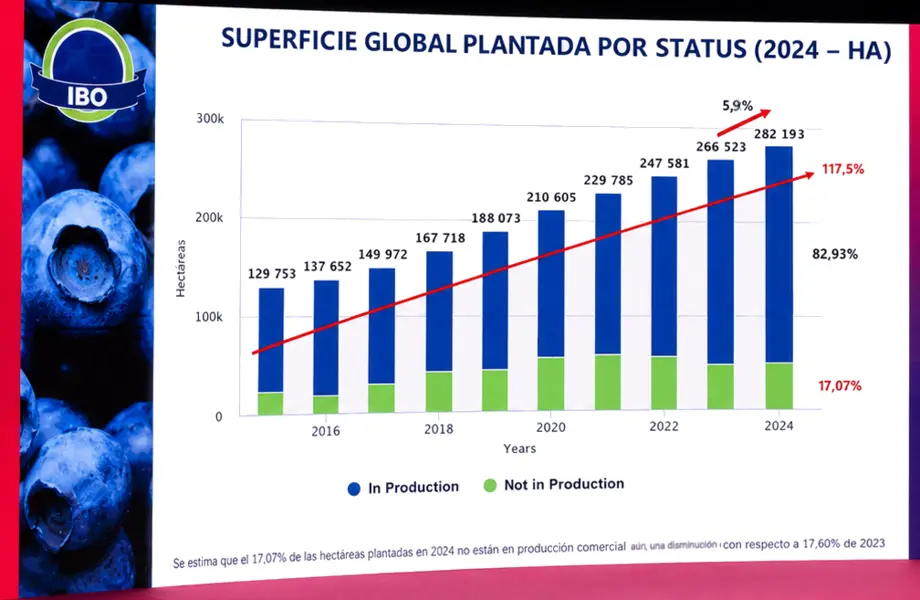
Steta recalled that Peru has become the world’s leading supplier of fresh blueberries, accounting for around one third of global production.
7. “The easy times are over”
One of the most significant messages of the presentation was that the sector is entering a phase of greater competition. The globalization of the crop and the increase in supply will lead to increasingly intense challenges related to:
- production efficiency and yield per hectare;
- integrated cost per kilogram;
- regional competitiveness.
8. Strategic constraints
Among the main risk factors identified were:
- water availability and quality;
- infrastructure and regulatory framework;
- labor recruitment and retention;
- worker migration;
- climate change and the need for emergency funds;
- trade restrictions.
9. Other strategic considerations
The IBO President also drew attention to:
- the need for regulatory simplification and harmonization between the EU and the United Kingdom;
- the possible impact of mechanical harvesting on traditional production systems;
- the emergence of new production areas thanks to genetics and technological innovation, particularly in India, Turkey and Central Asian countries;
- China’s growing competitiveness as an exporter;
- the importance of developing local markets.
Innovation, collaboration and efficiency
In conclusion, Mario Steta expressed a positive view of the future of the blueberry sector, provided that the supply chain is able to focus on a number of fundamental pillars:
- Innovation
- Collaboration between operators and organizations
- Ability to adapt
- Efficiency
The final objective, he emphasized, must be the creation of value for producers, customers and consumers, in an increasingly competitive global context that is nevertheless full of opportunities for those able to evolve rapidly.