













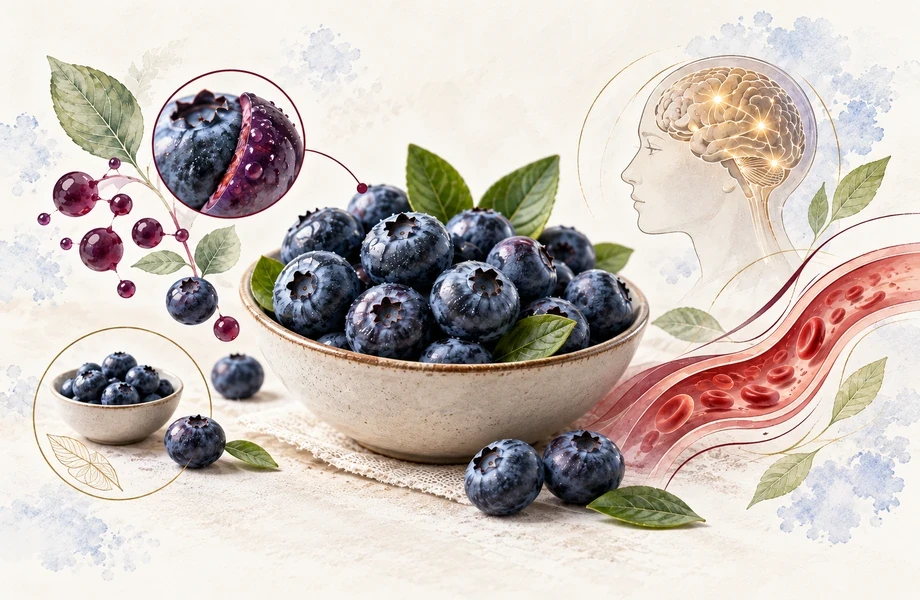
How many blueberries per day should you eat to obtain potential health benefits? It is a widely searched question, but the answer provided by scientific research is less straightforward than it may seem.
Clinical studies have used different amounts, in people with different characteristics and, above all, they have not always administered fresh blueberries: freeze-dried or powdered products have often been used.
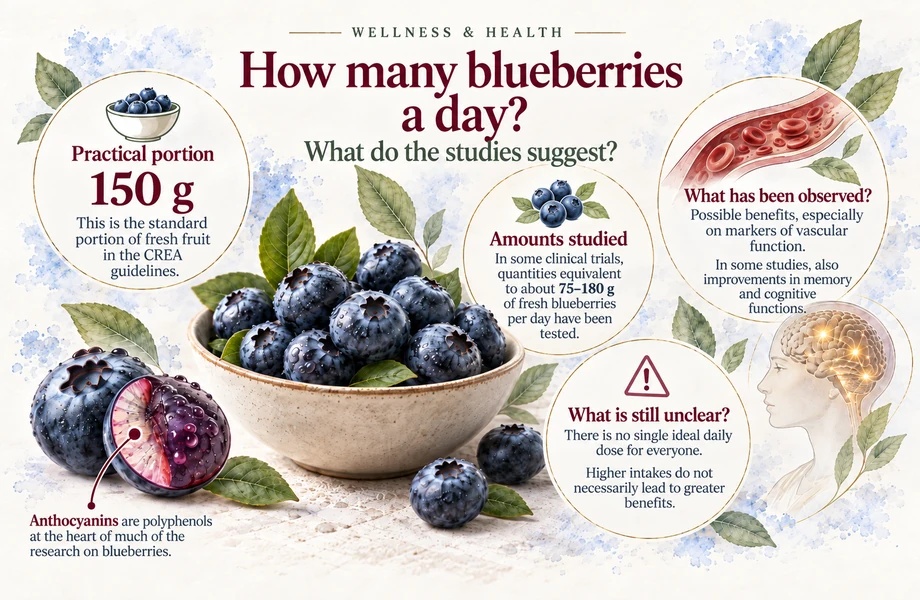
However, there are some useful data that can provide guidance. Several studies have tested amounts equivalent to approximately 75-180 grams of fresh blueberries per day, mainly observing parameters related to vascular health and, in some cases, cognitive function.
This does not mean that there is an optimal daily dose or that eating more blueberries automatically produces greater benefits.
Why the amount of blueberries matters
Blueberries are a source of fiber and several plant compounds, including anthocyanins, pigments belonging to the polyphenol family that are responsible for their characteristic blue-purple color.
Anthocyanins in particular are at the center of much of the research into the potential effects of blueberries on blood vessel function.
However, when discussing benefits, the amount consumed is only one of the factors to consider: the duration of intake, blueberry variety, overall diet composition and the characteristics of the people studied also matter.
For this reason, it is not correct to extract a number from a single study and turn it into the “ideal dose” for everyone.
How many blueberries per day in clinical studies?
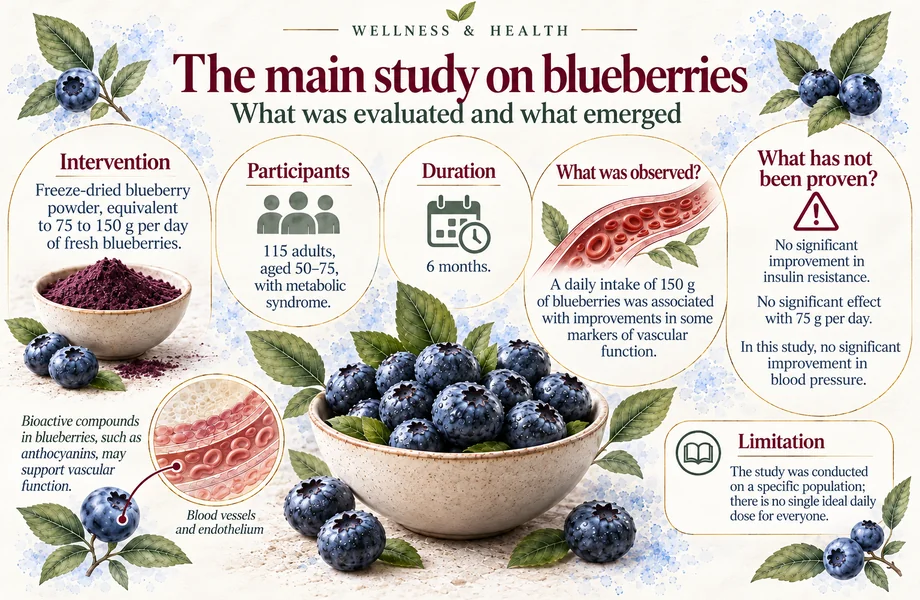
One of the most interesting studies addressing this question was published in 2019 in the American Journal of Clinical Nutrition. It was a randomized, controlled, double-blind trial conducted in adults aged 50 to 75 with metabolic syndrome.
The 115 participants who completed the study were followed for six months and divided into three groups. The amounts tested corresponded to 75 grams or 150 grams of fresh blueberries per day, compared with a placebo.
In practice, the participants consumed 13 or 26 grams of freeze-dried blueberry powder, respectively; the equivalence with the fresh product was stated directly by the authors.
With the equivalent of 150 grams per day, researchers observed an improvement in some markers of vascular function, including flow-mediated dilation, a measure of the ability of arteries to dilate.
Results on vascular function
Favorable changes were also observed in some parameters related to arterial stiffness.
However, not all outcomes improved. Insulin resistance, which was the primary outcome of the study, did not change significantly.
No significant effects were observed on blood pressure either, while the amount equivalent to 75 grams per day did not produce significant changes in the indicators analyzed.
This finding is particularly important: it does not allow us to conclude that 75 grams of blueberries are “not beneficial,” but only that in that specific study and in that population they did not significantly affect the parameters measured.
What happens with amounts close to a large serving?
Another randomized trial, published in 2023, also in the American Journal of Clinical Nutrition, involved 61 healthy people aged between 65 and 80.
For 12 weeks, participants consumed 26 grams of freeze-dried wild blueberry powder every day, containing 302 mg of anthocyanins. The authors described this amount as equivalent to 178 grams of fresh wild blueberries.
Compared with the placebo, the blueberry group showed an improvement in flow-mediated dilation and a 3.59 mmHg reduction in 24-hour systolic blood pressure.
Favorable results were also observed in some tests of immediate memory and executive function.
Meta-analysis and variability among studies
Even in this case, the overall picture is not consistent. No significant changes were detected in cerebral blood flow or gut microbiota composition; moreover, not all cognitive tests showed an advantage for the blueberry group.
A meta-analysis published in 2026 in Nutrition Research, which combined 14 randomized studies involving a total of 632 healthy participants, helps put the findings into further perspective.
Overall, the consumption of blueberries or blueberry-derived products was associated with an improvement in endothelial function, while no statistically significant effects emerged for systolic blood pressure, diastolic blood pressure, executive function or mood.
The authors also highlighted considerable variability among studies in terms of dose, type of product, duration and participant characteristics.
Why anthocyanins are of interest to researchers
One possible explanation for the effects observed on blood vessels concerns anthocyanins themselves and the metabolites formed after their digestion.
In the six-month 2019 trial, blueberry intake resulted in a dose-dependent increase in anthocyanin-derived metabolites in the blood and urine.
The researchers hypothesized the involvement of pathways linked to nitric oxide, a molecule involved in the regulation of blood vessel dilation.
Biological mechanism and limitations of the evidence
However, this is only a possible biological mechanism, not proof that a specific amount of blueberries can prevent cardiovascular disease.
The available studies mainly measure intermediate markers, not the actual long-term reduction in heart attacks, strokes or other diseases.
So, is there an ideal amount of blueberries per day?
At present, there is no scientifically established amount of blueberries per day considered optimal for obtaining specific benefits.
The most informative trials suggest that amounts in the range of one serving, approximately 150 grams, are compatible with some favorable effects on vascular function. Other studies have used equivalent amounts close to 180 grams.
However, it cannot be concluded that 150 or 180 grams represent a necessary threshold, nor that larger amounts are more effective.
The same 2026 meta-analysis emphasizes that the diversity of doses and products used makes it difficult to establish a precise relationship between amount consumed and benefit.
Products used and research funding
In addition, some studies have used powders, extracts or freeze-dried blueberries: results obtained with these products should not automatically be transferred to fresh fruit.
Research funding should also be taken into account.
The 2019 trial was supported by the US Highbush Blueberry Council, while the 2023 trial received an unrestricted grant from the Wild Blueberry Association of North America; in both studies, the authors stated that the funders were not involved in the analysis or interpretation of the results.
The 2026 meta-analysis was funded by Chinese public research programs, and the authors declared no conflicts of interest.
A serving of blueberries in everyday life
To turn these data into a practical dietary reference, it is useful to distinguish clinical research from general recommendations for a healthy diet.
The Italian CREA Guidelines consider 150 grams to be the standard serving of fresh fruit. This is not a specific recommendation for blueberries, but rather a practical reference for fruit in general.
An amount of blueberries close to 150 grams can therefore be considered a normal serving of fruit and, at the same time, is similar to the amount used in some of the most interesting clinical studies.
This does not make it necessary to eat blueberries every day: alternating different colors and types of fruit remains consistent with the principle of a varied diet.
In conclusion: how many blueberries per day?
There is no scientifically established dose that answers the question of how many blueberries should be eaten per day.
Studies have used different amounts, but some of the most interesting evidence concerns intakes equivalent to approximately 150-180 grams per day, particularly in relation to blood vessel function.
A serving of approximately 150 grams is also the Italian reference for a standard serving of fresh fruit. It is therefore a practical dietary guideline, not a therapeutic amount or a threshold beyond which benefits necessarily increase.
A varied diet and educational purposes
Blueberries can be part of a varied and balanced diet alongside other fruits, vegetables and plant-based foods.
The available evidence is interesting, particularly with regard to vascular health, but it does not justify attributing disease prevention or treatment effects to a single food.
The information is provided for educational purposes and does not replace the advice of doctors, dietitians or nutritionists.
Sources:
Curtis PJ, van der Velpen V, Berends L, Jennings A, Feelisch M, Umpleby AM, Evans M, Fernandez BO, Meiss MS, Minnion M, Potter J, Minihane AM, Kay CD, Rimm EB, Cassidy A. “Blueberries improve biomarkers of cardiometabolic function in participants with metabolic syndrome—results from a 6-month, double-blind, randomized controlled trial”, The American Journal of Clinical Nutrition, 2019, 109(6):1535-1545. DOI: 10.1093/ajcn/nqy380. PMID: 31136659.
Wood E, Hein S, Mesnage R, Fernandes F, Abhayaratne N, Xu Y, Zhang Z, Bell L, Williams C, Rodriguez-Mateos A. “Wild blueberry (poly)phenols can improve vascular function and cognitive performance in healthy older individuals: a double-blind randomized controlled trial”, The American Journal of Clinical Nutrition, 2023, 117(6):1306-1319. DOI: 10.1016/j.ajcnut.2023.03.017. PMID: 36972800.
He Y, Yang J, Zhang S, Mai J, Li M. “Blueberry consumption enhances vascular function but not cognitive abilities in healthy individuals: a systematic review and meta-analysis”, Nutrition Research, 2026, 149:162-177. DOI: 10.1016/j.nutres.2026.03.007. PMID: 41974068.
CREA – Council for Agricultural Research and Economics. Guidelines for Healthy Eating. 2018 Revision. Rome: CREA, Research Centre for Food and Nutrition.
Italian Berry - All rights reserved
🫐 Wellness & Health with Berries 🍓This article is part of the section dedicated to the Wellness & Health with Berries editorial project, which brings scientific research closer to everyday life, promoting berries as allies of well-being. The section features clear, up-to-date content based on scientific evidence, designed to inform consumers and support all operators throughout the berry supply chain. |