












Summary of the presentation "Georgia: the leading emerging blueberry supplier in Europe" by Shota Tsukoshvili and Tornike Phanjavidze (Georgia Blueberry Growers Association), as part of the Berry Area 2026 event programme (Macfrut).
The global berry industry is witnessing the rise of a new strategic player: Georgia.
Supported by unique microclimates and rapid agronomic modernization, the Caucasian country is positioning itself precisely within a crucial commercial window between mid-May and July, historically less covered by the major South American players.
Listen to the full presentation on Spotify
The evolution of the sector goes beyond the simple expansion of acreage, aiming instead at a clear quality leap driven by the Georgia Blueberry Growers Association.
Through the adoption of club varieties, major investments in post-harvest technologies and free trade agreements for exports, the supply chain is redefining sourcing dynamics, positioning itself not only as a premium supplier for Europe and Asia, but also as a key logistics hub for the entire region.
Key takeaways
1. Georgia is targeting a strategic market window.
The country is positioning itself in the global blueberry market by taking advantage of a crucial commercial calendar between mid-May and July, a period when volumes from major South American exporters are not in direct competition.
2. Varietal renewal is progressing rapidly.
The sector is moving away from obsolete cultivars in favour of premium genetics and club programmes, such as the Sekoya line, to ensure larger berry size, crunchiness and resistance during transport to Northern European markets.
3. Volumes are set to grow dramatically.
Projections indicate an increase in national production from the recent 7,000 tonnes to more than 30,000 tonnes, driven by the full maturity of new plantings, which today are on average only two or three years old.
4. Georgia aims to become a regional logistics hub.
Supported by free trade agreements covering a potential market of 2.7 billion consumers, the supply chain aims to act as a re-export platform for berries from the Caucasus and Central Asia.
5. Post-harvest management is the decisive factor.
The adoption of advanced operating standards, such as pre-cooling within one hour of harvest, optical sorting machines and SO2 fumigation systems for long transits, is becoming essential to gain access to international retail circuits.
Browse and download the full presentation
What emerges from the presentation
Georgia's entry into the global blueberry landscape represents a clear case of rapid industrialization of a non-traditional crop.
After the first commercial trials began around 2010, growers initially faced operational challenges linked to varietal choices that were not fully suited to export requirements.
The real technical turning point coincided with the transition towards premium genetics and the combined use of high-chill and low-chill cultivars, managed simultaneously by exploiting the marked altitudinal gradients of the territory.
This geographical flexibility, combined with protected cultivation systems such as tunnels, now makes it possible to extend the season and firmly cover the May-June supply window, a time of year when major overseas exports are more limited.
The competitive advantage of the May-July window
Georgia's strength does not derive only from the increase in acreage, but from its ability to enter the global calendar at a precise point.
Between mid-May and July, Georgian product can intercept European and Asian demand at a stage when South American supply does not exert the same competitive pressure that characterizes other periods of the year.
From young acreage to a production leap
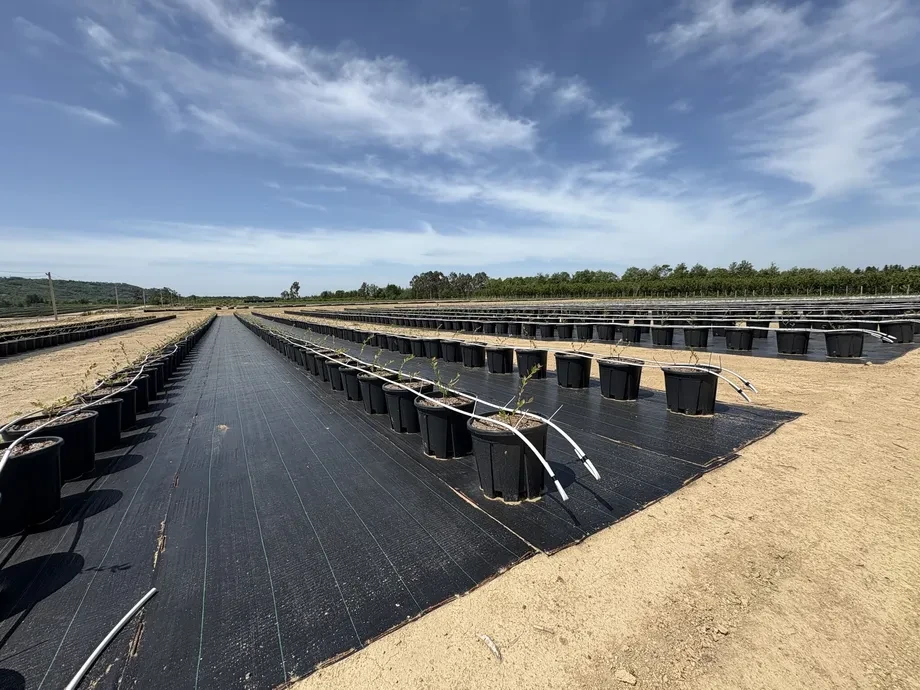
An analysis of production parameters shows a temporary mismatch between cultivated acreage and yields. Growth has been very rapid: from around 500 hectares in 2020 to the current 3,500 hectares.
Average productivity per hectare still appears limited. The reason is mainly physiological: most bushes are less than three years old and currently produce between 7 and 10 tonnes per hectare.
Once these plantings reach full agronomic maturity, the entire supply chain expects a sharp increase in total volumes, exceeding 30,000 tonnes per year.
Varietal renewal as a quality lever
Quantitative growth is not the only relevant element. The Georgian sector is in fact accelerating its varietal renewal, progressively abandoning cultivars considered obsolete.
The goal is to move towards premium genetics and club programmes capable of delivering fruit with larger size, firmness, crunchiness and suitability for long-distance transport.
This transition is particularly important for reaching Northern European markets, where retailers require high standards not only in appearance, but also in post-harvest shelf-life and quality uniformity.
| Strategic factor | Impact on the Georgian supply chain | Competitive objective |
|---|---|---|
| May-July window | Allows entry into the market during a phase less exposed to South American competition. | Strengthen presence in European and Asian markets. |
| New premium varieties | Improve size, crunchiness, shelf-life and transport resistance. | Access the most remunerative retail segments. |
| Young plantings | Current yields are still partial, but production potential is growing strongly. | Exceed 30,000 tonnes per year once plantings reach full maturity. |
| Advanced post-harvest | Reduces quality risks during long transit and increases commercial reliability. | Serve the United Kingdom, European Union, Middle East and Asia. |
| Regional logistics hub | Allows consolidation, repacking and re-export of product from neighbouring countries. | Become a reference platform for the Caucasus and Central Asia. |
Post-harvest as a condition for export
To manage the future surge in commercial supply, Georgian companies have had to focus on the efficiency of the cold chain and conditioning.
The strategic objective is to move beyond the historical dependence on Russian routes, shifting towards more demanding and more remunerative destinations such as the United Kingdom, the European Union and the Middle East.
To this end, industry associations have promoted strict management protocols: mandatory temperature reduction from 30 to 0 degrees within the first hour after harvest, calibration with advanced optical sorters, the use of micro-ventilated bags and sulphur dioxide gasification chambers to preserve quality during long transit periods.
The quality leap depends on logistics
For a country aiming to serve distant and selective markets, fruit quality is not measured only in the field.
Pre-cooling, optical sorting, packaging and atmosphere management during transport become central elements of competitive positioning.
Towards a hub for the Caucasus and Central Asia
In addition to enhancing domestic production through the duty-free access guaranteed by international treaties to a potential market of 2.7 billion people, Georgia is preparing to act as an international consolidation platform.
The project is to use existing infrastructure to import, repack and re-export blueberries from neighbouring production basins such as Armenia, Kazakhstan and Uzbekistan to Central Asian markets.
In this way, the country could manage flows even in counter-season, increasing the efficiency of packing infrastructure and strengthening its regional logistics role.
In summary
Georgia is emerging as one of the new protagonists of the global blueberry sector, not only because of the growth in acreage and volumes, but also because of its ability to build an integrated strategy based on calendar, varieties, post-harvest and logistics.
The expected leap beyond 30,000 tonnes will change the competitive balance in the May-July window, increasing pressure on European countries operating in the same commercial period.
Georgia's path shows how a young supply chain can quickly become competitive when it combines premium genetics, modern infrastructure, strict post-harvest protocols and a clear international positioning vision.