







Summary of the presentation "Presentation of the XIV International Vaccinium Symposium (ISHS)" by Xiaomin Wang (Agriculture Academy of Nanjing), delivered as part of the Berry Area 2026 event programme at Macfrut.
The rise of China in the global blueberry market has moved beyond the phase of simple volume expansion and entered a new era driven by high technology, agronomic research and supply-chain integration.
With production expected to approach one million tonnes in 2025 and a supply chain capable of guaranteeing uninterrupted availability twelve months a year, the country has established itself as the world’s leading blueberry producer.
The assignment of the XIV International Vaccinium Symposium in 2028 to the Nanjing Botanical Garden confirms this paradigm shift: China is no longer merely a large production basin, but a centre of scientific and technological innovation for the entire berry supply chain.
Understanding this transformation, from proprietary genetics to AI-based automation, is now essential for international operators looking at the future commercial and technological balance of the sector.
Key takeaways
1. Productive yields have grown explosively.
Between 2015 and 2025, while the cultivated area increased fivefold to around 110,000 hectares, Chinese blueberry production grew almost 14 times, approaching one million tonnes. This indicates a drastic improvement in agronomic techniques and production efficiency.
2. China guarantees fresh blueberries 12 months a year.
By exploiting six different climate zones and making extensive use of substrate cultivation, the country has built a supply chain capable of placing fresh product on the market without interruption throughout the year.
3. Technology and genetics are becoming increasingly proprietary.
Chinese companies are replacing imported solutions with domestic technologies, developing AI-based optical sorters capable of reading internal Brix levels and patented varieties with anthocyanin concentrations up to 10 times higher than standard levels.
4. Agrochemical players are evolving into supply-chain managers.
Some large groups traditionally linked to agrochemicals are redefining their role, becoming providers of advanced agricultural services and building closed ecosystems ranging from varietal research to the marketing of premium brands in large-scale retail.
5. Nanjing becomes a capital of Vaccinium research.
The assignment of the XIV International Vaccinium Symposium to China for 2028 marks the country’s transition from production hub to global centre of excellence for scientific research, varietal innovation and technologies applied to berries.
What emerges from the presentation
The transformation of the Chinese blueberry industry is one of the most disruptive phenomena in the global fruit and vegetable sector over the past decade.
The shift from emerging market to world leader has been extremely rapid. Between 2015 and 2025, the cultivated area increased fivefold, but production volumes grew even more strongly, approaching one million tonnes per year.
Browse and download the presentation
This disproportion between the increase in hectares and the rise in production highlights a radical technological leap.
China’s growth no longer depends only on land availability, but on the ability to increase yield per unit of surface area through more precise agronomic techniques, advanced production infrastructure and strong investment in applied research.
From quantity to technological quality
China has moved beyond the phase of volume expansion alone.
The new competitive stage is based on substrate cultivation, automation, proprietary genetics, artificial intelligence and integrated supply-chain control.
From emerging market to world’s leading producer
The most relevant factor is the speed of change.
In ten years, China has built an unprecedented production platform in blueberries, reaching an estimated area of around 110,000 hectares.
But the real leap is not only quantitative. Production has increased almost fourteenfold, indicating that the supply chain has acquired far more advanced agronomic, technical and organizational capabilities than in its initial phase.
This shift reduces the importance of simple land expansion and moves competitive advantage towards yields, quality, environmental control and crop management.
For international operators, China’s growth should therefore not be read only as an increase in supply, but as the construction of a new, technology-intensive production standard.
Six climate zones for continuous supply
One of the most important strengths of the Chinese supply chain is the ability to exploit an extremely broad production geography.
The presence of six different climate zones allows harvests to be distributed throughout the year, creating supply continuity that is difficult to replicate in other countries.
The province of Yunnan plays a key role in winter and spring supply, while other production areas cover complementary windows.
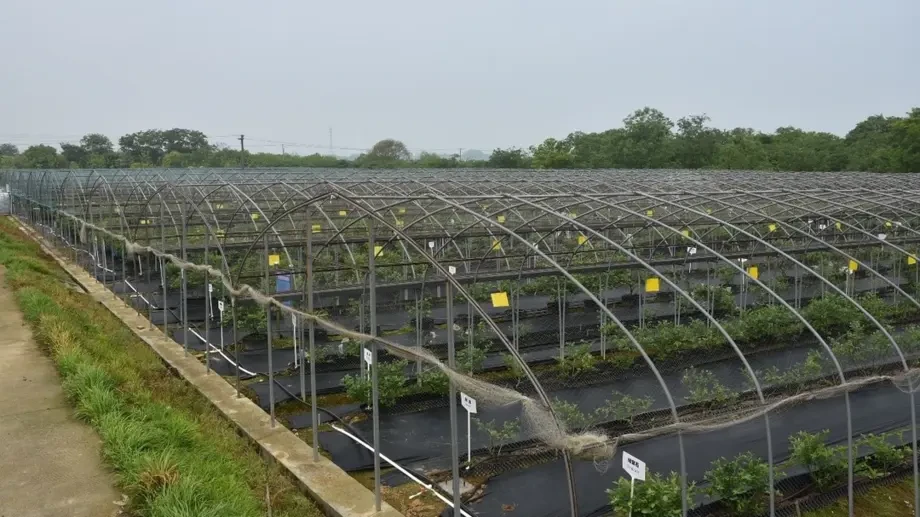
This territorial diversification is combined with the extensive use of substrate cultivation, which allows greater control over nutrition, the root system, water management and product quality.
The result is a supply chain capable of placing fresh blueberries on the market twelve months a year, reducing dependence on natural seasonality and strengthening commercial power with retailers.
| Strategic factor | Evolution in China | Impact on the global supply chain |
|---|---|---|
| Cultivated area | Fivefold increase between 2015 and 2025, up to around 110,000 hectares. | Structural increase in global production capacity. |
| Production | Almost 14-fold growth, moving towards one million tonnes. | Growing pressure on international supply balances. |
| Substrate cultivation | Massive adoption of substrate systems and advanced agronomic control. | Higher yields and greater quality standardization. |
| AI and automation | Optical sorters capable of assessing internal Brix levels. | New standards for sorting, quality and commercial segmentation. |
| Scientific research | Nanjing will host the XIV International Vaccinium Symposium in 2028. | Legitimizes China as a global innovation hub. |
Substrate cultivation and agronomic research as accelerators
The pillar of China’s new phase is the widespread adoption of substrate cultivation.
This model makes it possible to free the crop from the limits of unsuitable soils and manage water, nutrients, pH, conductivity and root development with greater precision.
In the case of blueberry, a species particularly sensitive to soil and water quality, substrate cultivation becomes an accelerator of yield and standardization.
The research team at the Nanjing Botanical Garden has extensive specialized experience in this field, built over decades of work on the crop.
This scientific continuity has made it possible to turn complex agronomic techniques into protocols applicable at industrial scale, with direct effects on production efficiency.
Automation and artificial intelligence in quality control
China is not growing only on the agronomic front.
Another area of transformation concerns post-harvest automation and AI-based quality control.
Local technology companies are developing optical sorting systems capable of assessing fruit at high speed, going beyond simple size or colour inspection.
The possibility of reading the internal sugar level of each single fruit non-destructively, through AI-driven systems, opens up significant scenarios for commercial segmentation.
The product could be classified not only by size and appearance, but also by internal quality, flavour potential and market destination.
This type of innovation shifts competition onto a more sophisticated level: no longer just producing large quantities of blueberries, but sorting and enhancing each lot more precisely.
Quality becomes measurable fruit by fruit
With artificial intelligence applied to sorting, quality control enters a more advanced phase.
Non-destructive reading of internal Brix levels makes it possible to connect selection, flavour and commercial positioning with previously unimaginable precision.
Proprietary genetics and anthocyanins
The Chinese supply chain is also accelerating on proprietary genetics.
The development of patented varieties with specific characteristics, including anthocyanin concentrations up to 10 times higher than standard levels, points to a strategy that goes beyond the traditional fresh market.
Blueberries are also being interpreted as a functional platform, with possible outlets linked to extraction, processing and high-value-added segments.
This trajectory strengthens the country’s technological and varietal independence, reducing dependence on foreign genetic programmes.
For the international market, this means that China could become not only the world’s leading producer of blueberries, but also a supplier of genetics, technologies and production models that can be replicated in other contexts.
From agrochemicals to advanced agricultural services
Another structural element in China’s transformation concerns the repositioning of supply-chain players.
Some large groups traditionally linked to agrochemicals are evolving towards the role of advanced agricultural service managers.
Their objective is no longer limited to supplying inputs, but to building integrated ecosystems that include varietal research, nursery activity, nutrition, crop protection, agronomic management, post-harvest and marketing.
In this model, supply-chain control becomes much tighter: from genetic choice to premium brands in large-scale retail.
It is a transition that changes the role of technical suppliers, turning them into industrial partners capable of overseeing value, quality and market access.
Nanjing 2028: scientific legitimization
The assignment of the XIV International Vaccinium Symposium to China for 2028 represents both a symbolic and strategic step.
Hosting the leading international scientific event dedicated to the genus Vaccinium in Nanjing means consolidating the country’s role as a global research centre for blueberries and related berries.
It is not just an academic event.
The symposium marks China’s transition from a large production hub to an innovation platform capable of influencing agronomic, genetic, technological and commercial standards.
For international operators, Nanjing 2028 will therefore be a privileged observatory for understanding the direction the global blueberry market will take in the coming years.
In summary
China is redefining the global blueberry market through a combination of production scale, scientific research, substrate cultivation, automation, AI and proprietary genetics.
The almost fourteenfold growth in production over ten years, compared with a fivefold increase in cultivated area, shows that the real competitive advantage is no longer only size, but technological efficiency.
The ability to supply fresh product twelve months a year, together with the development of proprietary technologies and patented varieties, projects the country towards an increasingly central role in the global balance of the category.
With the XIV International Vaccinium Symposium 2028 in Nanjing, China definitively enters the scientific geography that will guide the future of berries.