











The United Kingdom and Italy consume far more blueberries than they produce. For local growers, the challenge is not to replace imports, but to find their place in the market.
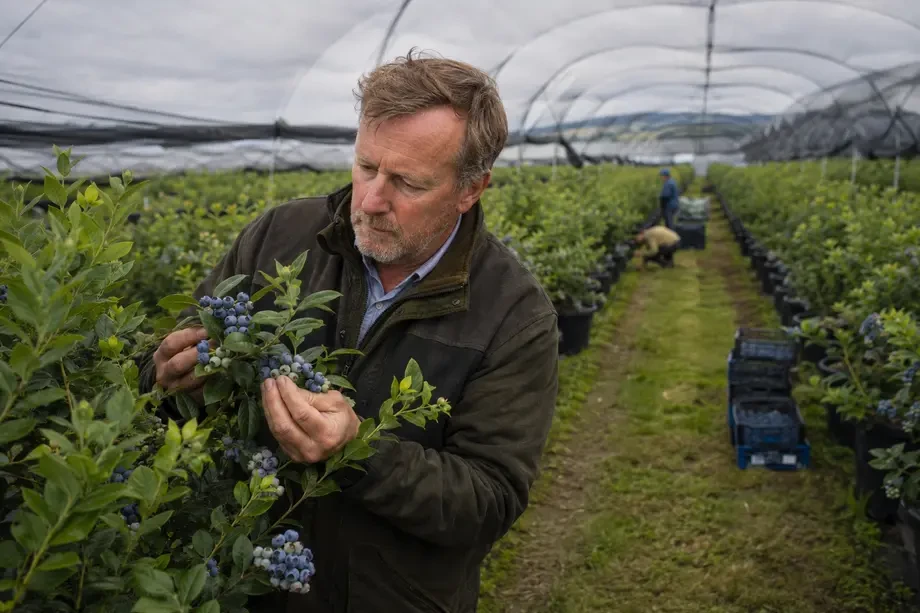
British blueberry production covers just 8% of national consumption. The remainder necessarily comes from abroad. However, this figure reflects more than a heavy reliance on imports: above all, it highlights the difficulty of producing in a country where everyone wants to consume blueberries, but where costs, climate and market conditions limit the competitiveness of local farms.
This is the situation described by Stephen Taylor, Managing Director of Winterwood Farms Ltd. and UK representative for the International Blueberry Organization (IBO). His analysis focuses on the United Kingdom, but raises issues that are also highly relevant to the Italian supply chain.
In Italy too, domestic production is not sufficient to meet demand throughout the year. Supplies from abroad are therefore neither an anomaly nor simply an alternative to Italian fruit: they are a structural component of the market.
For both countries, the central question is not how to achieve self-sufficiency at any cost. It is to understand what role local production can play within an inevitably international supply chain.
UK production covers only 8% of demand
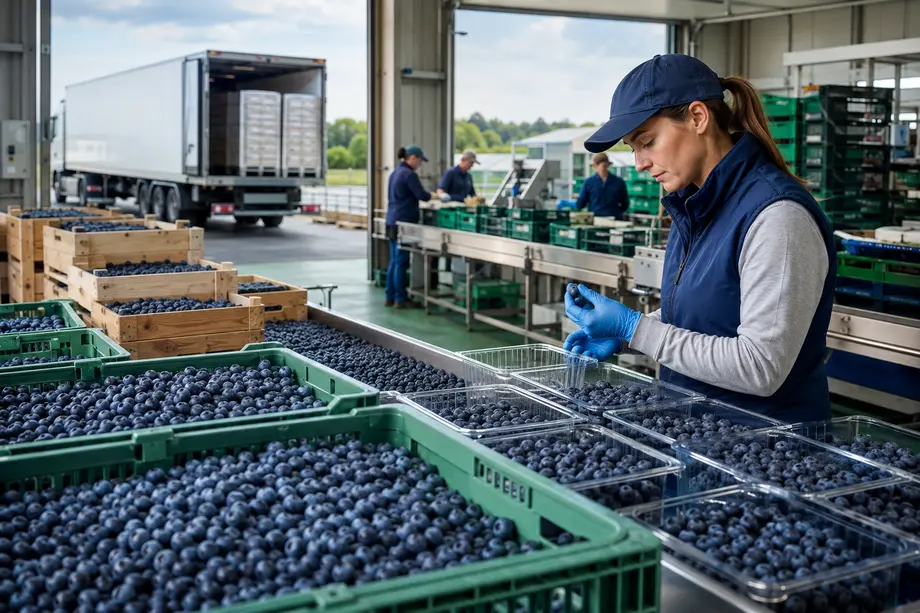
According to Taylor, the United Kingdom produces approximately 6,000 tonnes of blueberries a year, while consumption stands at close to 75,000 tonnes, equivalent to around 1.1 kg per person.
Local production therefore represents just 8% of the market. This is nevertheless a significant achievement, considering that British blueberry cultivation was virtually non-existent until relatively recently.
The problem is that further expansion faces structural barriers. Harvesting is still almost entirely manual and, over the past three years, the cost of employing pickers and packhouse workers has risen by more than 30% overall.
Picking one kilogram of blueberries now generally costs more than £2, equivalent to approximately $2.70–3.00. This is compounded by the reduction in government support following Brexit, the need to invest in container production and the rising cost of protecting crops against extreme weather.
Costs and investment also constrain Italian production
The parallel with Italy is immediate. Although its growing conditions and production calendar are different, Italian farms must also contend with high labour costs, increasingly limited workforce availability and substantial initial investment.
New plantings, substrates, containers, fertigation systems, covers, hail nets and temperature-management structures require substantial capital. These expenses come on top of the costs of grading, cooling, packing and logistics.
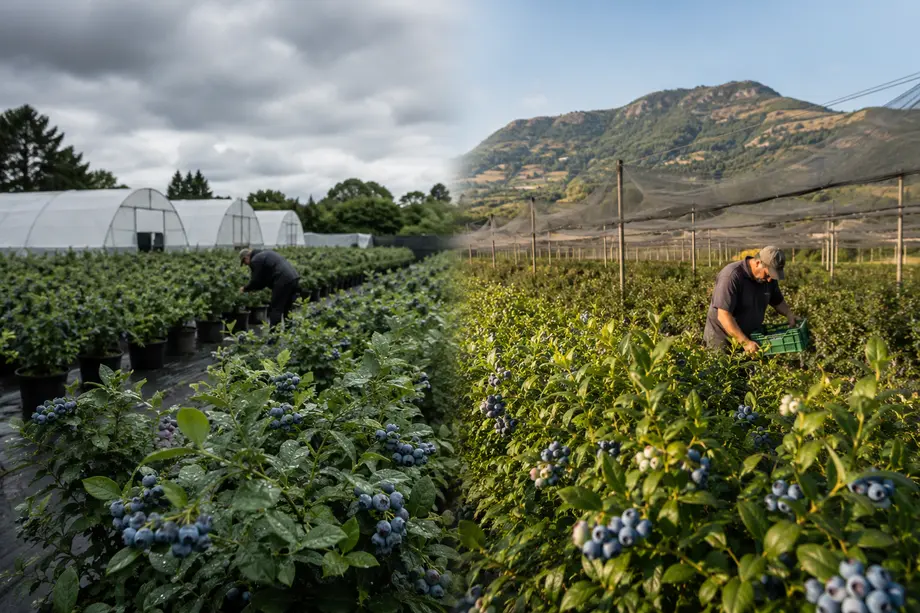
Italy’s climate makes it possible to build a more extensive production calendar than in the United Kingdom, beginning in the southern regions and moving progressively northwards and into mountain areas. This broader window does not, however, eliminate the risks.
Late frosts, concentrated rainfall, hail, drought and excessively high temperatures can compromise yield, size, firmness and storability. Crop protection is therefore becoming less and less optional, but it absorbs resources that could otherwise be used to expand planted acreage.
The same mechanism is therefore at work in both countries: the market is growing, but local production is not always able to expand at the same pace.
Varietal differences widen the competitive gap
In the United Kingdom, the maritime climate mainly favours Northern Highbush varieties. According to Taylor, their yield potential is improving more slowly than that of Southern Highbush varieties grown in more favourable climatic regions.
This genetic gap has economic consequences. New Southern Highbush varieties produced in other countries are raising standards for size, firmness, flavour and shelf life, while simultaneously increasing yields.
Italian production must also contend with this evolution. Businesses are no longer competing solely with origins characterised by lower costs, but with production programmes based on recent genetics, planned calendars and large, uniform volumes.
Varietal selection is therefore crucial. It is not enough for a cultivar to be productive: it must be suited to a specific environment, maintain quality after harvest and reach the market at a time when that quality can command an adequate return.
Local fruit does not automatically command a higher price
Taylor identifies another challenge: British consumers attach cultural and emotional value to domestic strawberries that blueberries have not been able to establish.
British strawberries are perceived as an iconic national product and can command a price premium. Blueberries, by contrast, are mainly regarded as a global commodity. National origin may influence purchasing decisions, but it rarely justifies a price difference large enough to offset higher domestic production costs.
The Italian situation has some similarities. A stated preference for domestic fruit does not always translate into a willingness to pay a significant premium, particularly when imported blueberries of excellent quality are available on the shelves at competitive prices.
Furthermore, blueberries have not yet developed a territorial identity in Italy comparable to that of other fruit and vegetable products. Italian origin alone may therefore not be enough.
Domestic fruit must offer something tangibly distinctive: greater freshness, more advanced ripeness, flavour, consistent quality, distinctive varieties or a credible connection with its growing region.
The goal cannot be to compete 52 weeks a year
Taylor’s conclusion is pragmatic: British growers cannot expect to compete with imports throughout the year.
Their best opportunity falls between June and early July, when supplies from North Africa and Southern Europe begin to decline, while the major Eastern European crops have not yet entered the market in full volume.
During this window, British blueberries can secure more favourable conditions, particularly in the Standard segment. Scottish production can capture some opportunities in September, although Southern Hemisphere supplies increase rapidly during that period.
In Italy too, the strategy cannot be to extend the domestic season regardless of costs and market conditions. The priority must be to identify the windows in which each production area has a genuine advantage.
The Italian calendar offers several opportunities, from early production in the South to late harvests in northern and mountain areas. Each window, however, must be assessed in relation to competing origins, retail programmes and the quality actually available.
Imports and domestic production are not alternatives
The most important point in the British analysis is the need to move beyond the opposition between local and imported fruit.
With production of 6,000 tonnes and demand of 75,000 tonnes, the United Kingdom could not sustain its market without an international supply chain. The same principle applies to Italy: growing consumption requires continuity, a broad assortment and product availability during periods when domestic fruit is absent or insufficient.
Imports keep the category on the shelves, reinforce purchasing habits and allow grading and packing facilities to operate throughout the year. In this way, they can also contribute indirectly to enhancing the value of domestic fruit when the Italian harvest arrives.
Taylor places particular emphasis on the role of the packhouse. A modern, efficient facility must spread its costs over twelve months: relying exclusively on a short domestic season would make it much more difficult to achieve the necessary scale.
For the Italian supply chain too, the integration of domestic production and international sourcing can therefore represent a competitive advantage, rather than necessarily posing a threat.
A clearly defined place for domestic blueberries
The British experience suggests three priorities that also apply to Italy.
The first is to increase efficiency by focusing on yield per hectare, work organisation and the automation of activities that do not necessarily require manual labour.
The second is to protect the most favourable market windows, planning varieties, growing areas and calendars according to market conditions instead of pursuing an undifferentiated and extended domestic presence.
The third is to differentiate the product. If blueberries are perceived as a global commodity, origin alone is not enough. Superior quality, flavour, freshness, reliability and segmentation that consumers can understand are all essential.
Local production therefore has a future in both the United Kingdom and Italy, but it must find a clearly defined position. It is not expected to replace imports entirely or compete on price throughout the year.
Its role is to offer exceptional fruit when growing area, climate and calendar allow, while integrating with an international supply chain capable of sustaining demand during the rest of the year.
In markets where everyone wants to consume blueberries, the challenge is not to produce everything locally. It is to ensure that local fruit has a value and a moment in which it can be genuinely competitive.
Italian Berry – All rights reserved