









When discussing blueberries and cholesterol, one of the most common questions is whether eating these small fruits can help improve LDL and triglyceride levels.
Scientific interest stems mainly from their anthocyanin content. These pigments belong to the polyphenol family, give blueberries their characteristic blue-purple colour, and have been studied for their potential effects on metabolism and blood vessel function.
However, human studies paint a more complex picture than some popular accounts suggest. Some meta-analyses have found beneficial effects on total and LDL cholesterol, while other studies have observed no significant changes.
Results for triglycerides are also inconsistent. The question, therefore, is not simply whether blueberries “lower cholesterol”, but which effects have actually been measured, in which people, and with what amounts and product forms.
Blueberries and cholesterol: why LDL and triglycerides matter
LDL cholesterol is one of the main parameters used to assess cardiovascular risk.
Triglycerides are another class of lipids found in the blood. Their levels can rise in response to various factors, including diet, body weight, carbohydrate metabolism, alcohol consumption, and individual predisposition.
For this reason, it is useful to distinguish between the different markers.
A food may, for example, be associated with a change in triglycerides without significantly affecting LDL cholesterol, or influence certain measures of vascular function without producing detectable changes in the lipid profile.
Furthermore, the effect of any individual food must always be considered within the context of the overall diet. Even when a difference is statistically significant, this does not automatically mean it is large enough to deliver a meaningful clinical benefit.
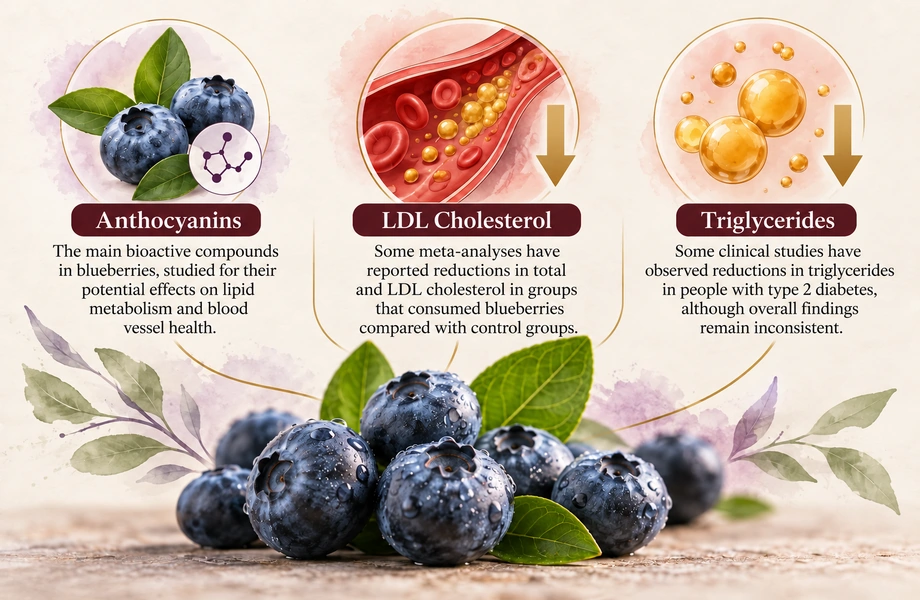
What meta-analyses on blueberries show
A systematic review and meta-analysis published in Nutrition Research in 2021 examined 18 randomised clinical trials, including 12 in the quantitative analysis.
The studies used very different forms of blueberry: whole fruit, frozen products, juice, powder, or extracts, with varying doses, durations, and study populations.
Overall, the authors found a statistically significant reduction in total cholesterol and LDL cholesterol in the groups consuming blueberry products. However, no significant effects were found on glycaemic markers or anthropometric measurements.
However, not all analyses reach the same conclusion.
A meta-analysis published in Complementary Therapies in Medicine in 2020, based on 11 randomised trials, found no significant differences between blueberry and control groups for most of the cardiovascular markers studied.
For triglycerides, the average reduction was 0.27 mmol/L, but the confidence interval included no effect, and the result did not reach statistical significance, with p=0.06.
Differences in study selection and the heterogeneity of the interventions help explain why conclusions may vary from one meta-analysis to another.
LDL and triglycerides: what happened in individual clinical trials
A randomised controlled trial published in 2020 involved 52 men with type 2 diabetes, mainly US veterans, with an average age of 67. For eight weeks, participants consumed either 22 grams of freeze-dried blueberries or a placebo each day.
At the end of the intervention, triglyceride levels were significantly lower in the blueberry group than in the placebo group: 179.6 versus 199.6 mg/dL in the analysis reported by the authors.
However, this finding did not extend to the entire lipid profile: total cholesterol, LDL, and HDL did not differ significantly between the two groups.
Another study offers a different perspective. In 2019, a six-month trial involved 115 adults with metabolic syndrome. Participants received freeze-dried blueberry powder equivalent, according to the authors, to 75 or 150 grams of blueberries per day, or a placebo.
The amount equivalent to 150 grams per day improved certain markers of vascular function, including flow-mediated dilation, a measure of the arteries’ ability to widen.
A small increase in HDL cholesterol was also observed among participants who were not taking statins.
By contrast, total and LDL cholesterol did not decrease significantly in the overall sample, while the lower dose did not produce improvements in the biomarkers assessed.
These findings show why assessing the cardiovascular effects of blueberries solely through LDL levels provides an incomplete picture.
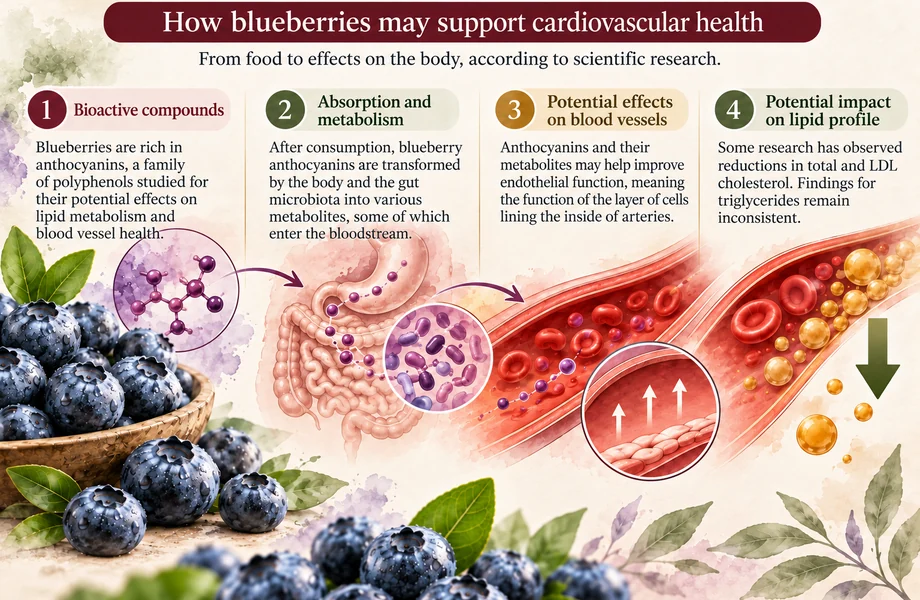
The potential role of anthocyanins
Anthocyanins are among the most extensively studied compounds in blueberries. After consumption, the body and the microbiota transform them into various metabolites, some of which can enter the bloodstream.
In the six-month trial, blueberry consumption led to a dose-dependent increase in anthocyanin-derived metabolites in the blood and urine.
The same study observed improvements in certain parameters of endothelial function, meaning the function of the layer of cells lining the inside of blood vessels.
It is plausible that polyphenols and their metabolites may interact with processes related to vascular function, oxidative stress, and lipid metabolism. However, these mechanisms do not demonstrate that the anthocyanins in blueberries directly reduce LDL cholesterol in humans.
Moving from a biologically plausible mechanism to a clinically meaningful effect requires confirmation through controlled studies.
Why results are not always consistent
The main uncertainties concern the heterogeneity of the studies. The populations examined include healthy people, adults with metabolic syndrome or diabetes, people taking lipid-lowering medication, and individuals with very different metabolic characteristics.
The “blueberry” studied is not always the same product, either. Some trials use whole fruit, while others use freeze-dried powder, juice, or extracts. Doses and durations can vary from a few days to several months.
It is therefore inappropriate to automatically apply a finding obtained with a concentrated amount of a freeze-dried product to the regular consumption of fresh blueberries.
Funding should also be considered. The 2019 and 2020 trials mentioned above received support from the US Highbush Blueberry Council; the articles state that the funder was not involved in the design, analysis, or interpretation of the results.
This is a factor to disclose and assess alongside the study’s methodology, rather than a sufficient reason to disregard its findings.
How to include blueberries in a balanced diet
The available evidence does not establish an amount of blueberries to consume specifically to lower cholesterol. The doses used in trials serve to investigate a scientific hypothesis and do not constitute a dietary prescription.
Blueberries can be included as a fruit within a varied, balanced diet, alongside other plant foods. Furthermore, whole fruit is not equivalent to an extract or a concentrated anthocyanin supplement.
For people with elevated LDL cholesterol or triglycerides, the overall diet, physical activity, body weight, any underlying conditions, and prescribed treatments play a much broader role.
Eating blueberries does not replace medication or advice from a doctor, dietitian, or nutritionist.
Blueberries and cholesterol: the most reliable takeaway
Research on blueberries and cholesterol suggests a potential beneficial effect on certain lipid markers, but the findings are not yet consistent.
Some meta-analyses report reductions in total and LDL cholesterol; some trials instead observe changes mainly in triglycerides or vascular function, while others find no significant differences.
The most cautious conclusion is therefore that blueberries can contribute to the quality of a dietary pattern that supports cardiovascular health, but they cannot be considered a standalone way to control LDL or triglycerides.
As with any individual food, their nutritional significance depends on the overall context of diet and lifestyle. The information provided is for educational purposes and does not replace advice from healthcare professionals.
🫐 Wellness & Health with Berries 🍓This article is part of the series dedicated to the Wellness & Health with Berries editorial project, which brings scientific research closer to everyday life, promoting berries as allies for wellbeing. The series offers clear, up-to-date, evidence-based content, designed to inform consumers and support everyone working across the berry supply chain. |
Sources:
Carvalho MF, Lucca ABA, Silva VRRE, Macedo LR, Silva M, “Blueberry intervention improves metabolic syndrome risk factors: systematic review and meta-analysis”, Nutrition Research, 2021, 91:67-80. DOI: 10.1016/j.nutres.2021.04.006. PMID: 34139510.
Miraghajani M, Momenyan S, Arab A, Hasanpour Dehkordi A, Symonds ME, “Blueberry and cardiovascular disease risk factors: A systematic review and meta-analysis of randomized controlled trials”, Complementary Therapies in Medicine, 2020, 53:102389. DOI: 10.1016/j.ctim.2020.102389. PMID: 33066847.
Curtis PJ, van der Velpen V, Berends L, Jennings A, Feelisch M, Umpleby AM, Evans M, Fernandez BO, Meiss MS, Minnion M, Potter J, Minihane AM, Kay CD, Rimm EB, Cassidy A, “Blueberries improve biomarkers of cardiometabolic function in participants with metabolic syndrome-results from a 6-month, double-blind, randomized controlled trial”, The American Journal of Clinical Nutrition, 2019, 109(6):1535-1545. DOI: 10.1093/ajcn/nqy380. PMID: 31136659.
Stote KS, Wilson MM, Hallenbeck D, Thomas K, Rourke JM, Sweeney MI, Gottschall-Pass KT, Gosmanov AR, “Effect of Blueberry Consumption on Cardiometabolic Health Parameters in Men with Type 2 Diabetes: An 8-Week, Double-Blind, Randomized, Placebo-Controlled Trial”, Current Developments in Nutrition, 2020, 4(4). DOI: 10.1093/cdn/nzaa030. PMID: 32337475.
Italian Berry - All rights reserved