







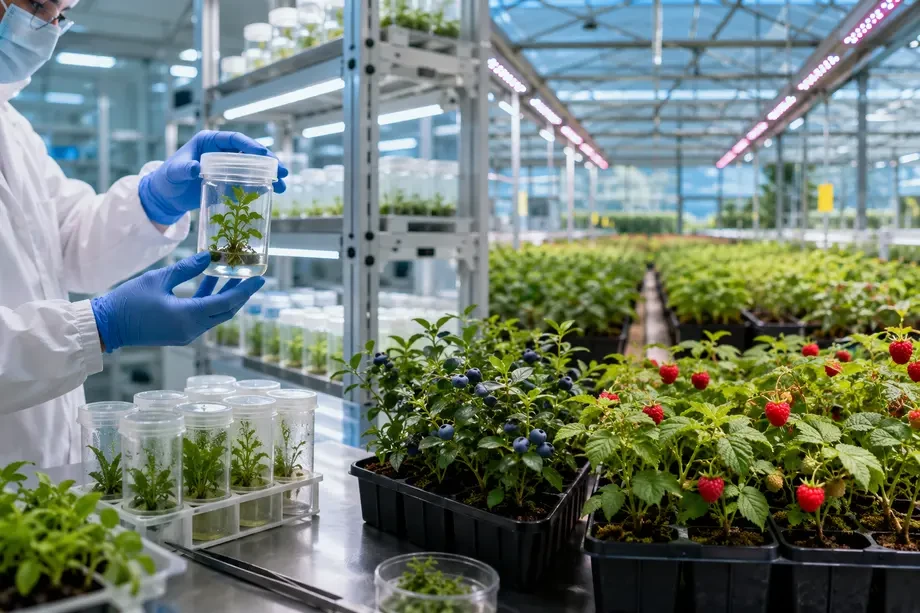
Summary of the presentation "In vitro propagation of berries: between technical innovation and critical issue management" by Massimiliano Meneghini (Battistini Vivai), presented as part of the Berry Area 2026 event programme at Macfrut.
Micropropagation is confirmed as a strategic lever to ensure efficiency, plant health and genetic uniformity in the berry supply chain, but it requires rigorous protocol management to avoid quality drift.
The optimization of laboratory and acclimatization phases is now a crucial competitive factor for specialized nursery production.
The experience of Battistini Vivai, with an annual production of 1.8 million in vitro propagated berry plants, shows how technical innovation can compress production cycle times while preserving genetic stability.
From the calibration of LED light spectra to the elimination of in vitro rooting, the laboratory is evolving from a simple multiplication unit into an integrated platform for varietal improvement in blueberries and raspberries.
Key takeaways
1. Direct in vivo rooting reduces production times.
Protocol optimization has made it possible to eliminate the laboratory rooting induction phase. Shoots move directly into plug trays, combining root development and acclimatization.
2. LED light becomes a growth accelerator.
Specific studies on light spectra inside the phytotron show that calibrating light quality during the first acclimatization phase accelerates rooting, reducing the production cycle by up to one week.
3. Proliferation and genetic fidelity must be balanced.
To avoid genetic instability caused by excessive phytohormones or prolonged subcultures, the operational strategy requires continuous renewal of the starting material in the laboratory, taken from mother plants in the field.
4. Blueberries dominate production volumes.
Out of a total output of 1.8 million in vitro propagated berry plants per year, blueberries account for the largest share, equal to 56.1%, followed by raspberries at 25.3%.
5. The laboratory is an integral part of breeding.
Micropropagation is not limited to commercial multiplication: it actively supports genetic improvement, maintaining more than 100 raspberry selections in vitro and evaluating 60 new international blueberry clones.
What emerges from the presentation
In vitro propagation of berries requires a constant technical compromise between two apparently opposing needs: maximizing multiplication rates and preserving the absolute genetic fidelity of clones.
Production efficiency naturally pushes towards the use of growth regulators, which are necessary to obtain high yields during the proliferation phases.
Browse and download the full presentation
However, excessive use of phytohormones or prolonged subcultures can expose plant material to risks of genetic instability, undesired morphological variations and loss of uniformity.
The operational solution adopted by the most advanced laboratories consists of strict turnover of plant material: subculture cycles are kept low and new explants taken from mother plants in the field are frequently reintroduced in vitro.
The critical point: multiplying without deforming
In industrial micropropagation, the real challenge is not only producing many plants, but producing identical, healthy and stable plants.
Reducing prolonged exposure to phytohormones and subcultures is essential to protect the genetic quality of nursery material.
Direct in vivo rooting: fewer steps, greater efficiency
On the process optimization front, there is a clear trend towards streamlining the transition phases between the sterile laboratory environment and the growing greenhouse.
The elimination of in vitro rooting induction represents a significant operational and economic achievement.
The plant material leaving the elongation phase is now transferred directly into plug trays, where root development proceeds together with in vivo acclimatization.
This approach reduces technical steps, limits transplant stress and shortens overall processing times.
For a nursery working at industrial volumes, even a few days saved per cycle can translate into greater production capacity and more efficient use of space.
LED light as an agronomic tool
In this context of efficiency improvement, LED technology management takes on an active agronomic role.
The use of dedicated research areas, such as phytotrons, has demonstrated how modulation of light spectra directly influences plant performance.
Visually white light is optimal for morphological development in sterile containers, but during the in vivo acclimatization phase, the application of specific wavelengths can significantly accelerate root emission.
This technical refinement allows an estimated saving of up to one week on standard rooting times, with positive effects on processed volumes and production organization.
| Technical innovation | Function in the process | Impact for nursery production |
|---|---|---|
| Direct in vivo rooting | Combines rooting and acclimatization in a single phase. | Reduces steps, stress and overall production times. |
| LED management | Modulates the light spectrum during the different growth phases. | Accelerates rooting and improves cycle efficiency. |
| Explants turnover | Frequently renews the starting material. | Reduces the risk of genetic instability and undesired variations. |
| In vitro collections | Keep advanced selections available for research and multiplication. | Support breeding programmes and large-scale varietal evaluation. |
| Phytotrons | Enable controlled tests on light, nutrients and environmental conditions. | Optimize protocols and overcome species-specific critical issues. |
Blueberries lead micropropagation volumes
In production volumes, blueberries are confirmed as the dominant species.
Out of a total output of 1.8 million in vitro propagated berry plants per year, blueberries account for 56.1% of production.
Raspberries follow, with a share of 25.3%, confirming the growing role of this species in nursery and varietal programmes.
The distribution of volumes reflects the evolution of agricultural demand: blueberries remain at the centre of investment, while raspberries require increasingly specialized technical support to overcome issues related to conservation, multiplication and adaptation.
Micropropagation and breeding: increasingly close integration
The micropropagation infrastructure no longer operates only as a production hub.
The laboratory is evolving into an integrated research platform, capable of simultaneously managing hundreds of selections and supporting advanced genetic improvement programmes.
In raspberries, the in vitro conservation of more than 100 selections makes it possible to keep valuable genetic material available and support varietal evaluation programmes.
In blueberries, experimentation on 60 new international clones directly connects nursery capacity with global genetic scouting.
This structure makes it possible to support the analysis of more than 12,000 seedlings and field trials of dozens of cultivars, creating an operational bridge between laboratory, nursery, breeding and commercial production.
The laboratory becomes a strategic platform
In modern nursery production, the laboratory is no longer just the place where plant material is multiplied.
It becomes a technological node connecting plant health, genetic uniformity, production acceleration, conservation of selections and direct support for varietal innovation.
Overcoming species-specific critical issues
Each species presents different technical constraints in micropropagation.
Raspberries, for example, show critical issues in cold storage, requiring a precise balance between light, nutrients and in vitro culture conditions.
The ability to experiment with differentiated protocols, test light spectra, modulate nutrients and adapt growth conditions makes it possible to overcome obstacles that, in a standardized approach, would limit the quality of the final material.
Berry micropropagation therefore cannot be interpreted as a uniform procedure. Instead, it requires specific protocols for each species, variety and production objective.
In summary
Berry micropropagation is entering a phase of greater industrial precision, in which efficiency, genetic stability and varietal innovation must advance together.
The Battistini Vivai case shows how the elimination of in vitro rooting, targeted management of LED spectra and turnover of starting material can reduce production times without compromising genetic quality.
The most relevant perspective is structural integration with breeding: the laboratory does not only produce plants, but becomes a platform for conserving selections, testing new clones and accelerating varietal development.
In an increasingly competitive berry market, the quality of nursery material will be one of the decisive factors in ensuring productivity, plant health and uniformity for the orchards of the future.