











Blueberries, strawberries, raspberries, blackberries and currants can be much more than a simple splash of colour on the table. When regularly included in a varied and balanced diet, berries provide bioactive compounds that scientific research is investigating mainly for their potential effects on cardiometabolic health and cognitive function.
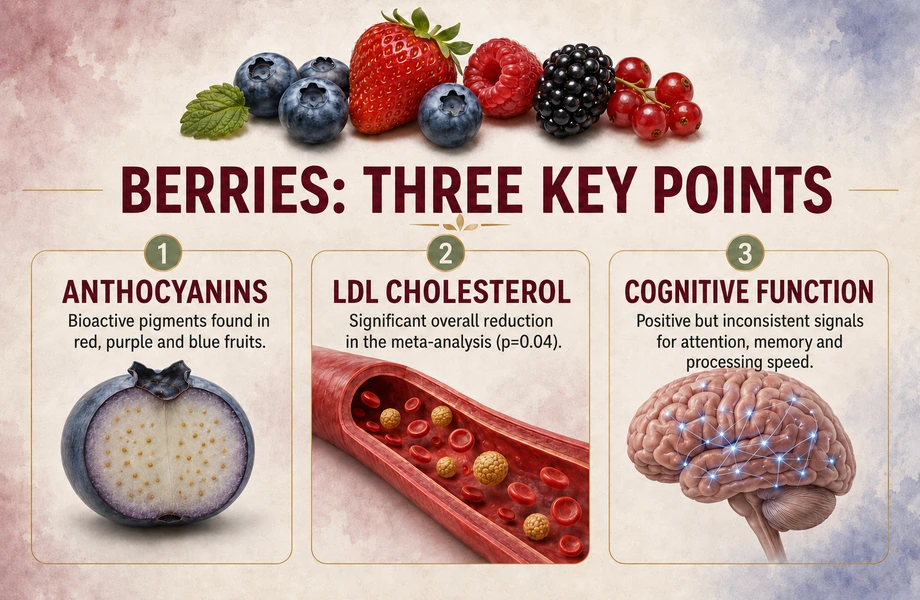
Among the substances attracting the greatest interest are anthocyanins, pigments belonging to the flavonoid family that are responsible for the red, purple and blue shades of many berries. However, they are not miracle ingredients: the available evidence suggests specific potential benefits, while also highlighting the importance of considering berries as part of the overall diet rather than as a stand-alone remedy.
Anthocyanins: the pigments at the centre of research
Anthocyanins have been studied for their biological activity and their potential ability to influence processes associated with oxidative stress and inflammation. Their concentration varies according to the species, variety, stage of ripeness and form in which the fruit is consumed.
This variability makes it difficult to establish a universal quantity of berries required to achieve a specific effect. The available studies have used very different products, including fresh or frozen fruit, juices, powders, extracts and freeze-dried berries, with dosages and intervention periods that are not always comparable.
Nevertheless, research has identified several areas in which berry consumption appears particularly interesting.
Effects on cardiometabolic health
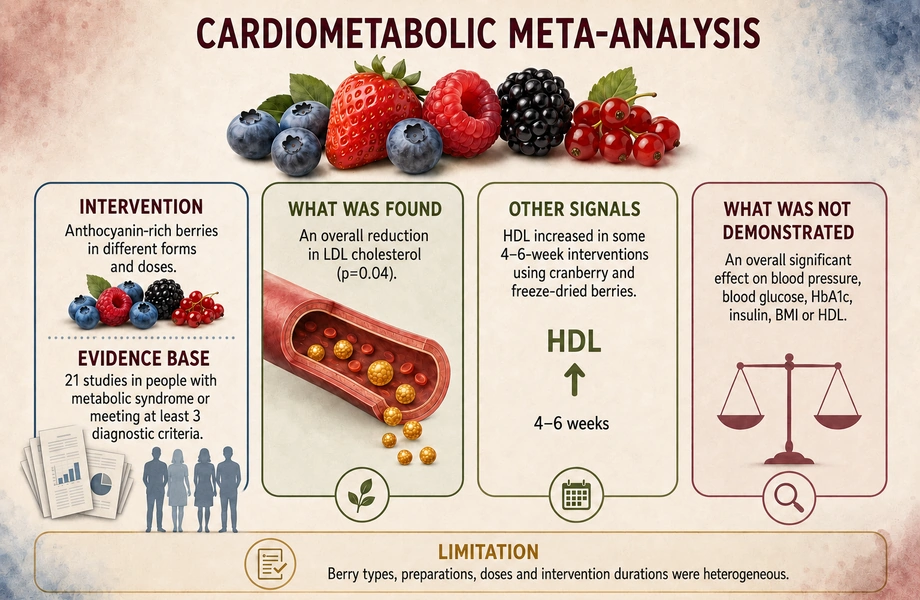
A systematic review and meta-analysis published in 2022 examined 21 studies investigating the effects of anthocyanin-rich berries on the main risk factors associated with metabolic syndrome.
Overall, the researchers observed a statistically significant reduction in LDL cholesterol, commonly known as “bad” cholesterol. Some interventions involving cranberries and freeze-dried berry products also recorded an increase in HDL cholesterol after periods ranging from four to six weeks.
However, the results were not consistently positive across all indicators. The meta-analysis found no significant overall changes in blood pressure, fasting blood glucose, glycated haemoglobin, insulin, body mass index or HDL cholesterol.
This finding is important for interpreting the evidence correctly: berries may have a beneficial effect on certain parameters of lipid metabolism, but they cannot be presented as a solution capable of correcting all cardiovascular risk factors on their own.
Their value emerges above all when they replace foods with a less favourable nutritional profile and are included as part of an overall balanced dietary pattern.
Potential benefits for cognitive function
The second area examined by research concerns cognitive function. A systematic review conducted by Italian researchers considered 12 intervention studies involving a total of 399 healthy participants aged between 18 and 81.
The studies assessed different aspects of cognition, including attention, concentration, memory, executive function and information-processing speed. Some studies observed improvements following berry consumption, but the results were not consistent across all tests.
In particular, benefits relating to attention and concentration were found in three of the nine studies that examined these parameters. Two out of five studies recorded positive results for memory, while four of the nine studies focusing on processing speed observed improvements. Effects on executive function emerged in only one of the five studies that assessed it.
The overall picture is therefore promising, but still preliminary. Sample sizes were generally small, and the researchers used different products, quantities, intake periods and cognitive tests. It is therefore not possible to claim that eating berries prevents cognitive decline. Instead, the evidence points to a potential supporting role that will need to be confirmed by larger, standardised studies.
How to include berries in your daily diet
While waiting for more precise guidance on quantities, the most sensible approach is to alternate different berries and incorporate them naturally into everyday meals. They can be added to breakfast alongside yoghurt and cereals, eaten as a snack, or included in salads and both sweet and savoury dishes.
Fresh products are not the only option. Frozen berries can also be practical when a particular species is out of season. However, it is advisable to check the ingredients in juices, jams and processed products, avoiding the mistake of confusing their berry content with the possible presence of high levels of added sugars.
Variety remains a useful principle: alternating blueberries, strawberries, raspberries, blackberries and currants helps prevent the diet from relying on a single fruit or bioactive compound. Moreover, the studies examined do not support the conclusion that any one species is consistently superior across every area of health.
A beneficial food, not a miracle solution
The two scientific reviews show that berries can make a valuable contribution to the diet, particularly with regard to certain parameters of lipid metabolism and, potentially, specific aspects of cognitive function.
At the same time, the findings call for caution: not all indicators improve, effects may vary from person to person and a universally effective dose has not yet been identified. The strongest message is therefore not to rely on extracts or exceptionally large quantities, but to include berries more regularly as part of a varied diet.
- Wilken M.R. et al., Effects of Anthocyanin-rich Berries on the Risk of Metabolic Syndrome: A Systematic Review and Meta-analysis, The Review of Diabetic Studies, 2022.
- De Amicis R. et al., Systematic Review on the Potential Effect of Berry Intake in the Cognitive Functions of Healthy People, Nutrients, 2022.
🫐 Well-being & Health with Berries 🍓This article is part of the editorial series Wellness & Health with Berries, which brings scientific research closer to everyday life, promoting berries as allies for well-being. The series offers clear, up-to-date, and evidence-based content designed to inform consumers and support all operators in the berry supply chain. |