





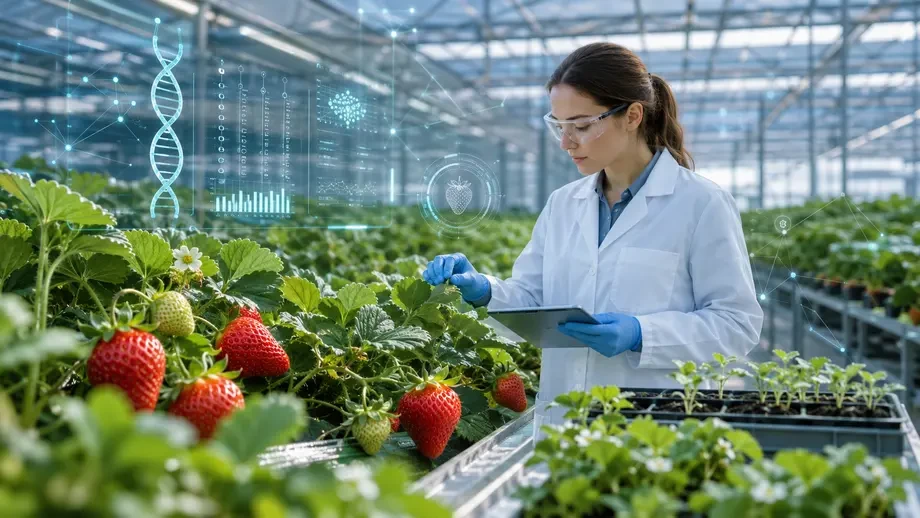
Summary of the presentation "From breeding to market: the future of strawberries" by Alice Patella (CIV Consorzio Italiano Vivaisti), held as part of the Berry Area 2026 event programme at Macfrut.
The application of artificial intelligence is leading the fruit nursery sector into a new evolutionary phase, moving beyond the traditional statistical approach through advanced predictive models.
For the berries supply chain, the integration of these tools represents a pragmatic breakthrough: AI processes unprecedented volumes of genomic, phenotypic and environmental parameters to address historical bottlenecks in varietal improvement.
This paradigm shift makes it possible to radically shorten the development times of new cultivars and to select strawberry varieties with greater resilience, improved genotypic plasticity and characteristics more closely aligned with the needs of nurseries, growers and retail operators.
Key takeaways
1. Artificial intelligence halves breeding times.
The integration of predictive algorithms makes it possible to reduce the development cycle of a new strawberry variety from the traditional 10 years to around 5 years, optimising parental selection from the very earliest stages.
2. The value of AI lies in managing wild data.
The real strategic advantage lies in the ability to normalise highly heterogeneous agricultural inputs, such as temperatures, solar radiation, transcriptomics and genetic markers, transforming them into clear outputs to guide crosses.
3. Models help address the issue of pleiotropy.
By simultaneously analysing genetic and phenotypic data, AI makes it possible to balance traits that have historically been in conflict with each other, such as sweetness and fruit firmness, overcoming the trade-offs typical of traditional statistics.
4. Genotypic plasticity becomes measurable under stress.
The experimental programme conducted with Heritable and Red Sun Farms analyses the behaviour of CIV’s extensive germplasm in Canadian greenhouses, dynamically mapping plant adaptation to environmental changes phase by phase.
What emerges from the presentation
Consorzio Italiano Vivaisti, an organisation that manages the production of around 350 million strawberry plants per year, is reshaping the logic of varietal selection through a strategic partnership with Heritable, a Google X spin-out, and the Canadian company Red Sun Farms.
The central issue addressed by this innovation is the management of so-called wild data. In agriculture, the information collected is extremely heterogeneous: temperatures expressed in degrees Celsius, solar radiation levels, nucleic acid sequences, genetic markers, phenotypic data and physiological plant responses.
Browse and download the full presentation
These are profoundly heterogeneous quantities, which the human mind or simple traditional statistics struggle to correlate effectively and causally.
Artificial intelligence intervenes precisely to store, normalise and translate this volume of data into a clear predictive output, capable of concretely guiding the breeder’s work.
From raw data to genetic decision-making
The value of AI does not simply lie in collecting more data, but in transforming disorderly, incomplete and heterogeneous agricultural data into operational guidance.
For breeding, this means selecting parents more effectively, anticipating the results of crosses and reducing the number of less promising genetic combinations.
A holistic approach: genomics, transcriptomics and metabolomics
At an operational level, the system is not limited to the analysis of individual molecular markers.
The approach adopted integrates genomics, transcriptomics and metabolomics, building a far more complete reading of plant behaviour.
The neural network is trained using CIV’s complex germplasm, which includes high chill, low chill and everbearing varieties.
The objective is to understand the physiological reactions of plants at each specific growth stage and under the stress conditions typical of Canadian greenhouses.
This method makes it possible to accurately map genotypic plasticity, namely the plant’s ability to adapt its behaviour as the production environment changes.
Genotypic plasticity: why it matters for the supply chain
Genotypic plasticity is an increasingly strategic parameter for berries, because new varieties must perform in very different production environments.
Temperature, light, humidity, irrigation management, substrates, greenhouses and growing systems can significantly modify plant response and fruit quality.
For this reason, breeding can no longer be limited to selecting a variety that performs well under standard conditions. Instead, it must predict how that variety will respond to stress, environmental variations and different production models.
AI makes it possible to observe this response dynamically, linking genetic data with phenotypic expression and the real growing environment.
| Area of innovation | Function of AI | Impact on the supply chain |
|---|---|---|
| Parental selection | Identifies more promising genetic combinations from the earliest stages. | Reduced timelines and greater efficiency in breeding programmes. |
| Wild data | Normalises heterogeneous agricultural data and translates them into usable outputs. | Improved decision-making capacity and reduced information dispersion. |
| Pleiotropy | Simultaneously analyses interconnected genetic and phenotypic traits. | Possibility to balance sweetness, firmness, yield and commercial quality. |
| Genotypic plasticity | Maps plant response to environmental changes phase by phase. | Development of more resilient varieties, better suited to different production contexts. |
| Time to market | Concentrates inefficiencies and anticipates selection decisions. | Reduction of the varietal development cycle from 10 to around 5 years. |
The issue of pleiotropy: balancing competing traits
For operators in the berry supply chain, one of the most relevant implications concerns the resolution of pleiotropy, namely the simultaneous control of interconnected phenotypic traits.
In traditional breeding, the breeder often has to deal with difficult compromises. Some desirable traits may in fact be inversely correlated or difficult to combine within the same variety.
In the case of strawberries, one of the clearest examples concerns the balance between sweetness and fruit firmness. A very sweet variety does not always guarantee the firmness required by distribution, while a very firm variety may prove less satisfactory from an organoleptic perspective.
Predictive AI makes it possible to simultaneously analyse genetic and phenotypic data, identifying upstream the parents that are less likely to trigger negative compensation dynamics.
In this way, the selection process can focus on genetic combinations with a higher probability of expressing multiple positive traits within the same genotype.
A new precision for strawberry breeding
The strength of AI lies in its ability to read simultaneously what traditional breeding tends to assess sequentially.
This makes it possible to anticipate genetic trade-offs, reduce selection errors and guide development towards more complete cultivars: flavourful, resilient, productive and market-ready.
Halving varietal time to market
The predictive model leads to a drastic acceleration of time to market.
The conventional method often requires at least a decade to reach a single commercial variety, starting from a broad base of seedlings and moving through successive stages of selection, trialling, discarding and validation.
The computational approach concentrates many of these inefficiencies in the initial stages of the process.
After a first year of intensive algorithmic training, the system can support geneticists in parental selection and in interpreting the most promising combinations.
The expected result is the possibility of bringing to market a highly performing variety, whose biology is much more fully understood, in around five years.
A new decision-making platform for nurseries, growers and retailers
The application of AI to breeding does not only concern the work of geneticists.
The information generated by predictive models can become a decision-making platform for the entire supply chain: from nurseries planning plant material, to growers seeking varieties better suited to their environments, through to retailers requiring consistent quality and more stable commercial standards.
For a category such as strawberries, where flavour, shelf life, productivity and adaptability must coexist, this approach reduces uncertainty and directs innovation towards more measurable objectives.
In summary
Artificial intelligence introduces a new predictive capability into strawberry breeding, based on the integration of genetic, phenotypic, environmental and metabolic data.
The CIV case, developed with Heritable and Red Sun Farms, shows how the management of wild data can become a concrete competitive advantage: selecting better, faster and with greater biological awareness.
The most relevant perspective for the berry supply chain is the possibility of drastically reducing varietal development times, while at the same time improving the quality of new cultivars and their ability to adapt to increasingly complex production contexts.