












In the berries market, innovation does not only come from variety, origin or price. Increasingly, it comes from format. The blueberry reference proposed by Ahold in a 4x75g pack is an interesting example of how packaging can change product perception, suggest new consumption occasions and speak to consumers who are increasingly focused on convenience, health and portion control.
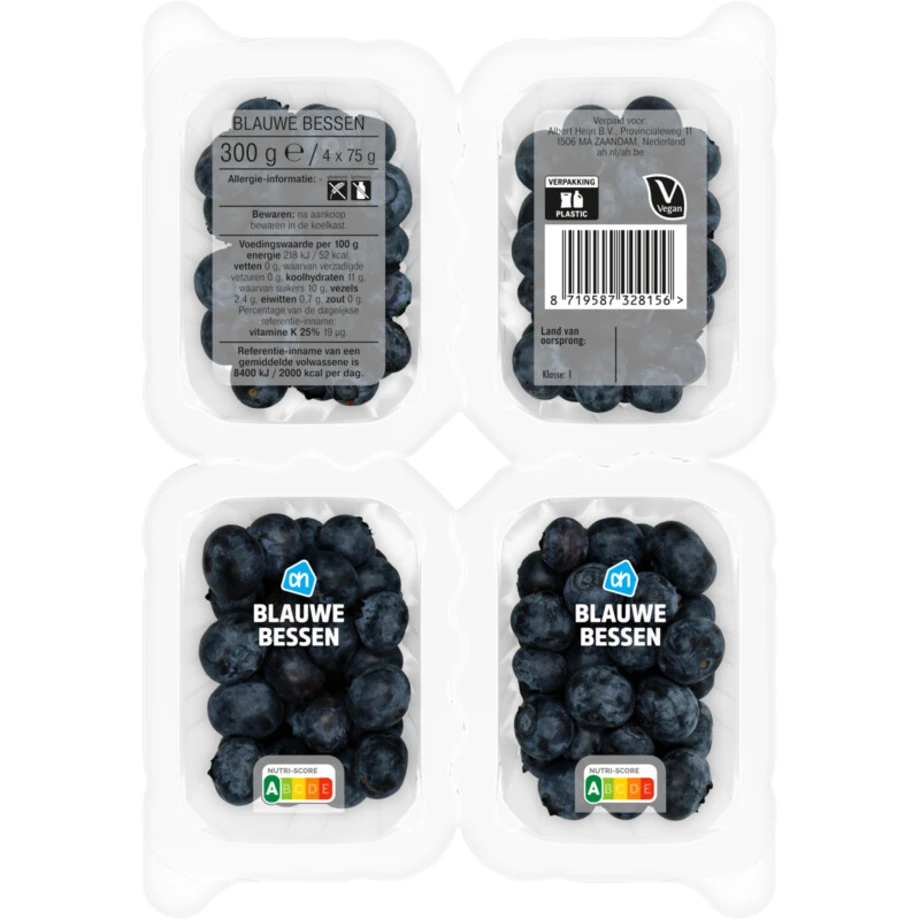
The pack, sold as “AH Blauwe bessen 4-pack”, contains a total of 300 grams of blueberries, divided into four 75-gram portions. The listed price is €4.99, equal to €16.63/kg. At first glance, it may look like a standard private label blueberry reference. In reality, the structure of the pack says much more: the product is not presented simply as fruit to be kept in the refrigerator, but as a ready-to-eat, separable, portable and easily portioned consumption unit.
From loose product to consumption portion
Blueberries are among the berries best suited to direct consumption. They do not need to be peeled, they do not make a mess, they are easy to portion and can be consumed both as a snack and as an ingredient. The 4x75g format enhances precisely these characteristics.
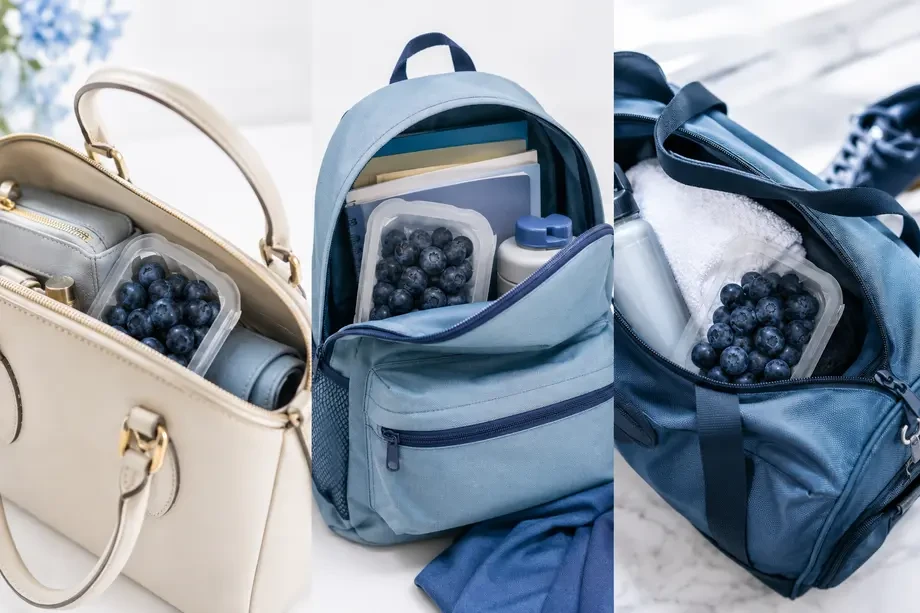
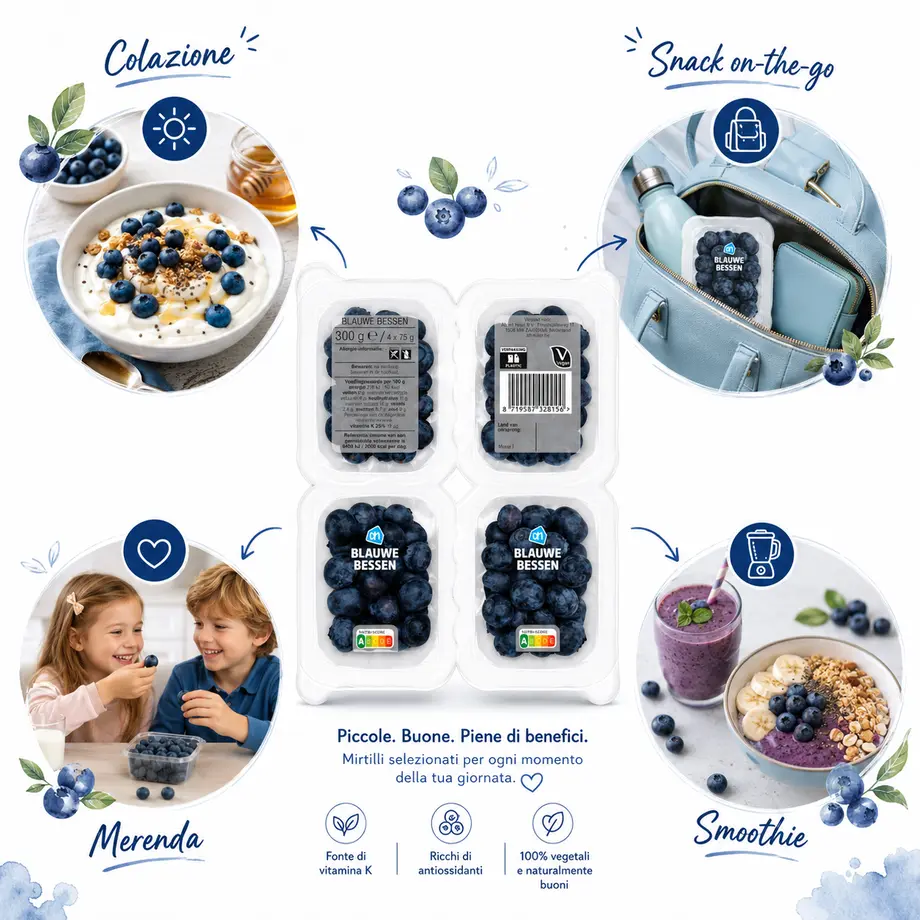
The division into four small trays shifts the product from a “family pack” logic to a micro-consumption occasion logic. Each unit becomes an independent portion: for a child’s snack, for a break at the office, for out-of-home consumption, for morning yogurt or for a smoothie. It is no coincidence that the product sheet refers to occasions such as “tussendoor” and “onderweg”, meaning consumption between meals and on the go.
This is a precise marketing choice: blueberries are not presented only as fresh fruit, but as a healthy snack. The message is also consistent with the Nutri-Score A shown on the product sheet, which reinforces the association between product, wellbeing and daily consumption.
The value of the format: less waste, more control, greater frequency
One of the main barriers to berry consumption is perceived perishability. Consumers know that the product is delicate and may fear they will not be able to consume a larger pack quickly enough. The 4x75g format responds to this barrier with a simple solution: dividing the risk.
The small portion communicates freshness, control and convenience. Although the total content is 300 grams, consumers do not necessarily perceive the purchase as a large pack. They perceive it as four separate consumption moments.
This can have important effects on usage frequency. A 75-gram tray can be placed in a lunch box, taken to school, eaten in the car, added to yogurt or shared as a light snack. In this way, the product enters the daily routine more easily.
For the retailer, the advantage is clear: it is not just selling a quantity of blueberries, but a consumption solution. Packaging helps suggest what to do with the product and when to consume it.
A pack designed for families, children and out-of-home consumption
The 4-pack format has a strong affinity with the family target. Four trays may correspond to four family members, four snacks or four days of consumption. The 75-gram portion is small enough to be perceived as suitable for a child, but generous enough to work as an adult snack too.
This positioning taps into a broader trend: the search for healthy alternatives to industrial snacks. Blueberries increasingly compete not only with other fruit, but also with yogurt, bars, sweet snacks, snack products and functional beverages. In this competition, format is decisive.
A small, ready-to-use and easily portable tray reduces the distance between fresh fruit and packaged snacks. The fresh product takes on some typical codes of modern grocery: portability, defined portion, ease of use and immediate nutritional messaging.
Private label, but with a premium logic
The reference is under the AH brand, therefore within a private label logic. However, the 4x75g format allows the retailer to work on a more evolved perception than simple convenience.
The price per kilo of €16.63 does not place the product in the most aggressive segment of the market. The lever is not the lowest price, but the combination of convenience, portion control and service. Consumers are paying not only for blueberries, but also for ease of use.
This is a central point in the evolution of the category. Private label no longer merely covers the standard product: it can become a segmentation laboratory, testing formats that respond to specific shopping missions.
In the case of blueberries, the 4-pack makes it possible to communicate added value without necessarily relying on club varieties, premium claims or highly distinctive packaging. It is the format itself that creates differentiation.

The product sheet as an extension of the packaging
The online presentation of the reference also contributes to its positioning. The description highlights a “friszoet” taste, meaning fresh-sweet, and a “knapperige bite”, a crisp bite texture. These are important sensory attributes because they take blueberries beyond the purely health-related dimension.
The message is not only “it is good for you”, but also “it is good, convenient and pleasant to eat”. This balance is essential: modern consumers are looking for healthy products, but they are not willing to give up the sensory experience.
The reference to vitamin K reinforces the nutritional profile, while the indication to keep the product refrigerated refers to domestic freshness management. The minimum shelf life indicated after delivery, at least one day, may appear limited, but it is consistent with the nature of the fresh product and with a rapid-consumption logic.
A small pack that changes the category
The Ahold case shows how blueberries are moving ever closer to a hybrid category: fresh fruit, ingredient, snack and functional consumption product. This transition does not happen only through communication, but through the way the product is physically organized.
The 75-gram portion invites immediate consumption. The 4-pack invites repeated consumption. The total of 300 grams ensures a significant basket value for the retailer. The combination of these three elements creates a reference capable of combining perceived convenience, practicality and value.
For the berry supply chain, this operation highlights the ability to build formats that respond more effectively to real consumer behavior.
In the case of blueberries, the 4x75g format suggests a clear direction: less product “to be consumed before it spoils”, more product “already organized to be consumed”. It is a subtle but decisive difference. Because in contemporary retail, packaging is not just a container: it is a usage instruction, a service promise and a marketing tool.