












Summary of the presentation "Advanced diagnostic tools for berry crop management" delivered by Jorge Duarte (Hortitool Consulting) at the Berry Area (Macfrut 2026).
Berry crop agronomic management is undergoing a decisive transition: from the simple control of nutritional inputs to the dynamic measurement of the plant’s real demand.
Despite the abundance of data available on modern farms, the gap between what is supplied and what is actually metabolized still generates production inefficiencies and misleading diagnoses.
Understanding the correct hierarchy of diagnostic tools — starting from the physical analysis of the root zone through to AI-based predictive technologies — becomes an essential strategic step.
A clinical and integrated approach enables growers to move beyond guesswork, optimizing resource use and intervening with precision before stress compromises yield or the commercial quality of the crop.
Key takeaways
1. The gap between input and real uptake represents the main agronomic critical issue.
What is supplied through fertigation can be measured with precision, but tools are still lacking to monitor the plant’s real metabolic demand and internal flows in real time.
2. The choice of diagnostic test depends on nutrient mobility.
Sap analysis is ideal for tracking rapid flows of nitrogen and potassium, while traditional leaf analysis remains essential for diagnosing deficiencies of low-mobility elements such as calcium, iron and boron.
3. Calcium deficiencies in fruit are a transpiration issue, not a nutrition issue.
Calcium physiology depends on the plant’s water flow: to solve disorders such as tip burn, dendrometers, tensiometers and pressure chambers may be more useful than sap analysis.
4. The health status of the root system can mislead diagnoses.
Oxygen deficiencies in the substrate, asphyxia or pathogens block nutrient uptake and generate foliar symptoms that are wrongly mistaken for nutritional deficiencies, leading to unnecessary changes in fertigation recipes.
5. The future lies in digital twins and artificial intelligence.
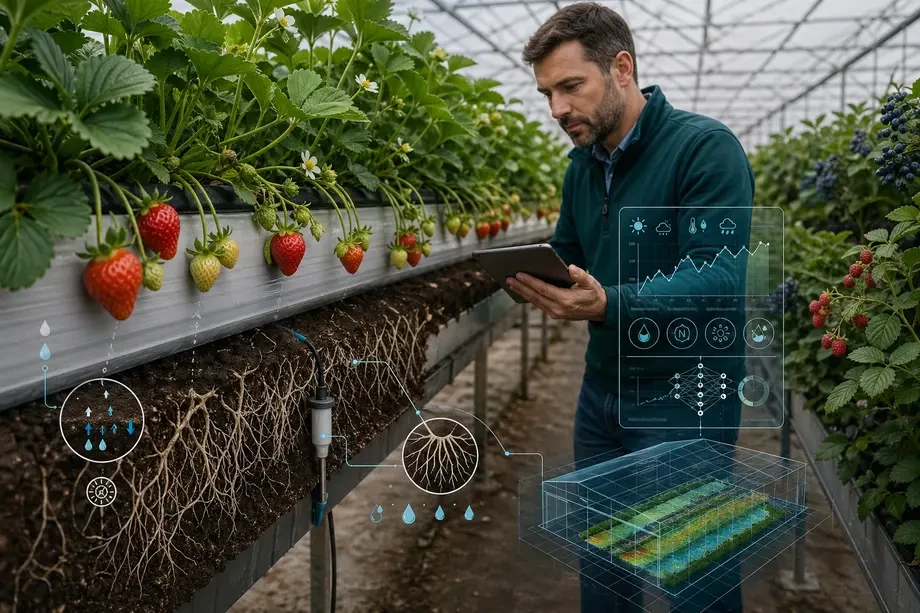
By 2028, virtual models integrated with IoT data may be able to simulate predictive crop requirements, analyzing historical trends and microclimate data to suggest corrections before stress affects yield.
What emerges from the presentation
The berry sector faces a technological paradox: water and chemical supply are measured with millimetric precision through in-line sensors and EC probes, yet interpreting the plant’s dynamic demand remains difficult.
The root, described as the true "brain and mouth" of the crop, is often the great absentee from daily monitoring. And yet it is precisely in the root zone that many critical issues originate before becoming visible in the aerial part of the plant.
Invisible anomalies such as poor substrate oxygenation, waterlogging or incorrect temperatures can block the uptake of critical elements, generating foliar symptoms identical to nutritional deficiencies.
To avoid costly mistakes, the physical and chemical inspection of the root zone must always precede any change to the fertigation program. In other words, before changing the nutritional recipe, it is necessary to verify whether the plant is actually in a condition to absorb what it is being supplied with.
Browse and download the original presentation
Sap analysis and leaf analysis: two different tools
An essential point concerns the targeted use of technology according to the mobility of plant elements.
Sap analysis confirms itself as a powerful tool, comparable to a real-time blood test. It is particularly useful for validating nutritional recipes, identifying deficiencies of mobile macronutrients such as nitrogen and potassium before they become visible.
By contrast, this test can be misleading for low-mobility elements. For nutrients such as calcium, iron and boron, traditional dry matter leaf analysis remains an indispensable tool, because it provides a more stable reading of the plant’s nutritional status.
The case of calcium
Complex problems such as calcium deficiency in fruit almost never depend on low availability in the substrate, but rather on a blockage in transpiration. Calcium physiology is in fact closely linked to the plant’s water flow.
In these scenarios, monitoring water status through dendrometers, tensiometers, pressure chambers or thermal cameras can be much more effective than conventional laboratory analyses.
A four-step diagnostic hierarchy
From a methodological standpoint, the presentation highlights the need to adopt a rigorous diagnostic hierarchy. The aim is to avoid impulsive interventions on fertigation and instead build a progressive interpretation process based on consistent data.
| Step | Objective | Main tools |
|---|---|---|
| 1. Stabilize the root substrate | Verify oxygenation, moisture, temperature, salinity and physical conditions in the rhizosphere. | Probes, tensiometers, drainage analysis, root inspection. |
| 2. Validate the long-term nutritional plan | Check the overall mineral status of the plant. | Dry matter leaf analysis. |
| 3. Monitor vegetative development | Identify visual signals, growth imbalances and early symptoms. | Field observation, vegetative assessments, phenological monitoring. |
| 4. Integrate sap analysis | Calibrate rapid nutritional flows and verify the effectiveness of fertigation recipes. | Sap analysis for mobile nutrients such as nitrogen and potassium. |
From data to prediction: the role of digital twins
The evolution of this discipline will no longer require fragmented interpretations. The supply chain is moving toward IoT synoptic dashboards, drone-based optical surveys and vegetation indices such as NDVI.
The near future will see the introduction of in-line ion sensors and digital twins capable of cross-referencing climate, genetics, substrate, irrigation and nutrition.
The real step forward will be the shift from reactive diagnostics to predictive diagnostics: no longer intervening when stress is already visible, but anticipating corrections before the problem compromises yield or commercial quality.
In summary
Berry nutrition can no longer be interpreted solely as a matter of inputs. The real challenge is understanding how much the plant is actually able to absorb, transport and use what it receives.
For this reason, the future of agronomic management depends on an integrated approach: roots, substrate, water status, leaf analysis, sap, sensors and artificial intelligence must be read as parts of a single decision-making system.