











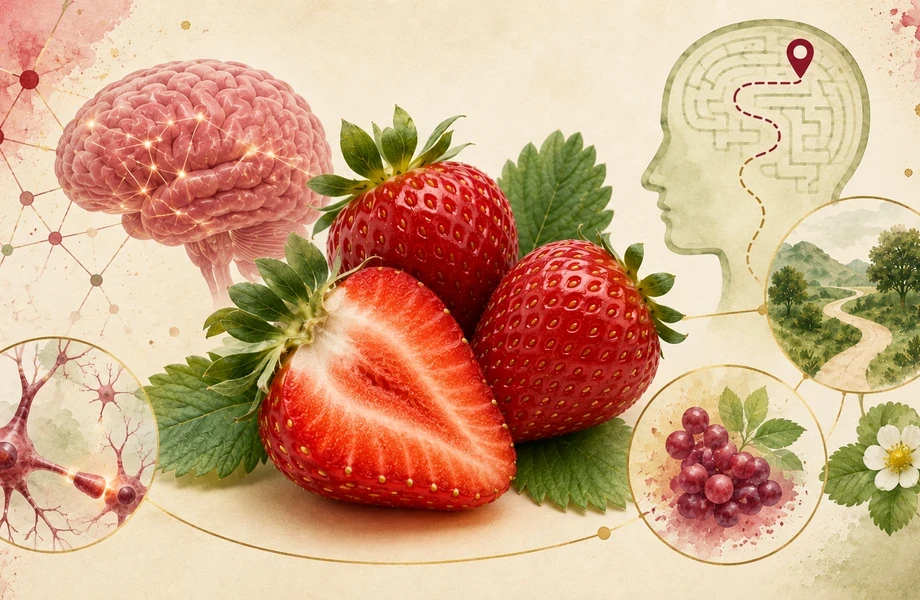
As people age, memory, learning ability and orientation may undergo physiological changes. Diet is one of the factors being studied to understand whether certain habits may help maintain cognitive functions over time.
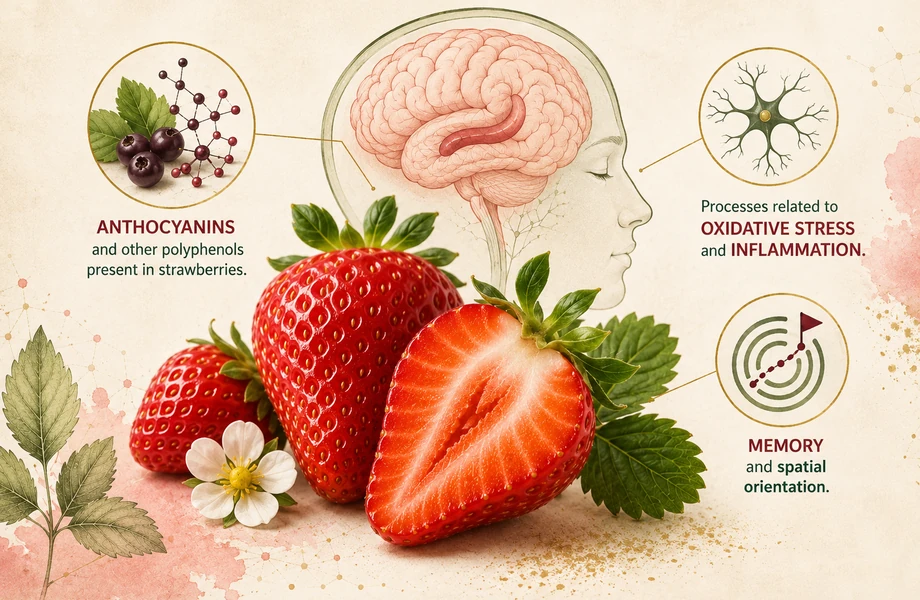
In this context, researchers have also shown interest in the relationship between strawberries and memory, particularly because the fruit contains anthocyanins and other phenolic compounds.
A randomised clinical trial conducted by researchers at the USDA Human Nutrition Research Center on Aging at Tufts University evaluated the effects of daily freeze-dried strawberry consumption in men and women aged between 60 and 75.
The results, published in 2021 in the British Journal of Nutrition, showed favourable differences in certain learning and memory tests, but not in all the abilities analysed. The study therefore provides interesting evidence, which should be interpreted in light of the small sample size and the specific characteristics of the intervention.
Why study strawberries and memory as people age?
Ageing does not necessarily lead to pathological cognitive decline. However, some abilities may gradually change even in healthy people, such as the speed at which new information is processed or the ease with which certain memories are retrieved.
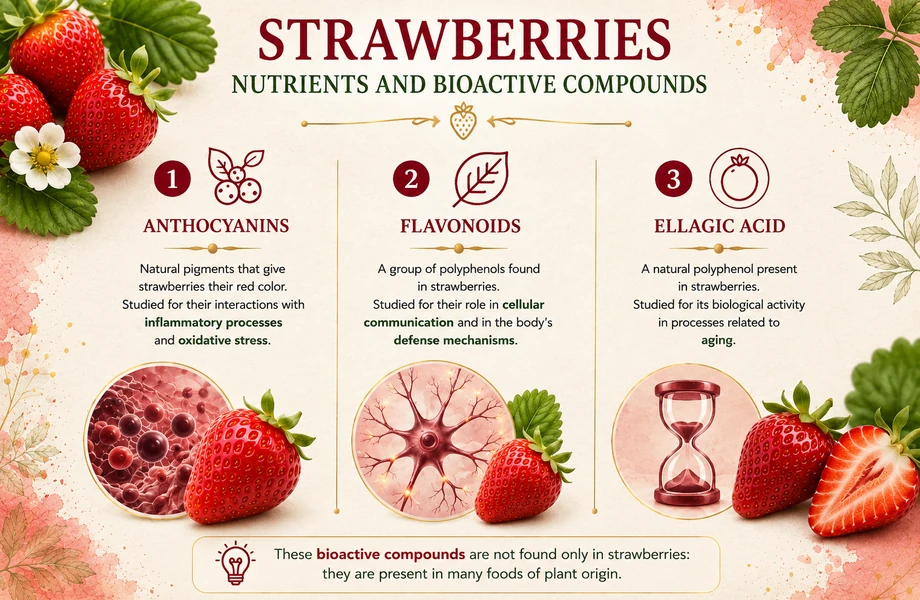
Nutritional research aims to understand whether dietary patterns and certain food groups may be associated with the maintenance of brain function. Strawberries are part of this field of research because they contain several bioactive compounds, including anthocyanins, flavonoids and ellagic acid.
These substances have been studied for their ability to interact with biological processes linked to oxidative stress and inflammation. These mechanisms are also involved in ageing, but the presence of a compound in the fruit is not sufficient, on its own, to demonstrate an effect on human memory.
This is why controlled clinical trials are particularly important: they make it possible to directly verify whether a dietary intervention produces measurable differences compared with a control group.
The study: freeze-dried strawberries for 90 days
The study by Miller and colleagues was a randomised, double-blind, placebo-controlled trial. This meant that neither the participants nor the researchers monitoring them knew who was receiving the strawberry product and who was receiving the control product.
The final analysis included 37 healthy adults aged between 60 and 75, comprising 22 men and 15 women: 18 received the strawberry product and 19 received the placebo. The study initially enrolled a larger number of people, but 16 participants did not complete it and were therefore excluded from the final analysis.
Adherence to the intervention among those who completed the protocol was above 97%.
The intervention group consumed 24 grams per day of freeze-dried strawberries, divided into two 12-gram servings, one at breakfast and one at dinner. According to the authors, this amount corresponded to approximately two cups (about 480 ml) of fresh strawberries per day. The product was made from a standardised blend of four strawberry varieties.
The control group and study duration
The control group received a powder that was similar in colour and energy content and was strawberry-flavoured, but did not contain the fruit used in the intervention.
The trial lasted 90 days. Memory, learning, spatial orientation, balance and walking ability were assessed at the beginning of the study, after 45 days and at the end of the intervention.
During the study, participants were also asked to avoid other berries and products containing them.
Strawberries and memory: what did the study find?
The most interesting results involved two cognitive tests.
In the California Verbal Learning Test, which is used to assess various aspects of learning and verbal memory, the group consuming strawberries showed a significant improvement in word recognition compared with the placebo group over the course of the study.
A second difference was observed in a computerised spatial navigation test designed to assess aspects of learning and memory related to orientation. In this case too, the strawberry group showed a more favourable trend than the control group.
This does not mean, however, that all cognitive abilities improved. Some measures of verbal recall increased over time in both groups, a result that the researchers themselves interpreted, at least in part, as a possible effect of becoming familiar with the tests.
Mobility and interpretation of the results
The study also assessed mobility, including balance and walking. For these parameters, no improvements attributable to the strawberry intervention were observed.
The findings are therefore limited in scope: the consumption of freeze-dried strawberries was associated with better results in specific memory and learning tests, rather than with a general improvement in all cognitive or motor functions.
Why strawberries might affect cognitive functions
The authors identified the polyphenols found in strawberries as possible contributors. Anthocyanins and other flavonoids are being studied for their interactions with inflammatory processes, oxidative stress and cellular communication systems.
Interest in these mechanisms also stems from previous experimental studies using animal models, in which supplementing the diet with berries produced changes in certain neuronal and behavioural functions.
Transferring findings from animals to humans, however, requires caution. The clinical trial did not establish which substance in strawberries was responsible for the observed results, nor does it allow researchers to claim that anthocyanins or other individual compounds directly improve memory.
Observational studies on flavonoid consumption have also found associations between diets richer in these compounds and certain indicators of cognitive health. An association, however, does not demonstrate a cause-and-effect relationship: people who eat more fruit and vegetables may simultaneously have many other health-promoting habits.
Limitations: a small sample and results requiring confirmation
The main reason for caution concerns the size of the study. The final analysis included only 37 people, an insufficient number to automatically extend the results to the entire older population.
The participants were also relatively healthy adults, with a body mass index ranging from 18.5 to 29.9 kg/m². Among those excluded were people with diabetes, major neurological diseases or scores indicating cognitive impairment on the Mini-Mental State Examination.
The results therefore cannot be applied directly to people with dementia, diabetes or other clinical conditions.
Another consideration concerns the product used: standardised freeze-dried strawberries, rather than ordinary fresh strawberries purchased and consumed daily. The authors indicated that the amount was equivalent to two cups (approximately 480 ml) of fresh fruit, but this does not mean that every quantity or form of strawberry will necessarily produce the same result.
What this means in everyday life
The study does not provide a dietary prescription and does not demonstrate that eating strawberries can prevent cognitive decline or neurodegenerative diseases.
However, it may contribute to a broader body of evidence in which fruit and berries represent valuable components of a varied diet. Strawberries can be eaten fresh when available or included alongside other fruits as part of normal dietary habits.
The 24 grams of freeze-dried product used in the study should not be interpreted as a dosage to replicate independently. The research tested a specific preparation under controlled conditions and for a defined period.
For people with medical conditions, those undergoing drug treatments or those with specific nutritional needs, dietary recommendations should be assessed with a doctor, dietitian or nutritionist.
Strawberries and memory: what can we conclude?
The study provides an interesting indication of the relationship between strawberries and memory: after 90 days of daily consumption of freeze-dried strawberries, healthy adults aged between 60 and 75 achieved better results than the placebo group in certain tests of word recognition and spatial memory.
Benefits were not observed across all cognitive measures or in the balance and walking tests, and the number of participants was limited. Larger and longer studies conducted in different populations are therefore needed to determine how reproducible these findings are and what their relevance may be in everyday life.
Strawberries remain a fruit that can form part of a varied and balanced diet. Considering them as one component of the overall diet is more consistent with the available evidence than attributing a specific protective role against brain ageing to a single food.
Sources:
- Miller MG, Thangthaeng N, Rutledge GA, Scott TM, Shukitt-Hale B, “Dietary strawberry improves cognition in a randomised, double-blind, placebo-controlled trial in older adults”, British Journal of Nutrition, 2021, 126(2), 253-263. DOI: 10.1017/S0007114521000222. PMID: 33468271.
- Miller MG, Thangthaeng N, Rutledge GA, Scott TM, Shukitt-Hale B, “Dietary strawberry improves cognition in a randomised, double-blind, placebo-controlled trial in older adults – ERRATUM”, British Journal of Nutrition, 2021, 126(2), 320. DOI: 10.1017/S0007114521000842. PMID: 33827726.
🫐 Well-being & Health with Berries 🍓This article is part of the editorial series Wellness & Health with Berries, which brings scientific research closer to everyday life, promoting berries as allies for well-being. The series offers clear, up-to-date, and evidence-based content designed to inform consumers and support all operators in the berry supply chain. |