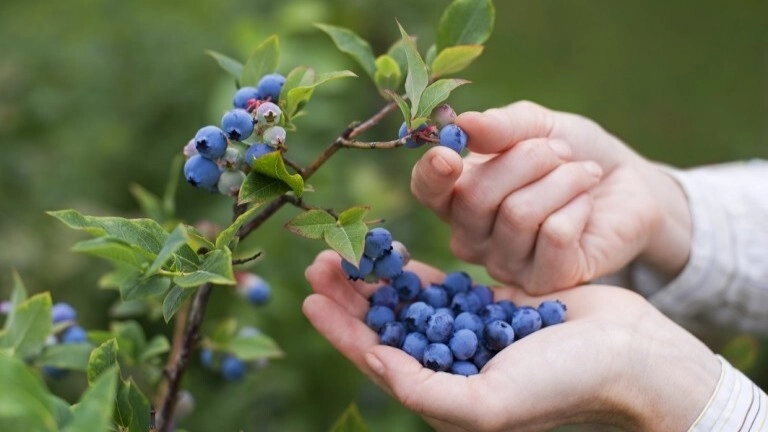





Wild European bilberries and cultivated blueberries often belong to different species. Studies have found differences in their composition, but do not show that either type offers greater health benefits.
When people talk about blueberries, “wild” and “cultivated” can sound like two versions of the same fruit: one more natural, the other more commercial. In reality, these terms may refer to different species, grown in different environments and analysed using methods that are not always comparable.
Studies have found differences in the composition of these fruits, particularly in their polyphenols, plant compounds that include the anthocyanins responsible for blue and purple hues. However, the findings do not establish that wild blueberries are universally nutritionally superior, or that one type has better effects on health.
What does “wild blueberry” mean?
The comparison starts with a botanical distinction. The European bilberry, which grows wild in forests and mountainous areas, is Vaccinium myrtillus. The cultivated blueberry most commonly found in supermarkets often belongs to the species Vaccinium corymbosum, also known as highbush blueberry.
In international research, however, “wild blueberry” can also refer to the North American lowbush blueberry, Vaccinium angustifolium.
So the comparison is not always between the same blueberry grown in a field or in the wild. The species—and the variety within each species—can differ. Growing conditions, ripeness and harvesting conditions can also affect the compounds measured.
For this reason, the results of a study on wild blueberries from a particular area cannot automatically be applied to every fruit sold under that description.
Differences in polyphenols and anthocyanins
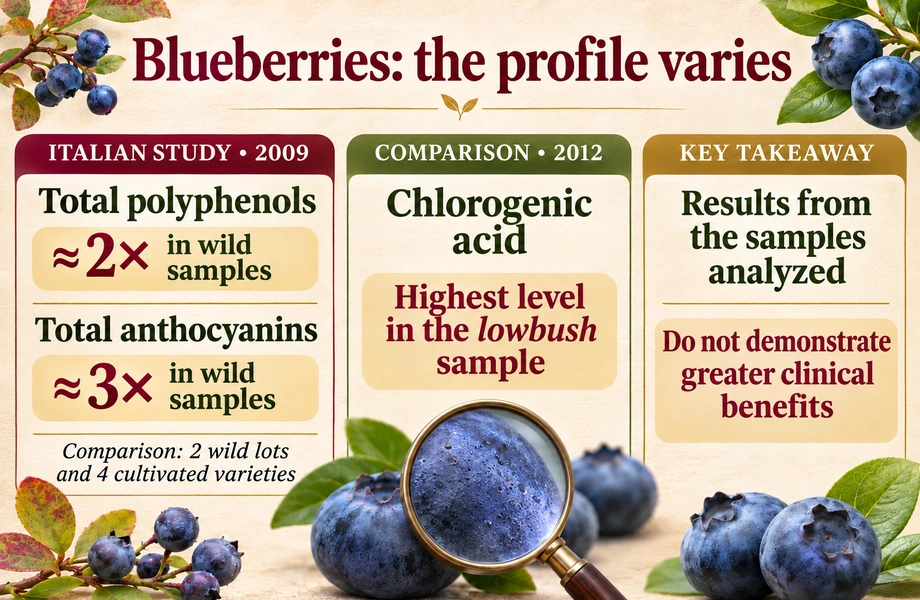
An Italian study published in 2009 compared two batches of wild European bilberries from the Modena Apennines with four cultivated varieties of Vaccinium corymbosum. In the samples analysed, the wild bilberries contained about twice as many total polyphenols and three times as many total anthocyanins as the cultivated blueberries. Their antioxidant activity, as measured in the laboratory, was also higher. [Source]
The finding is interesting, but limited in scope: the study examined two batches of wild bilberries and four cultivated varieties, from specific locations and harvested during a particular period.
Moreover, antioxidant activity tests are chemical analyses. They describe how a sample reacts in the laboratory; they do not measure clinical benefits in people. The result alone is not enough to conclude that eating wild blueberries provides greater health protection.
A comparison published in 2012 shows how much the variety can matter. Researchers analysed six cultivated highbush varieties and one wild lowbush type.
Some cultivated varieties had higher levels of anthocyanidins than others, while the lowbush sample had the highest concentration of chlorogenic acid. The profile of compounds was therefore not uniform even among cultivated blueberries.
One organically grown variety had higher levels of oligomeric flavanols and chlorogenic acid, but lower levels of anthocyanidins than its conventionally grown counterpart.
What the more recent analyses add
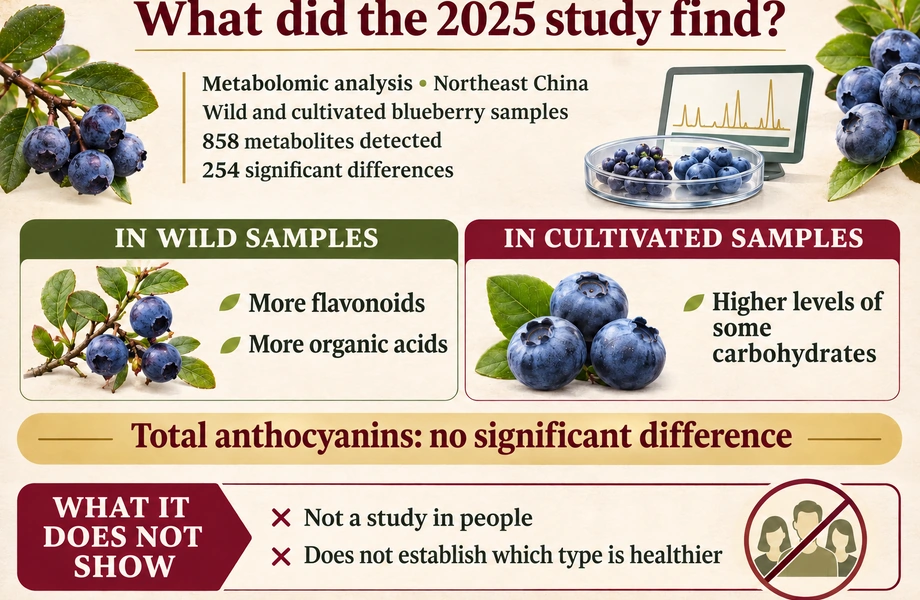
In 2025, a study conducted in northeastern China compared wild and cultivated blueberry varieties using metabolomic analysis, a technique that detects many of the compounds present in fruit. Of the 858 metabolites identified, 254 differed significantly between the samples.
The cultivated blueberries contained higher levels of some carbohydrates, while several organic acids and flavonoids were more abundant in the wild samples. Total anthocyanin content, however, did not differ significantly.
This research shifts the comparison away from the idea of a single “super-nutrient” and towards different compositional profiles, which are also linked to the varieties studied. The findings should be read for what they are: an analysis of specific samples, not a study of people’s diets.
Metabolomic analysis can identify differences between fruits, but on its own it cannot establish how much a serving contributes to nutritional requirements or whether those differences have a measurable effect on health.
The term “nutritional” also needs to be used with care. The comparisons cited here focus mainly on bioactive compounds and metabolites; they are not complete tables of energy, fibre, vitamins and minerals per serving.
Results also depend on how samples are prepared and how measurements are reported. To determine which fruit provides more of a particular nutrient, researchers would need a standardised comparison using fresh weight and samples at comparable stages of ripeness and storage.
More compounds do not automatically mean greater benefits
Polyphenols and anthocyanins are often described as beneficial compounds, but their concentration alone cannot determine which food is “healthier”. The body digests and metabolises plant compounds, and their effects may also depend on the amount consumed, the food matrix and individual characteristics.
Most importantly, a comparison of composition is not the same as clinical evidence. To show that one type of blueberry improves a health marker more than another, researchers would need intervention studies that directly compare the two types, with defined amounts and durations, and measure the same outcomes in people.
The compositional studies cited here do not answer that question. For example, they do not show that wild blueberries lower cholesterol more or better protect memory.
Which should you choose?
In practical terms, there is no scientific reason to consider cultivated blueberries an inferior choice. Wild European bilberries and cultivated varieties have different profiles, and composition also varies between varieties and harvests.
Your choice can therefore depend on taste, availability, price and how you plan to use them. Smaller, more aromatic fruits may be enjoyed fresh or in prepared foods, while cultivated blueberries are often available fresh for longer periods and can be used in a range of ways.
The most cautious conclusion is that “wild” is not a universal guarantee of nutritional superiority. Some studies have found more polyphenols or flavonoids in the wild samples they analysed; others show that levels of individual compounds vary between varieties and that anthocyanins are not always higher.
Until direct clinical comparisons are available, both types can be part of a varied diet. Choose the blueberries you prefer and are most likely to eat regularly.
🫐 Wellbeing & Health with Berries 🍓This article is part of Wellbeing & Health with Berries, an editorial project that connects scientific research with everyday life and explores the role of berries in wellbeing. The series offers content that is clear, up to date and based on scientific evidence, designed to inform consumers and support everyone working in the berry supply chain. |
Sources:
- Xie X., Tian J., Wang Y., Shu C., Gui H., Cheng Z., Wang Z., Song Z., Tian Q., Wen B., Li B., “Comparison of the content of taste and nutrition-related non-volatile compounds in cultivated and wild blueberry varieties in Northeast China”, Food Chemistry: X, 25, 102235, 2025. DOI: 10.1016/j.fochx.2025.102235.
- Rodriguez-Mateos A., Cifuentes-Gomez T., Tabatabaee S., Lecras C., Spencer J. P. E., “Procyanidin, anthocyanin, and chlorogenic acid contents of highbush and lowbush blueberries”, Journal of Agricultural and Food Chemistry, 60(23), 5772–5778, 2012. DOI: 10.1021/jf203812w.
- Giovanelli G., Buratti S., “Comparison of polyphenolic composition and antioxidant activity of wild Italian blueberries and some cultivated varieties”, Food Chemistry, 112(4), 903–908, 2009. DOI: 10.1016/j.foodchem.2008.06.066.
Italian Berry - All rights reserved